

Many problems in LED表示 projects don’t occur suddenly. They are often hidden in seemingly problem-free stages such as selection, design, and construction.
The more projects you complete, the more you’ll realize that what truly determines stability isn’t the final acceptance test, but every initial choice.
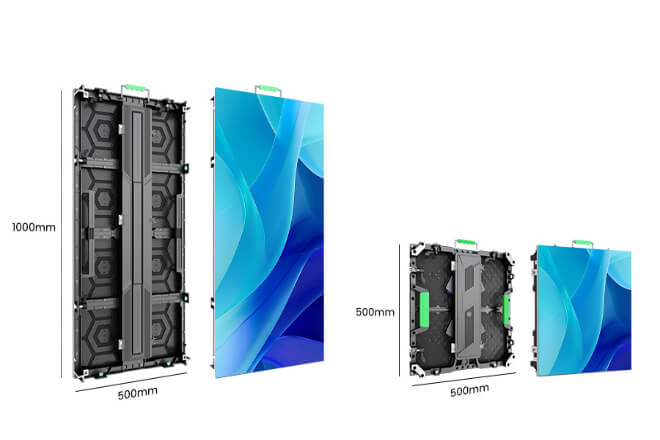
In LED display projects, the most likely place to “plant the seeds” is actually the initial selection stage.
Many problems don’t appear later; they are predetermined from the moment the wrong product is chosen.
For example, a common pitfall is mixing indoor and outdoor products.
They may look similar, but the actual usage environments are completely different: 屋外用 LED ディスプレイ require high brightness, waterproofing, and dustproofing.
If used as an 屋内用LEDスクリーン, problems such as insufficient 輝度 and water damage will quickly arise.Conversely, for indoor users, the outdoor screen may be too bright, causing eye strain after prolonged viewing and wasting costs.
Another example is choosing the wrong ピクセルピッチ, which will directly affect the viewing experience.
A large pixel pitch results in noticeable graininess at close range; a small pitch increases cost, but if viewers are already at a distance, such high 解決 isn’t necessary, leading to wasted money.
Another easily overlooked issue is focusing solely on price.
While a cheaper solution may seem appealing, substandard core components (like LEDs, 電源, and driver ICs) can cause uneven brightness, dead pixels, and frequent malfunctions, ultimately increasing maintenance costs.
Furthermore, incorrect protection levels can also cause problems. In environments with high humidity, dust.
Or significant temperature fluctuations, inadequate screen protection can shorten the lifespan or even damage the screen.
In short, making assumptions or focusing solely on price during the selection process can easily lead to numerous rework and repairs later, wasting both time and money.
Investing time and effort upfront to align the screen with the intended use, viewing needs, and product performance can save a lot of trouble later.
If selection is the foundation, then solution design is the structure.
If this step isn’t carefully considered, various minor problems will arise later, potentially affecting the stability of the entire system.
A common issue is the mismatch between the screen size and the site structure. It might look perfect on the drawings, but on-site, insufficient installation space.
Or inadequate structural load-bearing capacity and fixing methods become apparent, necessitating temporary changes that delay the project and increase costs.
Some projects even require custom-made screens due to inadequate dimensional planning, resulting in repeated adjustments.
Another often overlooked aspect is the power distribution scheme. LED screens consume significant power.
If the power load, wiring distribution, and redundancy design aren’t properly considered upfront, unstable 電源, circuit breaker trips, and even disruptions to the screen’s normal operation can occur later.
This is especially critical for projects operating for extended periods.
Furthermore, heat dissipation and ventilation may seem insignificant, but they are crucial. LED screens generate heat during prolonged operation.
Without proper heat dissipation design, such as vents, air ducts, or auxiliary cooling equipment, high temperatures can affect brightness stability and even shorten lifespan.
Many malfunctions are actually caused by overheating.
Another frequently neglected point is maintenance space. Many projects initially focus solely on “fitness,” neglecting “repairability.”
If malfunctions occur later, without adequate maintenance access or operating space, repairs become extremely difficult.
Sometimes requiring partial structural removal, significantly increasing costs and complexity.
Simply put, if the design only considers immediate installation without long-term operation and maintenance, it easily creates hidden problems.
Thoroughly planning structural, power, heat dissipation, and maintenance details beforehand ensures stable and worry-free LED screen operation, preventing continuous “problematic operation.”
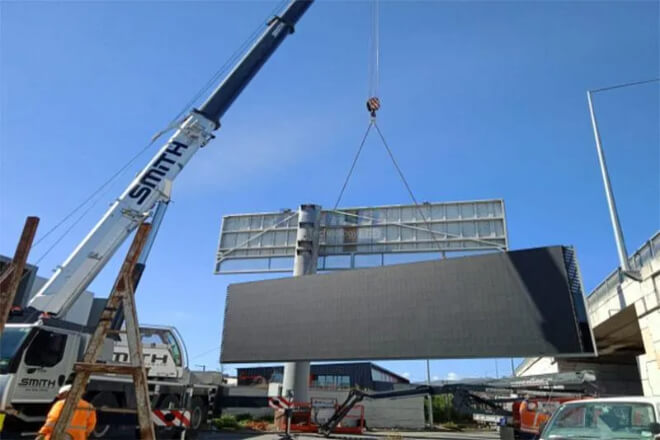
Many LED display projects have sound initial plans, but during construction, a lapse in attention leads to various minor issues. Installation, seemingly the final step, is actually the most prone to problems.
Regarding wiring, if high-voltage and low-voltage wiring are not separated or if the wiring is haphazard, signal interference is easily generated.
The result is intermittent flickering, stripes, or even blackouts, seemingly due to equipment problems, but often caused by improper wiring.
Another crucial aspect is grounding and lightning protection, often overlooked in projects, especially outdoor screens.
Inadequate grounding can lead to equipment instability, damage, and even safety hazards during thunderstorms or voltage fluctuations.
These issues may not be immediately apparent, but they often manifest as major problems.
Furthermore, the installation of the screen structure is critical. If it’s not securely fixed or the structural design is poorly executed, it can loosen over time.
This is particularly problematic in outdoor environments where wind, sun, and temperature fluctuations exacerbate instability, affecting usability and posing safety hazards.
Another common issue is improper module splicing.
While it may appear simple, uneven splicing and inconsistent gaps can result in uneven brightness, noticeable seams, and negatively impact the overall display quality.
Some problems become apparent immediately after installation, but by then, adjustments are difficult.
Ultimately, the installation process is a matter of “details determine the outcome.”
No matter how good the initial selection or design, improper installation will compromise both performance and safety.
Properly handling the fundamentals of wiring, grounding, structure, and splicing is crucial for ensuring the stable operation of an LED screen, preventing problems from arising after a short period.
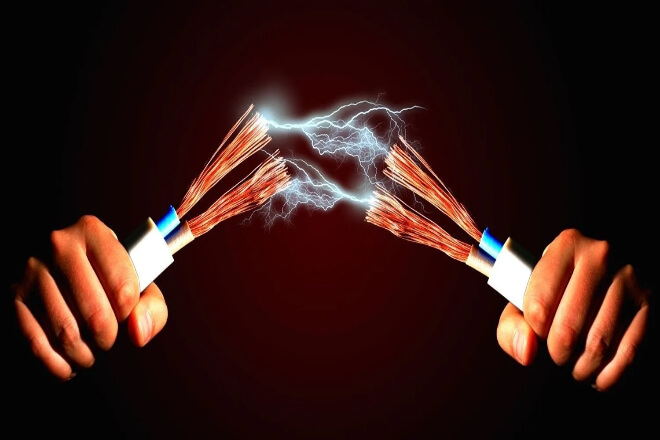
While the LED display appears to be the “star of the show,” the true backbone is the power supply system.
If the screen is likened to a person, the power system is the “heart.” An unstable heartbeat will disrupt the entire display’s rhythm.
The most obvious manifestation is unstable voltage. Voltage fluctuations can cause screen flickering, jittering, or even a complete shutdown.
Sometimes it appears as if the screen is broken, but it’s simply due to unreliable power – a fairly common occurrence.
This problem is more prevalent during peak electricity usage or in areas with complex power environments.
Furthermore, power quality is critical. Some projects, in an effort to control budgets, opt for mediocre power supplies.
While they may seem fine initially, prolonged use can lead to instability, decreased efficiency, and even significant overheating.
Over time, the equipment’s condition deteriorates, effectively shortening its lifespan.
Another easily overlooked aspect is surge protection and lightning strike protection.
Without proper protection measures, sudden surges in current during thunderstorms or power grid fluctuations can easily affect the equipment.
This can range from minor localized anomalies to severe damage, often occurring suddenly.
Furthermore, prolonged operation without proper load control can overload the system.
Just like a person constantly working without rest will eventually break down, the same applies to equipment.
In short, the power supply system is the kind of system that is “unnoticeable under normal circumstances, but becomes very apparent when problems arise.”
Ensuring stable voltage, high power quality, and effective protection measures are crucial for the screen to function reliably, rather than exhibiting inconsistent brightness.
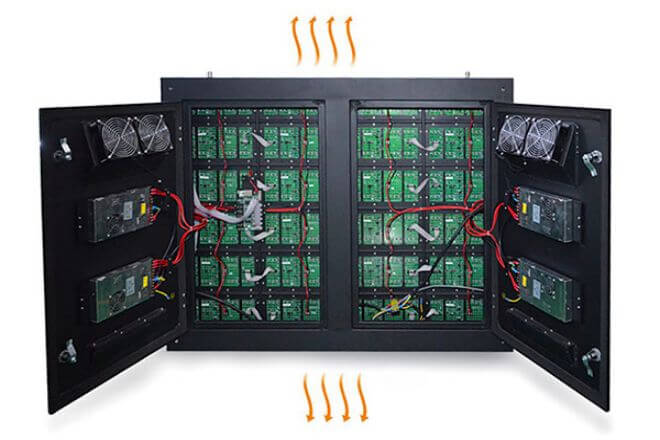
While LED displays appear to be “emitting light,” they are essentially battling temperature fluctuations.
Inadequate heat dissipation and environmental control significantly accelerate equipment aging, even affecting normal operation.
For example, in high-temperature outdoor environments, prolonged operation can easily lead to accelerated light decay.
Simply put, the screen becomes less bright over time, and colors may become unstable.
Especially in summer under direct sunlight, if heat dissipation is inadequate, the temperature will rise rapidly, significantly increasing the stress on the equipment.
Furthermore, in enclosed installation environments, such as indoor enclosed structures or poorly ventilated locations, heat can easily accumulate.
The screen itself generates heat during operation; if this heat cannot dissipate, it’s like being constantly “stuffed.”
Which over time not only affects stability but can also cause problems like stuttering and uneven brightness.
A humid environment is also a “hidden killer.” If the ambient humidity is high and proper protection is lacking, moisture can enter the equipment, leading to short circuits or corrosion of metal components.
Initially, there may be no obvious problems, but over time, the failure rate will gradually increase.
Dust is another issue that many people easily overlook. Dust accumulation on ventilation holes or the surface of the equipment affects airflow and reduces heat dissipation efficiency.
It may just look “a little dirty,” but it actually makes it harder for the equipment to dissipate heat, indirectly accelerating aging.
In short, an LED screen not only needs to be “bright,” but also “stable.” Properly designing for heat dissipation and adapting to the environment is like providing a more comfortable working environment for the device.
Allowing it to operate stably for a long time, rather than slowly “failing to withstand” high temperatures, humidity, or dust.
Not only is proper installation important for LED displays, but proper use is equally crucial.
Some screens, despite having good specifications, have their lifespan significantly shortened due to improper usage—this is actually quite common.
For example, prolonged high-brightness operation is a typical example of “slow wear and tear.”
Working at high 輝度 continuously is like constantly “working overtime without rest.”
Resulting in high power consumption, increased heat generation, accelerated LED wear over time, and a gradual decrease in overall brightness.
Adjusting brightness appropriately according to ambient light can significantly extend lifespan.
Another easily overlooked problem is displaying static images for too long.
Playing the same image for an extended period, especially content with fixed elements such as logos or static interfaces, can cause “burn-in.”
Although LEDs are more durable than some display technologies, if the image is not changed for a long time, it can still leave “marks.”
Frequent power-on/off cycles also pose a problem.
Some projects, in an effort to save electricity or due to mismanagement, frequently switch the screen on and off, which can actually strain the equipment.
Each power-on and power-off cycle causes current fluctuations, which, over time, can affect the power supply and components, hindering stable operation.
Finally, there’s the content playback strategy.
Poorly designed content, such as continuously high brightness, prolonged use of a single image, or a lack of a reasonable rotation rhythm, will keep the screen in a state of “continuous high load.”
Good content should not only be visually appealing but also “used reasonably,” allowing the screen to have a more balanced rhythm between work and rest.
Simply put, an LED display screen is like a device that needs a “reasonable work-rest schedule.” Overuse or monotonous use will easily cause it to “fatigue” faster.
Properly arranging brightness, content, and usage rhythm is crucial for a screen that is both visually appealing and durable.
 English
  Español
  简体中文
简体中文  Français
  日本語
日本語  한국어
한국어  العربية