

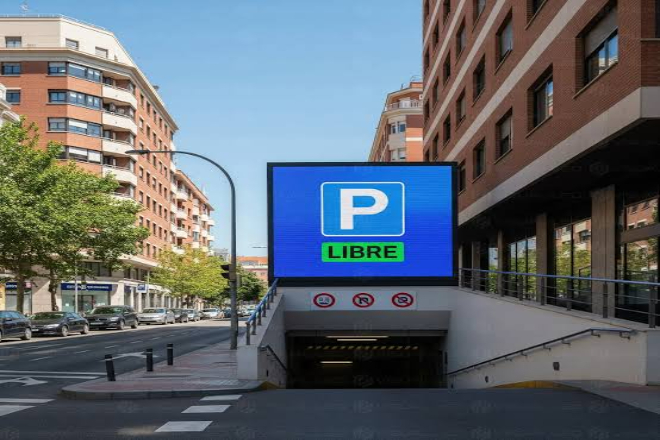
Parking lot entrances may seem like a small area, but they bear the responsibility of vehicle identification, information display, and traffic guidance.
Different types of parking lots have different requirements for LED displays.
For example, ショッピングモール parking lots need to display remaining parking spaces, operating hours, and payment information;
Office building parking lots may focus more on monthly parking space guidance, visitor entrances, and parking space status;
Parking lots at 空港, 病院, or large transportation hubs need to clearly display directions to different areas and temporary traffic arrangements.
Therefore, when choosing an LED display for a parking lot entrance, the primary purpose of the screen must first be clearly defined.
If the main purpose is to display brief information, clarity and legibility are more important than complex visuals.
For example, prompts like “Ample Parking,” “Entrance Closed,” and “Please Slow Down” require drivers to understand the information quickly, making excessive decorative effects unsuitable.
If the screen also needs to display the number of remaining parking spaces, pricing, or information in multiple languages, further consideration must be given to font size, layout, and information switching speed.
Secondly, it’s crucial to determine whether the screen will be installed indoors or outdoors.
Indoor parking lot entrances are typically shielded by buildings, resulting in relatively stable ambient light;
Outdoor entrances, however, may be directly exposed to sunlight, rain, and temperature fluctuations, placing higher demands on brightness, protection, and structure.
Thirdly, vehicle traffic patterns must be considered.
If vehicles need to identify and turn within a short distance, the screen must allow drivers to clearly see the information from a reasonable distance.
If the entrance lane is wide or multiple lanes are used simultaneously, it’s also necessary to assess whether the screen can cover the primary viewing direction.
For project decision-makers, determining the information’s purpose, installation environment, and vehicle traffic flow before selecting product specifications is more effective than simply comparing prices.
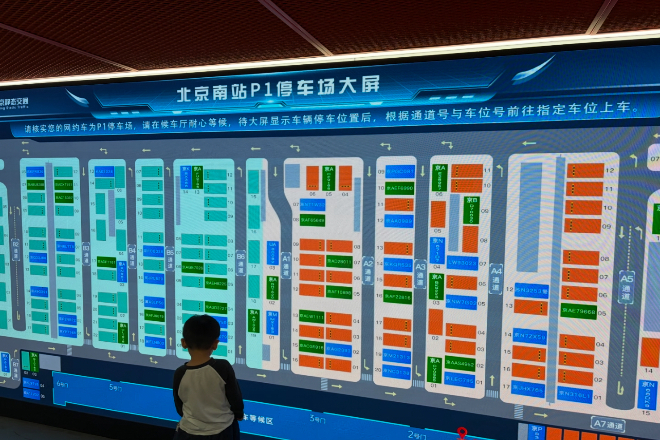
輝度 is one of the most important parameters when selecting a parking lot entrance LED display, but higher isn’t always better.
Imagine a driver entering a parking lot during the day under bright sunlight. If the entrance screen is insufficiently bright, the information may be difficult to read.
At night, if the screen remains at high brightness, it can be glaring and affect viewing comfort.
Therefore, when choosing brightness, it’s crucial to differentiate between indoor and outdoor environments.
- Indoor parking lot entrances: Focus on ambient light
If the screen is installed inside an underground parking lot or in a covered entrance passageway, it typically doesn’t need to meet the brightness requirements of unobstructed 屋外広告スクリーン.
Specifications should be determined based on on-site lighting, whether the entrance is exposed to direct sunlight, and the driver’s viewing distance.
- Outdoor parking lot entrances: Focus on direct sunlight
If the LED display is installed at an open entrance, especially facing direct sunlight, it’s necessary to choose a product that can adapt to strong ambient light to avoid a grayish image and illegible text during the day.
However, brightness requirements also depend on the installation orientation, shading conditions, and screen content.
Simply choosing the highest brightness based on “outdoor use” is insufficient.
Secondly, it’s recommended to prioritize products with brightness adjustment capabilities.
Through ambient light sensors or control systems, the screen can adjust its brightness according to changes in the environment during the day, evening, and night.
This ensures clear information while reducing unnecessary energy consumption.
Furthermore, parking lot entrance LED displays typically need to show numbers, arrows, and brief text.
Even with sufficient brightness, drivers may still have difficulty seeing the text if the font is too small or the background contrast is insufficient.
Therefore, on-site testing with actual display content should be conducted during procurement to check readability both during the day and at night.
For parking lot operators, appropriate brightness doesn’t mean making the screen the brightest thing at the entrance, but rather ensuring drivers can quickly understand the information when needed.
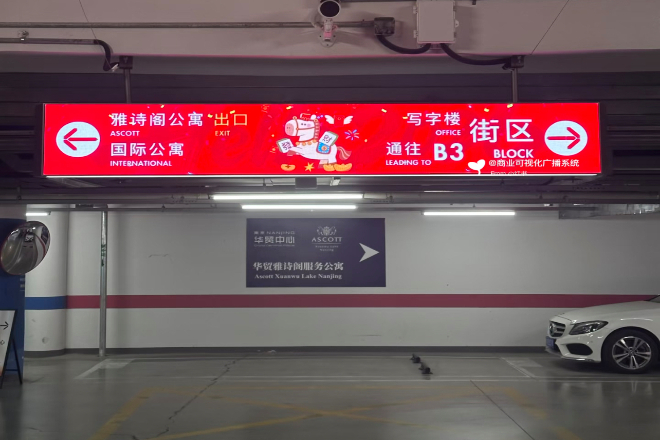
The size of the parking lot entrance LED display directly affects the information display range and 視聴距離。
However, bigger isn’t always better; the key is to match it with the entrance space, lane width, and display content.
First, the size should be determined based on the distance vehicles approach the screen.
If drivers need to determine whether to enter a lane from a distance, the main text and arrows on the screen must be sufficiently prominent.
If the screen is installed near the gate and information is only read upon vehicle approach, the size selection should be determined based on the actual parking position, eye level, and vehicle stopping distance.
Second, the number of entrance lanes must be considered.
Single-lane parking lot entrances typically only need to clearly display traffic guidance and brief notices.
If the entrance has two or more lanes, a wider screen may be needed, or multiple LED displays might be used to show information for different lanes.
For example, one lane might be for monthly rental vehicles, and another for temporary vehicles.
If all the information is crammed onto a small screen, drivers may hesitate at the entrance, impacting traffic flow.
Third, the screen ratio should be carefully considered.
If the main focus is on displaying the number of remaining parking spaces, a horizontal layout might be more convenient;
If multiple lines of payment instructions or various notices are needed, the screen ratio should be determined based on the information structure.
However, it is not recommended to infinitely increase the screen size to display more content.
Parking lot entrance information should be concise and clear; information that can be expressed with a number and an arrow should not be crammed into a large block of text.
Fourth, installation height and line of sight should also be considered.
If the screen is installed too high, vehicles may need to look up to find it; if installed too low, it may be obstructed by vehicles, turnstiles, or other facilities.
For parking lots with a high volume of large vehicles, the visibility range should also be checked based on vehicle type.
Ultimately, the size of the LED display screen should be determined through actual on-site measurements and viewing tests, not just estimated based on renderings.
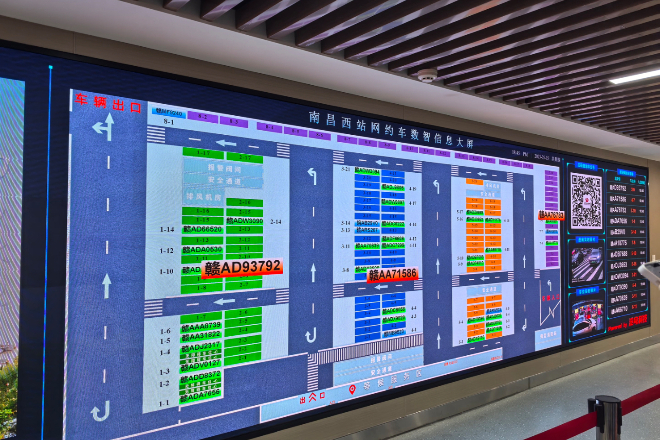
The primary task of a parking lot entrance LED display screen is to convey information, not to play a visual performance.
Therefore, pixel pitch, font size, and content design should all revolve around readability.
First, choose the ピクセルピッチ based on the viewing distance.
Pixel pitch is the distance between the centers of adjacent pixels.
All other things being equal, a smaller pixel pitch generally results in a sharper image, but may also be more expensive.
If the screen is installed in a location where vehicles need to observe it closely, the clarity of numbers and text should be carefully evaluated;
If drivers primarily view it from a distance, a more suitable specification can be chosen based on the actual distance.
Second, the information should be easily understood at a glance.
For example, parking lot entrances can use large numbers to display the number of remaining parking spaces, along with clear arrows indicating vehicle directions.
Fee information should highlight key prices and billing rules, avoiding excessive text.
For drivers, the entrance is not a place to read lengthy instructions. The simpler the information, the less hesitation and misjudgment it will reduce.
Third, pay attention to color and contrast.
There should be sufficient visual contrast between the background and text, and important notices should maintain a stable display.
Different colors can be used to distinguish parking space status or access information, but too many colors should not be used simultaneously to avoid a cluttered appearance.
Fourth, use dynamic effects with caution.
Animations can be used to indicate entrance openings, changes in parking space status, or temporary traffic adjustments, but it’s not suitable for all content to scroll rapidly or flash frequently.
For drivers, stable and clear information is usually more practical than complex dynamic effects.
Furthermore, if the parking lot needs to connect to a parking management system.
It should be confirmed whether the LED display’s control system supports the corresponding data access and whether the remaining parking space count can be updated in a timely manner.
A well-designed parking lot entrance LED display doesn’t necessarily need many visual effects.
As long as the numbers are eye-catching, the directions are clear, and the information is timely, the most important issues are solved.
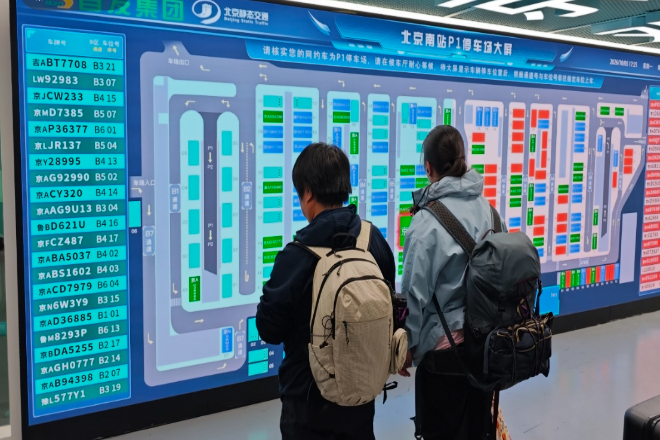
Parking lot entrance LED displays typically need to operate for extended periods.
If only 輝度 and size are considered during selection, while installation, protection, and maintenance are neglected, unnecessary costs may arise later.
First, select the appropriate protection level based on the installation environment.
Outdoor entrances may be affected by rain, dust, and temperature changes, so the protection capabilities of the enclosure, module joints, and cable connections need to be assessed.
For indoor entrances, products should be selected based on the actual environment; it’s unnecessary to blindly pursue excessively high protection specifications.
Second, plan a reasonable installation structure.
The screen should be fixed to a suitable supporting structure, considering wind load, vehicle passage space, maintenance locations, and cable routing.
For large outdoor screens, structural safety should be assessed by professionals to avoid obstructing vehicle passage or driver visibility.
Third, consider maintenance methods in advance.
If the screen is installed above a turnstile or in a narrow entrance location, ensure the modules, power supply, and control components are easily accessible for maintenance.
Maintenance that can be performed without extensive structural disassembly is generally more beneficial for reducing downtime.
Fourth, consider energy consumption and operational management.
Screen area, brightness settings, and daily operating duration all affect power consumption.
For parking lots operating for extended periods, unnecessary energy consumption can be reduced by appropriately setting brightness and playback content.
Finally, compare the overall project cost.
In addition to the purchase cost of the LED display screen, the costs of installation brackets, electrical systems, control systems, debugging, spare parts, and after-sales service should also be considered.
If the screen needs to be integrated with the parking management system, the data interface and system integration costs should also be included in the budget.
For project decision-makers, the most suitable LED display screen for parking lot entrances is not necessarily the largest or brightest product.
But rather a solution that allows drivers to see clearly, facilitates smoother traffic flow, and is easy to maintain in the long term.


 English
 Español
 简体中文
 Français
 日本語
 한국어
 العربية