
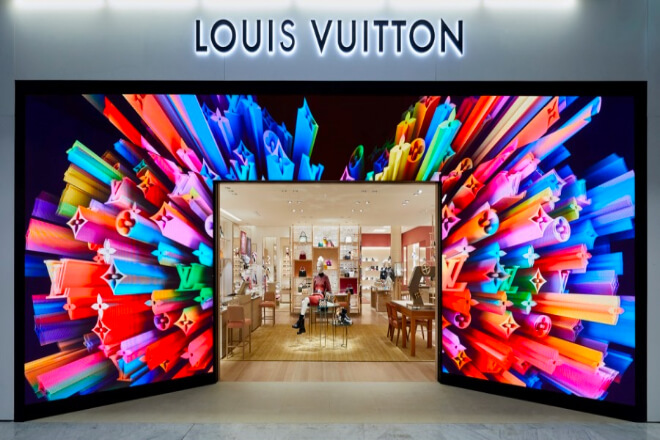
Before using an LED display for your brand display, first clarify your brand’s most important “visual calling card.”
This includes the brand’s logo, standard colors, commonly used fonts, and overall graphic style—these are essentially the brand’s first impression.
Whether displayed on store signs, advertising posters, or on an LED screen, these elements should ideally remain consistent. This way, customers can easily associate the relevant images with your brand.
Next, design the visual effects on the screen according to the brand’s image. If the brand adopts a technological approach, the visuals can be simpler, using more cool colors, lines, or futuristic animations.
For young, trendy brands, the screen can be more vibrant, using dynamic videos, bright colors, and rhythmic visuals.
While high-end or professional brands are often better suited to clean, sophisticated designs that give the overall look a more refined feel.
For a simple example, some brands are instantly recognizable just by seeing a certain color or graphic. This is the effect of consistent visual elements over time.
When LED displays repeatedly showcase these elements, customers will gradually remember them after passing by a few times, and may even be able to guess which brand it is from a distance just by seeing the color or style.
Therefore, LED screens are not just tools for “playing advertisements”; they are also part of brand image display.
By using core visual elements effectively, each screen display helps deepen the brand’s impression, making it easier for customers to remember you.

Many people, when they think of LED displays, might only picture the huge advertising screens on the exterior walls of shopping malls.
But in fact, there are many more types of LED screens than just that.
Depending on the installation location and usage scenario, you can choose from indoor ELD screens, 屋外 LED スクリーン, 透明LEDスクリーン, curved screens, or even arc-shaped screens, each with its own strengths.
For example, in shopping malls, brand stores, or showrooms, indoor LED screens typically offer more detailed images and softer colors, making them ideal for playing brand videos, product displays, or event promotions.
As customers approach, the image details remain clearly visible, resulting in a more refined and high-quality look.
Outdoor LED screens are more suitable for streets, commercial plazas, or the exterior walls of large buildings. These screens are bright and large, ensuring clear visibility even in strong sunlight.
People approaching from a distance are easily drawn to the images, which is why many brands prefer them for advertising.
Of course, if a brand wants to be more creative, they can consider transparent or curved screens.
Transparent LED screens are commonly found in shopping mall windows or glass curtain walls.
Making the image appear to float on the glass without obstructing the interior space, creating a stylish and futuristic look.
Curved or arc-shaped LED screens can be designed to blend seamlessly with the building’s shape, creating a more distinctive and memorable visual effect.
Simply put, choosing the right type of LED screen is like choosing the right stage for a brand’s display.
A suitable screen not only maximizes the visual impact but also harmonizes perfectly with the surrounding environment.
This allows the LED screen to attract the attention of passersby and make the brand appear more stylish and memorable.
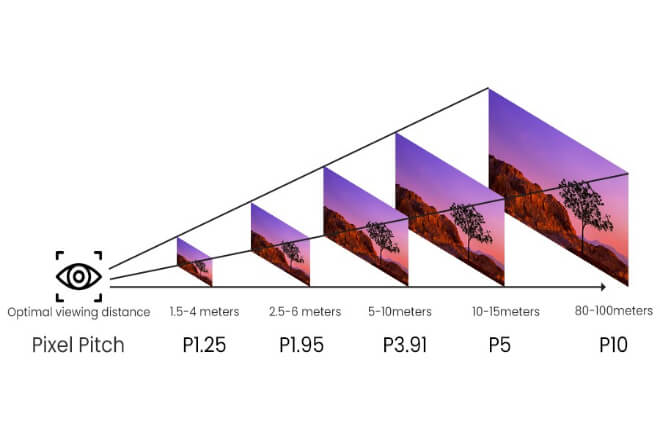
Size is crucial when creating an LED display; bigger isn’t always better.
It’s more important to design it in conjunction with the installation space and the audience’s viewing distance to ensure a comfortable, clear, and visually impactful image.
例えば、 ショッピングモール, customers are usually close to the screen. If the screen is too large or the resolution is insufficient, the image will appear grainy.
Conversely, if the screen is too small, it will be difficult for people at a distance to see the content.
Conversely, large screens are more advantageous for outdoor advertising or commercial plazas because passersby often see them from tens of meters or even further away.
In these cases, size and 輝度 need to be more prominent.
Many brands consider this question first when designing LED screens: From what distance will viewers see it?
Is it three to five meters from the entrance, or tens of meters across the street? Determining the screen size and pixel pitch based on this distance usually results in a much better image quality.
Another easily overlooked point is overall visual balance. If the screen is too large, it may create a feeling of spatial oppression.
If it’s too small, it may be easily “swallowed up” by the surrounding environment.
A suitably sized LED screen looks eye-catching without appearing obtrusive, and the brand logo is clearer.
Simply put, choosing the right screen size is like finding the perfect display window for your brand.
Whether customers are passing by from a distance or viewing it up close, they can clearly see the brand content and experience a more impactful visual experience.
The allure of LED displays lies not only in their clarity and 輝度 but more importantly in their placement and how they integrate with the surrounding space.
A well-chosen location can make a screen the visual focal point of the entire space; an unsuitable location can cause even the best screen to be overlooked.
For example, installing an LED screen at a store entrance allows passersby to see the changing images as they walk by, attracting attention more easily than a regular sign.
Placing it in a shop window is also interesting—the screen can display brand images or product stories, while the window displays actual merchandise.
This “screen + product” combination creates a more layered look and encourages customers to stop and take a closer look.
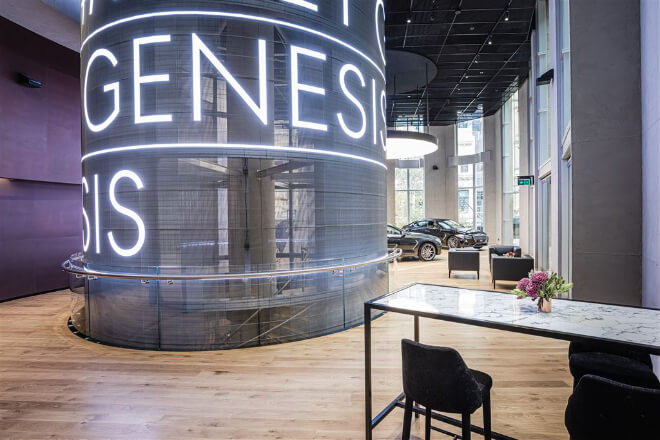
Some shops design their LED screens more creatively, such as embedding them in walls, making them curved, or integrating them with architectural lines.
In this way, the screen becomes more than just a standalone device; it becomes part of the spatial design, appearing both natural and technologically advanced.
When entering such a space, the eye is gradually guided, and the brand logo is unconsciously remembered.
Furthermore, the angle and height of the screen are also crucial. If the display is within the customer’s line of sight, it will be more easily noticed.
If combined with lighting or booth design, it will create a more three-dimensional visual effect.
Simply put, when an LED display screen is perfectly matched with the spatial layout, it’s not just a tool for displaying content.
But can become the most eye-catching part of the entire environment, making the brand more distinctive and attractive.
 English
  Español
  简体中文
简体中文  Français
  日本語
日本語  한국어
한국어  العربية