
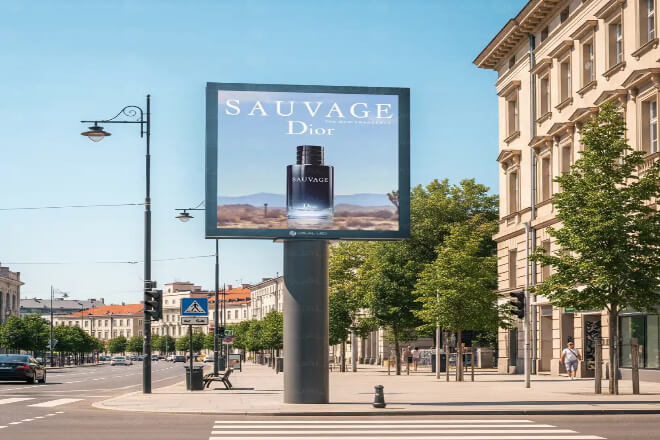
When customers choose LEDディスプレイ, their focus has long shifted from “how much does it cost today” to “how much cost will it save me in the future?”
Lower energy consumption, longer lifespan, and less maintenance directly impact the long-term return on a project.
Therefore, sustainable development is not just an environmental concept for customers, but also a smarter investment approach.
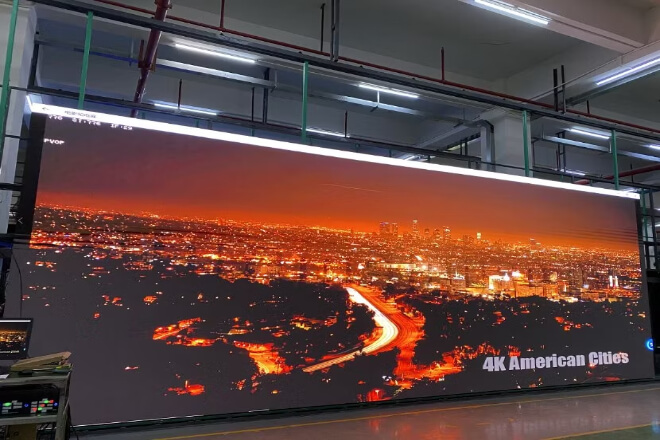
Now, customers buying LED displays are no longer just concerned with “輝度,” but also with an increasingly practical issue—electricity costs.
After all, the screen may be on for over ten hours a day. Over time, the savings aren’t just a few kilowatt-hours, but a high long-term cost.
Therefore, “energy saving” has become a crucial competitive advantage for LED products.
The first step is using low-power LED chips and high-efficiency 電源. New-generation LED chips consume less energy while maintaining brightness and display quality.
Paired with high-efficiency power supplies, energy waste is reduced, ensuring every kilowatt-hour is used effectively.
Simply put, it allows the screen to “use less electricity while doing more work.”
For example, two outdoor advertising screens of the same size, one using a traditional solution and the other an energy-saving solution, might appear similar in brightness during the day.
However, the difference becomes apparent when the electricity bill is checked at the end of the month. The boss will usually say, “Hmm, that’s a real saving.”
Secondly, intelligent brightness adjustment can reduce unnecessary 消費電力. During the day, when sunlight is strong, the screen automatically increases brightness.
At night, when the environment is dark, the system automatically decreases brightness, ensuring viewing quality while avoiding “brightening up even when no one is looking.”
This is similar to the automatic brightness function on a mobile phone—bright when needed, and dim when not, providing both comfort and energy savings.
More importantly, these technologies help clients reduce carbon emissions. Lower energy consumption means less overall energy use.
Better aligning with the green development requirements of an increasing number of businesses and public projects.
Large shopping malls, スポーツ stadiums, and 政府 projects, in particular, are rapidly increasing their focus on “green equipment.”
For example, the electricity saved by dozens of screens in a ショッピングモール over a year could be enough to power many of its daily equipment.
Saving money while also contributing to environmental protection—a “win-win” situation that clients typically appreciate.
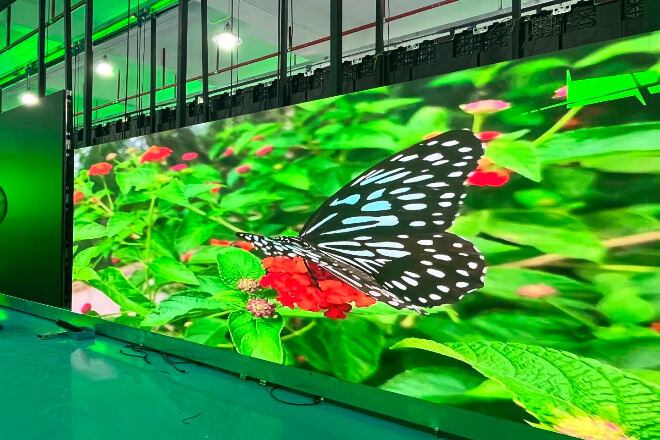
When buying LED displays, everyone wants them to “work well,” but even more importantly, they want them to “last long.”
After all, if a screen needs frequent repairs or even replacement every three to five years, it’s not only inconvenient but also quietly increases costs.
Therefore, from a sustainable development perspective, durability is itself a form of environmental protection.
Firstly, this involves extending the lifespan of the LED display. Through more stable LED chips, more reliable drive systems, and more mature structural designs.
The screen can operate stably for a long time, reducing the probability of “premature retirement.”
Simply put, it’s about turning the screen from a “sprinter” into an “endurance runner.”
For example, consider two LED displays in a ショッピングモール atrium: one starts frequently losing pixels after three years.
While another is still working normally after seven or eight years—the former may have already been replaced with a second-generation display.
While the latter is still quietly “working”—the difference is immediately apparent.
Secondly, it reduces material consumption caused by frequent replacements.
Replacing a screen not only costs money but also means new material input, dismantling and disposal of old equipment, all of which consume resources.
The longer the product lifespan, the less overall resource waste.
This is somewhat similar to buying home appliances—everyone hopes their refrigerator will last for years, rather than breaking down just as they get used to its sound. The same logic applies to LED screens.
More importantly, it significantly improves the long-term utilization rate of the product.
A longer-lasting screen can cover more usage cycles and application scenarios, resulting in higher investment value, and customers are more willing to use it long-term.
For example, a stadium LED screen can be used for スポーツ events during the week and for concerts.
Activities, and commercial displays on weekends—if the equipment is stable enough, the longer its “on-the-job time,” the higher its value.
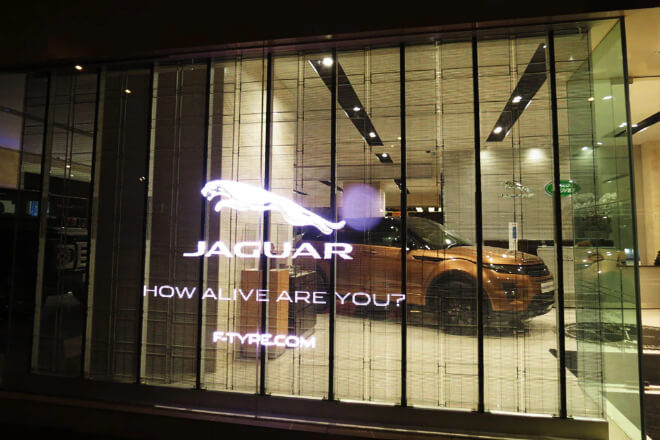
The “green” aspect of LED displays isn’t just about saving electricity after installation; it’s about being green from the “birth” stage—that is, the manufacturing process.
After all, true sustainability isn’t just about making the product work, but also about making its “way out of the factory” more environmentally friendly.
First, it’s about using environmentally friendly materials and processes.
For example, choosing more environmentally friendly raw materials, low-pollution coatings, and safer encapsulation processes to reduce the impact on the environment and people.
Simply put, it’s about making LED displays follow a green path from the “raw materials” stage.
For example, some manufacturing processes used to be like “heavy industry,” characterized by high noise and energy consumption.
Now, more and more companies are upgrading their processes, shifting production lines from “high-energy-consumption mode” to “refined mode”—an invisible change with significant value.
Secondly, it’s crucial to reduce pollution emissions during production.
Optimizing equipment, improving processes, and increasing automation can effectively reduce waste gas, wastewater, and energy waste.
To put it another way, previously it might have been about “wasting resources while producing.”
Now it’s more about “using every material to its fullest potential,” minimizing unnecessary waste. For businesses, this is environmental protection; for costs, it’s optimization.
More importantly, this will drive green upgrades in the supply chain. Because it’s not enough for one company to be green, upstream material suppliers.
Component suppliers, and logistics must also “go green” for the entire chain to truly achieve sustainability.
For instance, when a brand proposes green procurement standards, suppliers will follow suit and upgrade their materials and processes.
Everyone progresses together, and the industry naturally moves towards a more environmentally friendly direction.
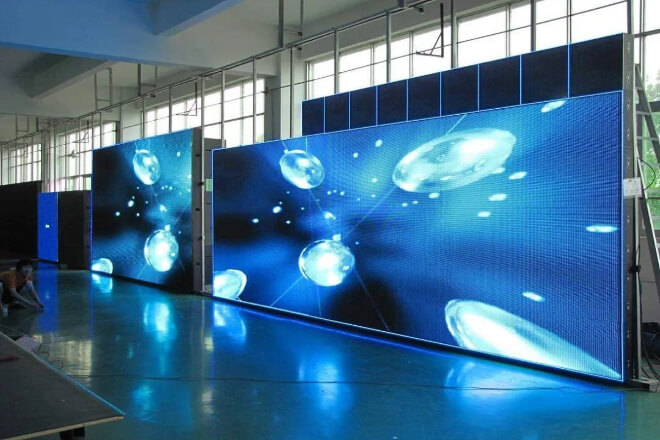
Many LED displays “retire” not because the entire screen is broken, but because a small component malfunctions, which can result in major repairs or even complete replacement.
This sounds like being advised to “replace the whole phone” because your phone screen is slightly cracked—it’s a bit of a waste.
Therefore, a smarter approach is to make products easier to repair, not easier to become obsolete.
First, modular design facilitates repair and replacement. Breaking down LED displays into independent modules, power supplies, control cards, etc..
Allows you to replace only the faulty component, avoiding a domino effect.
For example, if a corner of a large ショッピングモール screen experiences a dead light, previously it might have required extensive disassembly and reassembly.
Now, only the corresponding module needs to be replaced, like “replacing building blocks”—more efficient and less costly. Engineers are happy, and customers are happy.
Second, this design significantly reduces the overall scrap rate. Often, the main structure of the equipment is still in good condition, but only a small part is aging.
If rapid repair is supported, the screen can continue to “work” instead of prematurely “retiring.”
This is somewhat like changing a car tire—you don’t replace the whole car just because one tire is worn out, right? The same logic should apply to LED screens.
More importantly, it increases the recycling value of the equipment.
Old modules can be repaired and reused, usable parts can be recycled and replaced, extending the equipment’s lifespan and naturally improving resource utilization.
For example, an indoor screen upgraded from a stadium can be maintained and then reused in conference rooms, exhibition halls, or other settings—not “discarded,” but “re-energized and put to use.”
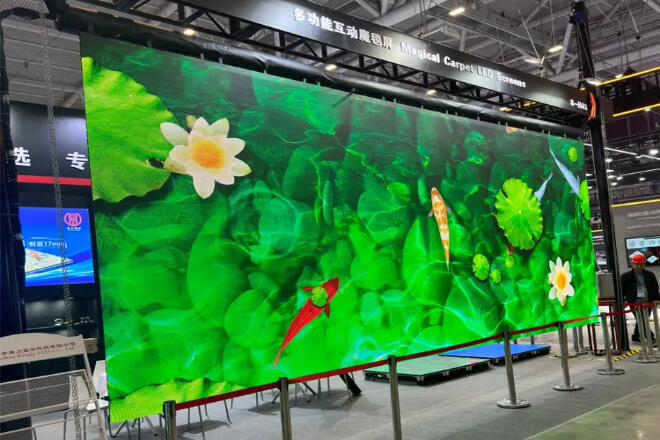
Managing LED displays used to be a bit like “raising a child”—you had to check on them constantly: “Is it bright? Are there any problems? Why is the color strange today?”
Now it’s different. Intelligent management allows the screens to “report their work,” and people no longer need to “monitor” them every day.
First, remote monitoring reduces maintenance resource waste. Through the backend system, managers can view the screen’s operating status in real time, such as temperature, voltage, brightness, and signal status.
If anything is abnormal, the system will alert you in advance, instead of waiting until the screen goes black.
For example, previously, if a ショッピングモール‘s advertising screen malfunctioned, we might have to wait for the customer to call and ask, “Why is a corner of your screen black?”
Now, the backend will proactively display a notification: “Module 3 is experiencing an abnormality.
Please pay attention.” — Before the malfunction even occurs, engineers are already on their way.
Secondly, intelligent control can optimize operational status. For example, 輝度 can be automatically adjusted based on ambient light, brighter during the day and softer at night.
Automatic on/off switching based on usage time avoids “still emitting light at 2 AM.”
This is like a smart air conditioner at home—you don’t need to constantly adjust it; it knows when to conserve energy and when to operate at full power.
The same applies to LED screens; the smarter they are, the more efficient they become.
More importantly, it enables more efficient lifecycle management. From installation and operation to maintenance and upgrades, data at each stage can be recorded and analyzed.
Helping managers determine which equipment is in good condition, which is nearing its maintenance cycle, and which needs to be replaced early.
For example, for a stadium LED screen, if the system detects that a batch of 電源 has been running continuously nearing its lifespan’s critical value, it can arrange for replacement in advance.
Onstead of waiting for it to “suddenly fail” on the day of the event—this “prevention is better than cure” is true efficient management.


 English
  Español
  简体中文
简体中文  Français
  日本語
日本語  한국어
한국어  العربية