
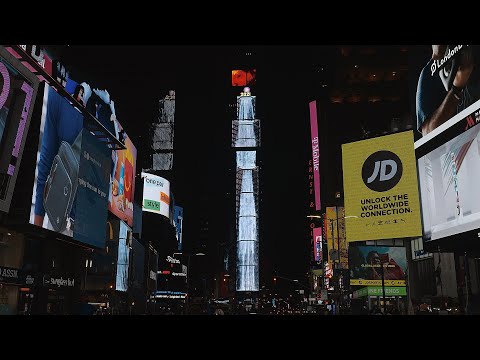
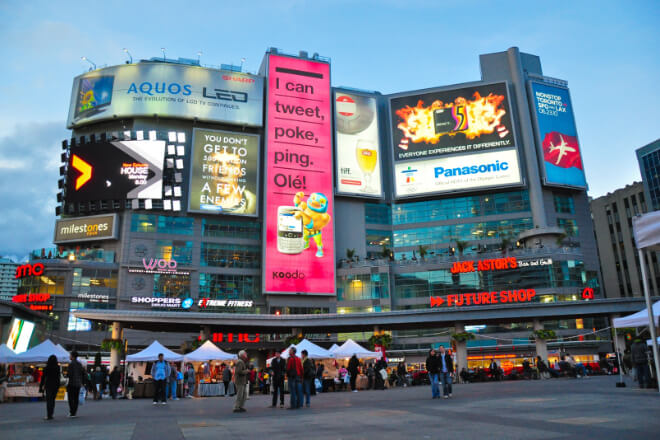
In crowded centres commerciaux, stores, or streets, people essentially “automatically ignore advertisements” every day.
After seeing static posters for a while, many people don’t even bother to glance at them.
But LED displays are different. Because as soon as the image moves, the human eye almost instinctively looks at it.
First, videos and animations are inherently more visually impactful. Whether it’s scene transitions, lighting changes, or dynamic effects, they are more likely to grab attention than static images.
Especially in places like shopping mall atriums, brand stores, or outdoor large LED screens—places where “information competition is particularly fierce”—dynamic content often “grabs” attention more quickly in a crowd.
Second, it is indeed easier to see than static advertisements. For example, if a bubble tea shop simply displays a new product poster, many people might just walk past.
However, if an LED screen is playing dynamic visuals like “ice cubes falling into a cup” or “slow-motion flow of milk foam,” passersby are more likely to subconsciously look for a couple more seconds.
Don’t underestimate those two seconds—many consumer decisions begin with that extra glance.
Furthermore, LED displays are particularly suitable for high-traffic areas.
In places like shopping malls, electronics stores, chain restaurants, and outdoor commercial streets, viewers have limited time to linger, and brands must grab their attention quickly.
Dynamic videos deliver information faster and create memorable moments.
Finally, it effectively increases dwell time and attention. When the visuals are constantly changing, viewers are more likely to think, “Let’s see what happens next.”
Thus, someone who was just passing by might stop for a few seconds or even take out their phone to take a picture.
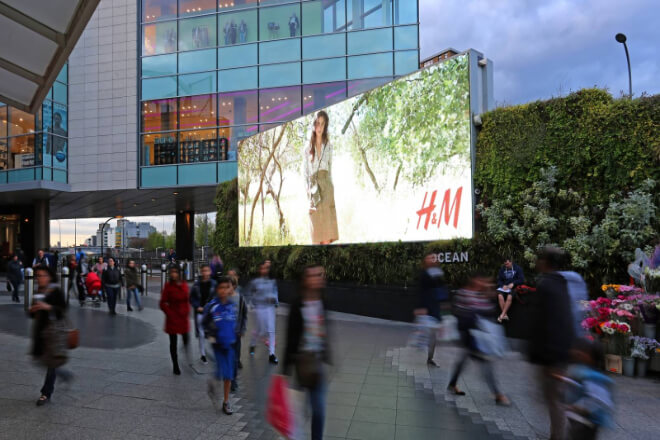
In reality, most people only spend a very short time looking at advertisements—perhaps only 3 seconds, or even 1 second.
Therefore, the issue often isn’t “whether the content is rich enough,” but rather: whether others have enough time to understand it.
This is why LED display content increasingly emphasizes “simplicity” and “high contrast.”
First, avoiding text and image overload is crucial. Many brands initially try to cram all information into the display: products, prices, promotions, slogans, QR codes, contact information…
The result is that viewers are left with only one feeling: “So much information, but I didn’t remember anything.”
Truly effective LED content is usually restrained—a key sentence, a core image, a clear action—allowing viewers to grasp the main point at a glance.
Second, high-contrast colors significantly improve readability. Especially in environments like centre commercial windows, outdoor streets, and transportation hubs, viewers often “look while walking.”
In these situations, clear color contrast and eye-catching fonts are more effective than complex designs.
For example, black text on a white background, or a dark background with a bright product image, is often easier to quickly identify than a flashy gradient background.
Furthermore, LED displays are particularly suitable for highlighting core selling points.
For example, information like “New Product Launch,” “Limited-Time Discount,” and “Today’s Special” can be received by viewers almost without thinking, as long as it’s large, concise, and eye-catching.
After all, in a fast-paced environment, no one is going to stand on the street and carefully “read an advertisement.”
Finally, this design logic is more suitable for modern browsing habits. People now acquire information more like “scrolling through short videos”—fast, intuitive, and instantly understandable.
If an LED display can clearly convey the key points within seconds, it has already won a significant advantage.
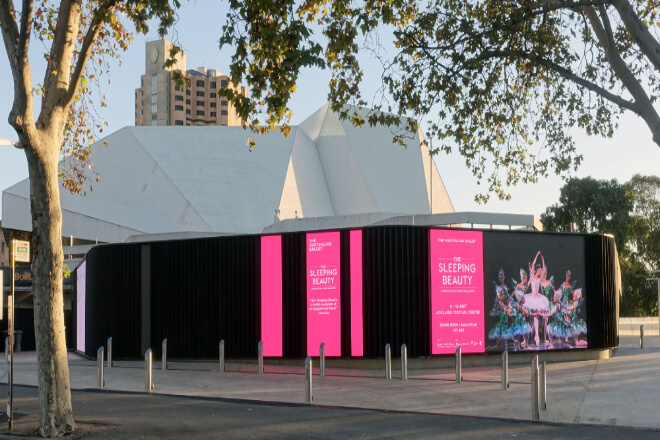
Many people think the role of LED displays is simply “advertising,” but brands that truly know how to operate value them more in the long run.
Because sometimes, consumers don’t place an order after seeing an advertisement only once.
But rather after seeing it repeatedly, they gradually remember it, become familiar with it, and finally develop trust.
And what LED displays excel at is “maintaining a long-term presence.”
Especially in fixed locations like shopping districts, stores, and transportation hubs, a large screen that operates stably for a long time will continuously bring the brand to the user’s attention.
Seeing a brand once today and again tomorrow, over time, naturally leads to increased brand familiarity.
For a very real example: you might never have seriously researched a brand, but because you see its large-screen ads at the same intersection every day on your commute.
You gradually start to think, “This brand seems pretty common,” and “It must be decent.”
Much brand awareness is actually built up little by little in this way.
Moreover, the dynamic content on LED displays is more likely to create memorable moments. Static posters might be forgotten after a while.
But dynamic videos, consistent visual styles, and recurring brand images are more likely to make users remember a certain feeling.
Over time, the content on the screen may even become associated with a particular area.
The greatest value of this continuous exposure is not just “being seen,” but the gradual formation of brand equity.
Once a brand establishes familiarity in the user’s mind, subsequent new product promotions, event marketing, and in-store conversions become much easier.
Because users naturally experience less unfamiliarity and decision-making pressure when facing a familiar brand.
Even many repeat purchases are essentially the result of “long-term exposure.”
Consumers may not remember where they first saw you, but when a brand consistently appears, people are more likely to develop trust: “I see it often, it can’t be too bad.”
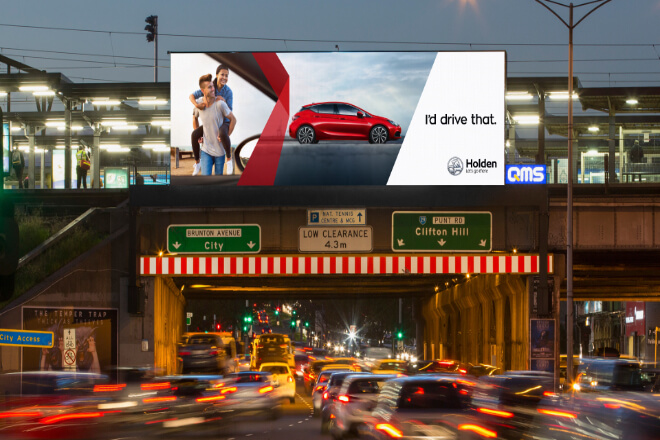
LED displays have a very real but easily overlooked aspect: if they remain unchanged, they gradually become “background.”
People might glance at them at first, but over time, they’ll easily become oblivious. Therefore, “continuous content updates” essentially help the screen maintain its presence.
In actual operation, it’s recommended that clients regularly change their advertising materials, rather than playing the same set of visuals for an extended period.
For example, periodically adjust the visual style, change the featured products, or redesign the visual rhythm so that viewers feel something is different each time they pass by.
To give a very relatable example: if the same LED screen in a centre commercial plays the same advertisement year-round, passersby might gradually go from “glancing at it” to “automatically ignoring it.”
But if the content is updated seasonally—fresh in spring, vibrant in summer, festive, or with enhanced promotions—it will always maintain a state of “having something new.”
In addition, updating content in sync with holidays, events, and new product launches is the most effective way to “refresh” your experience.
For example, switching to a red-themed visual style for Chinese New Year, emphasizing emotional expression for Valentine’s Day, highlighting the promotional pace for Singles’ Day.
And showcasing new product launches dynamically—this kind of time-sensitive content makes the screen feel like a “media that follows trending topics.”
This approach also has a crucial benefit: preventing visual fatigue. People become accustomed to repetitive images, and once they do, they lose their appeal.
Regular updates continuously provide viewers with fresh stimulation, encouraging them to look up again.
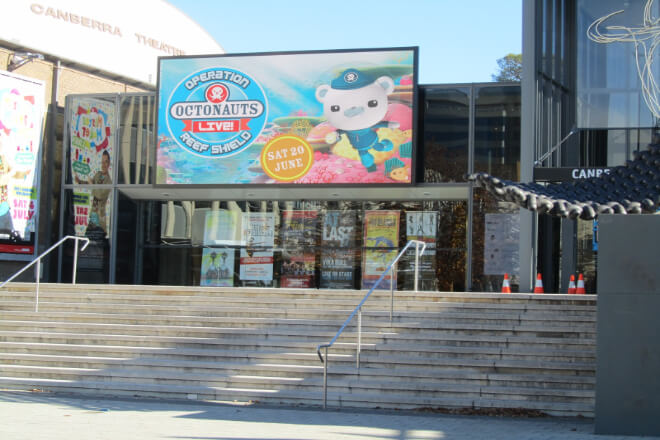
If an LED display only “plays” content, it’s more like an electronic poster; but once interactive guidance is added, it becomes an “entry point that draws people in.”
This change is often a key step in improving conversion rates and dissemination.
In practical applications, a common practice is to guide users to scan QR codes, participate in activities, or follow brand accounts through the screen.
Par exemple, dans un centre commercial atrium, a large screen might be displaying event information, along with prompts like “Scan to enter a prize draw” and “Limited-time coupon giveaway.”
At this point, users’ actions often shift from “just looking and leaving” to “scanning the code.”
A very real scenario: You were initially just passing by when you saw a screen saying, “Scan to participate and win a coffee coupon.”
You didn’t intend to stop, but because the process was simple and the reward was straightforward, you were easily tempted to “give it a try.”
Once the scan is complete, you might be directed to the brand’s mini-program, membership system, or even the purchase process, naturally extending the entire connection.
Furthermore, the effect is even more pronounced if the LED display can be integrated with membership systems or online activities.
For example, a pop-up notification of exclusive benefits immediately after new member registration, or a real-time display of on-site event participation on the large screen.
This feeling of “you participated, and the screen immediately provides feedback” significantly enhances the interactive experience.
Another crucial point is dissemination. Interactive content is often easier to share, such as lottery results, fun polls, and check-in activities.
Users who participate are likely to share them on social media platforms like WeChat Moments, effectively providing secondary promotion for the brand.


 English
  Español
  简体中文
简体中文  Français
  日本語
日本語  한국어
한국어  العربية