
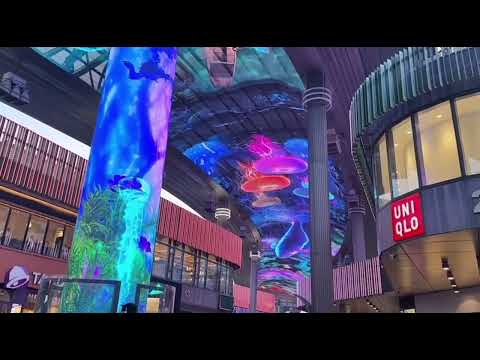
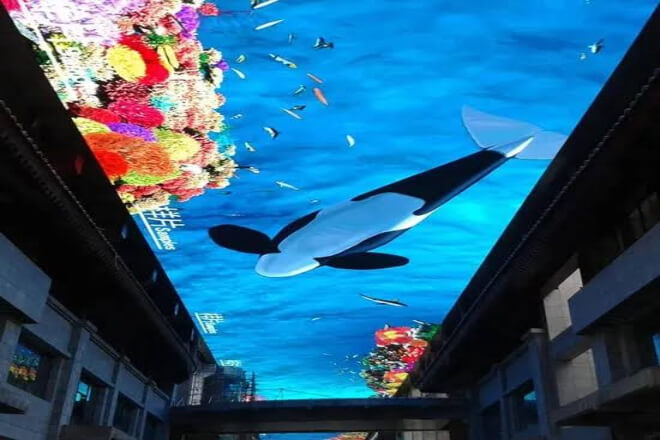
When designing an LED ceiling screen, brightness is often the primary consideration.
Many projects aim for maximum impact, leading to a preference for high-brightness display solutions. In reality, however, “brighter” is not always better.
Imagine a hotel lobby with soft, ambient lighting: a sudden, intensely bright dynamic image appearing overhead might catch the eye, but prolonged viewing could easily become glaring or uncomfortable.
Therefore, calibrate an LED ceiling screen’s brightness based on the installation environment, natural lighting conditions, and specific viewing requirements.
For instance, a shopping mall atrium—typically characterized by strong ambient lighting—allows for a higher display brightness tailored to the existing light levels.
Conversely, hotel lobbies, dining areas, and leisure zones call for a softer, more comfortable visual experience.
For spaces where natural light fluctuates significantly, ambient light sensors can be installed to automatically adjust the screen’s output based on surrounding light levels.
Beyond overall brightness, attention must be paid to the dynamics of light and dark within the content.
If the imagery frequently switches between high-brightness white scenes and dark scenes, it can cause significant visual strain—even if the average brightness remains relatively low.
Consequently, designers should avoid prolonged use of large, high-brightness areas and carefully manage image contrast and brightness transitions.
The ideal design approach lets the LED ceiling screen integrate harmoniously into the space, rather than letting its light dominate the environment.
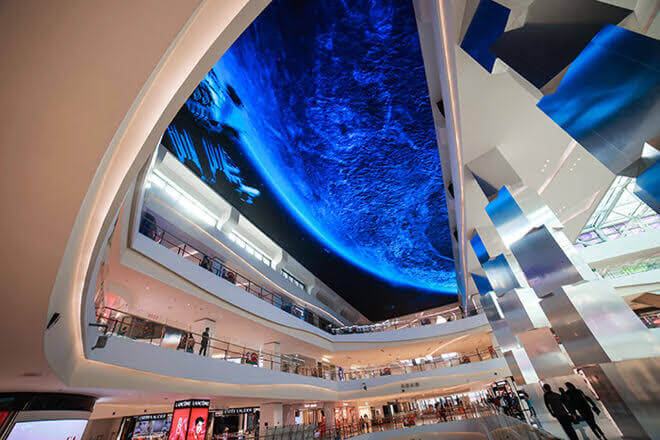
Because LED ceiling screens are installed overhead, viewers typically don’t maintain a fixed distance from the display as they might with a standard television.
Some people may be standing directly beneath the atrium, others sitting in a lounge area, while some might be passing by on an escalator or along a corridor.
Naturally, image clarity will vary depending on the viewer’s location. This brings us to a key parameter: pixel pitch.
Pixel pitch determines how pixels are distributed within a given area of an LED display.
Generally, a smaller pixel pitch means higher pixel density, allowing for finer, more detailed imagery when viewed up close.
However, this does not mean that every LED ceiling screen should aim for the smallest possible pixel pitch.
If the screen is installed at a significant height—meaning viewers are at a considerable distance—pursuing an excessively high pixel density may simply inflate project costs without yielding any noticeable visual benefit.
Design decisions should be made holistically, taking into account the installation height, primary viewing areas, the nature of the content, and the budget.
For instance, a large ceiling screen in the atrium of a commercial complex—primarily serving to create atmosphere or showcase visuals—can utilize a pixel pitch suited for long-distance viewing.
Conversely, if the screen is intended to display detailed imagery, text, or branding elements, designers must consider higher visual precision.
Furthermore, a ceiling screen may incorporate curves, waves, or other non-standard shapes.
Designers must account for viewing angles from various positions to ensure that the imagery does not suffer from significant visual distortion due to the screen’s structural geometry.
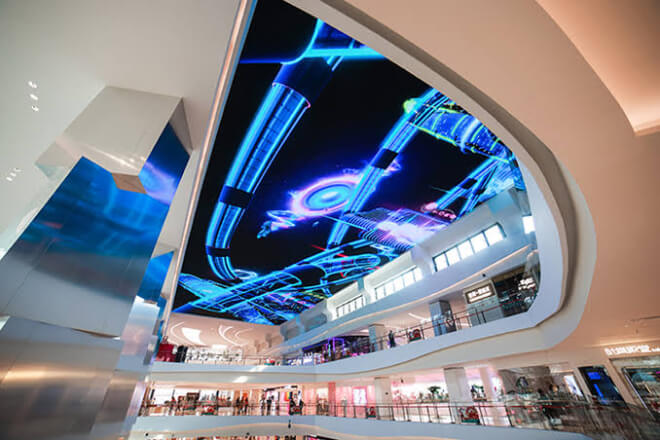
LED ceiling screens frequently display dynamic content, such as drifting clouds, rotating starry skies, waterfalls, oceans, and various 3D visual effects.
While such content enhances a space’s immersive quality, the viewing experience can be severely compromised if the display flickers, shows motion trails (ghosting), or lacks fluid motion.
Refresh rate is a critical metric influencing the quality of dynamic displays.
If the refresh rate is too low, or if the display system is improperly configured, noticeable flickering may occur—particularly under certain camera conditions—and the stability of fast-moving imagery may be compromised.
Therefore, during the project design phase, it is essential to select a driver solution and control system that align with the specific application requirements.
Focus on actual operational performance rather than relying solely on a single figure on a product specification sheet.
Additionally, attention must be paid to the video content’s frame rate, the playback equipment’s performance, and the quality of signal transmission.
Even if the display hardware supports a high refresh rate, poor-quality video source material can still cause stuttering or disjointed visuals.
With LED canopy screens, one should not blindly pursue intense, stimulating dynamic effects.
For instance, while rapidly rotating geometric patterns, continuously flashing high-brightness elements.
And frequent scene transitions can certainly create a strong visual impact, they are often unsuitable for prolonged viewing.
In contrast, slow-moving clouds, naturally unfolding light and shadow, and animations with a steady.
Measured rhythm generally suit spaces like hotel lobbies or shopping mall lounge areas—environments where a comfortable atmosphere is desired.
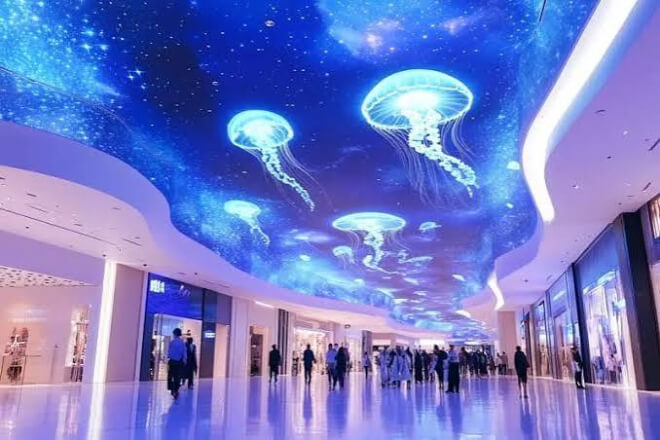
The visual comfort of an LED canopy screen is not determined solely by hardware; content design is equally critical.
In some projects, the focus is placed heavily on the screen’s surface area and visual impact, while the audience’s actual needs are overlooked.
The result is a screen that displays complex, dynamic imagery from morning till night; while the space may appear lively, viewers may not necessarily feel inclined to linger.
Effective content planning should consider the space’s function and audience behavior.
In commercial complexes, the type of content displayed can be tailored to different times of day.
During peak business hours, one might incorporate more engaging, dynamic visual elements.
Conversely, in lounge areas or during periods of lower foot traffic, the content could feature a more relaxed pace and softer color palettes.
In settings such as hotels, airports, and high-end commercial spaces, LED canopy screens can utilize imagery of natural landscapes, abstract light and shadow, or slow-motion dynamic designs to minimize unnecessary visual stimulation.
Color schemes also warrant careful attention. Overly saturated colors, large areas of high-contrast hues, and frequently shifting color combinations can make the visuals appear chaotic.
Incorporating “negative space” (blank areas), limiting visual elements, and maintaining a consistent visual style can make the content more accessible and pleasant to view.
Furthermore, avoid prolonged displays of highly stimulating imagery, such as rapid, high-frequency flashing or intense, alternating light-and-dark patterns.
For commercial projects intended for long-term operation, the content team should establish clear playback guidelines and regularly review media assets, rather than chasing stronger visual impact with every update.
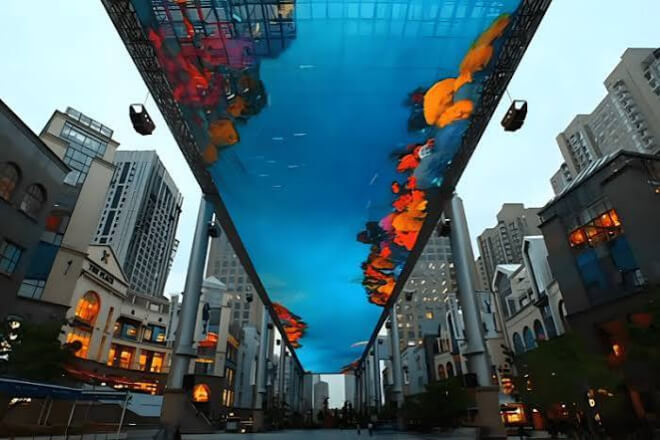
One of the primary differences between an LED canopy screen and a standard wall-mounted LED display is that the former is positioned directly above the viewers.
When viewing a ceiling-mounted LED display (often called a “sky screen”), the audience typically has to look upward.
Factors such as the viewing angle, duration of exposure, and the spatial structure all influence the visual experience.
If the design is poorly executed, even a screen with excellent display quality can cause discomfort.
Therefore, an analysis of the space and visual flow should be conducted during the project planning phase.
First, consider the screen’s installation height and coverage area.
A larger screen area is not necessarily better, and not every inch of the overhead space needs coverage.
Designers should evaluate the architectural structure, audience activity zones, and primary lines of sight to determine an appropriate display area, ensuring the screen does not overwhelm the visual space.
Second, ensure that the screen’s form aligns with the visual content.
For curved or arched LED screens, adapt content and test displays in advance to prevent unnatural stretching, aspect ratio distortion, or visual misalignment.
Attention should also be paid to the coordination between the screen and surrounding lighting.
For instance, intense decorative lighting beneath the screen can create unwanted competition between light sources.
Thoughtful ambient lighting planning allows the displayed content to integrate more naturally with the architectural space.
Finally, it is recommended to conduct on-site testing before the project is handed over.
Have people view the content from various locations to assess brightness, color, motion effects, and viewing angles.
Pay special attention to the viewing environment as experienced by the elderly, children, and those who may remain in the space for extended periods.
For corporate decision-makers, while this step may increase the project workload, it helps the team identify issues before official operations begin and reduces the cost of later adjustments.


 English
 Español
 简体中文
 Français
 日本語
 한국어
 العربية