

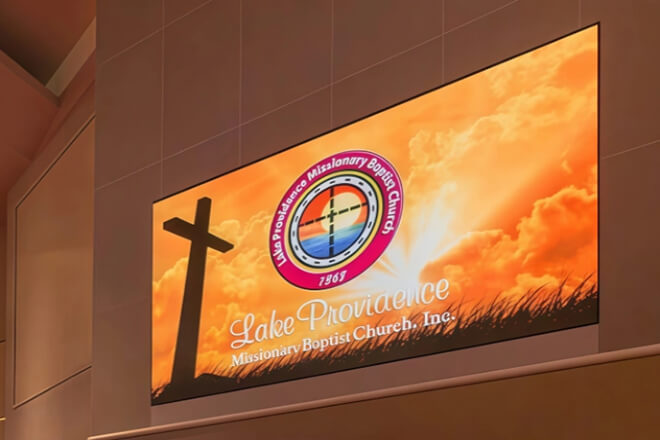
In worship, the most common minor embarrassment isn’t “not understanding,” but rather—”just turning to the previous page, and the next verse has already started.”
The role of pantallas LED is to transform this “race against the rhythm” experience into a unified rhythm of “everyone looking at the same screen.”
Firstly, hymn lyrics and scriptures can be displayed in real time on a large screen. For example, when singing a familiar but somewhat long hymn, previously you might have had to look down to flip through the hymnbook;
Now you can look up and see the next line, eliminating even the “page-turning anxiety.” Those sitting in the back rows don’t need to squint to find the words; they can simply look at the large screen.
Secondly, the worship service process can be updated synchronously. For example, “Next segment: Prayer” or “Next is the special hymn offering.”
The screen switches, and everyone knows what to do, avoiding the “out-of-sync” situation where some are still searching for songs while others have already started praying.
Even more interestingly, the LED display reduces the need for whispered requests for help, such as: “Which song are we singing now?” or “What’s the next section?”—previously relying on word-of-mouth, now the screen provides a unified answer.
To give a more relatable example: Previously, it was like “everyone holding different versions of the instruction manual and trying to understand it”;
Now it’s like “everyone watching a large screen broadcasting the instruction manual,” instantly creating a much more synchronized flow.
In short, the LED display transforms “everyone looking at their own thing” into “everyone following a single screen.”
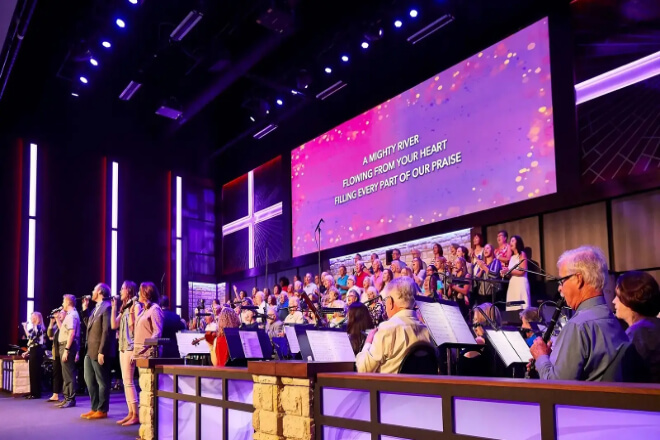
If clear information solves the problem of “understanding,” then atmosphere creation solves the problem of “whether you’re truly engaged.”
First, LED displays can work in tandem with lighting and music to create a unified mood throughout the space.
For example, during hymn performances, the screen gently displays soft images, the lighting gradually warms.
And the music unfolds layer by layer, naturally evoking the atmosphere without needing further explanation.
Second, during holidays or special ceremonies, the screen can display corresponding themed content.
For instance, during Christmas and Easter, the background visuals switch to festive elements, making the event feel less like a ritual and more directly conveying the meaning of the holiday. It’s as if the space itself is participating in the celebration.
Simultaneously, LED displays enhance the visual solemnity of a space. Traditional spaces may rely on decoration and structure.
But LEDs, through dynamic yet restrained visuals, can create a more unified and layered feel, rather than a static background.
Even more interestingly, this change can improve focus. For example, a waiting period that might normally lead to distraction can be transformed into a moment of quiet contemplation as the screen subtly changes the atmosphere, drawing the viewer into the moment.
To give a very intuitive example: it’s like before it was “listening to music + seeing a static background,” now it’s “the music is flowing, the visuals are breathing,” the entire space seems to be uniformly “lit up with a rhythm.”
Simply put, it can be summarized as: LED displays upgrade the sense of ritual from “looking at the setup” to “being surrounded by the atmosphere.”
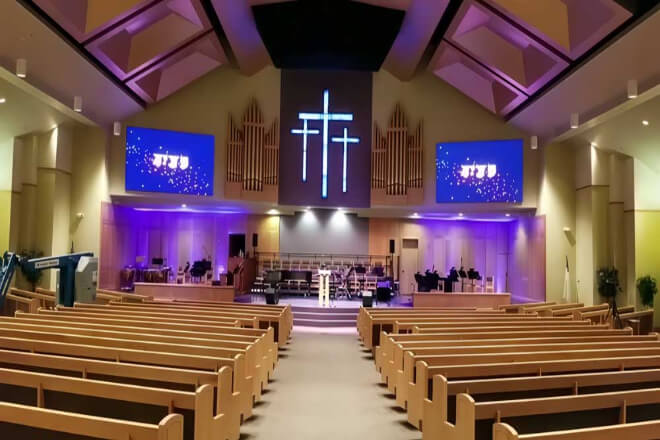
In a diverse community, the most realistic scenario for worship is often: for the same song, some people sing it fluently, while others are still struggling to understand the first line of lyrics.
The role of LED displays is to transform this problem of “a slight language barrier” into “everyone understanding it together.”
First, simultaneous multilingual display is the most direct help. For example, a passage of scripture or hymn lyrics can appear on the screen simultaneously in Chinese + English (or even more languages).
There’s no need to switch versions in turn, nor is there a need for “whoever understands, translates it.” Everyone can simply look up and get what they need.
Here’s a very real scenario: A new expat might have previously only been able to nod along with the atmosphere, but now, looking up at the screen.
They can see English subtitles and suddenly find themselves singing along—the sense of participation is completely different.
En segundo lugar, pantallas LED are well-suited for daily use in multicultural communities. For example, in some churches, one side has long-term members, and the other side has newcomers.
Previously, there might have been instances where people didn’t realize what was happening until the announcement was over.
Now, the screen displays information in both languages simultaneously: event time, schedule, reminders—all clearly displayed.
Even more interestingly, it reduces some awkward small interactions. For instance, someone might have quietly asked the person next to them, “Which part are we singing now?” Now, everyone just looks at the screen and can keep up without needing to ask for help.
To give a more vivid analogy: before, it was like “everyone was listening to the same content, but some were listening to the original audio while others were trying to guess the plot”;
Now it’s like “the whole audience is watching a live stream with multilingual subtitles on the same screen.”
In short, the function of LED displays is to allow people with different languages to participate in the same activity at the same pace.
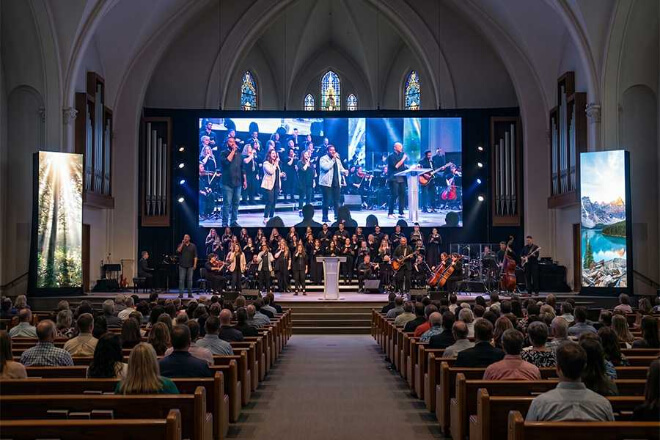
Many churches have long since transcended their role as mere “places of worship,” becoming more like community information centers.
The addition of LED displays transforms these “bulletin boards” into illuminated, constantly updated community screens.
First, they can be used to publish community events and public service information. For example, information on free clinics, charity fundraising, children’s activities.
And holiday gatherings is no longer limited to verbal announcements or paper flyers; it’s directly displayed on the large screen, making it easily visible to passersby.
For a relatable example: after Sunday service, while people are still chatting, the screen is already scrolling through next week’s community events:
“Wednesday Volunteer Cleaning Day,” “Saturday Family Gathering”—ensuring no one reminds them and preventing them from missing anything.
Second, LED displays are ideal for displaying church announcements and volunteer service information.
For instance, volunteer recruitment, service time adjustments, and special event reminders can all be clearly and repeatedly displayed, making them more reliable than relying on “one-time forgetting.”
Furthermore, LED displays can enhance community cohesion. When familiar activities and faces (such as volunteer photos or event recaps) repeatedly appear on the same screen, people are more likely to feel, “This is a place we all participate in.”
More interestingly, this method can also make information dissemination “active rather than passive.”
Previously, it was “someone speaks, someone relays”; now, “everyone sees it as they walk past the screen,” as if the information is flowing through the community itself.
To give a more intuitive analogy: before, it was like “a notice posted in a corner, requiring special searching”; now, it’s like “information plays automatically at the entrance, reminding passersby.”
Simply put, LED displays have transformed information dissemination in churches from “someone relaying messages” to “the space speaking for itself.”
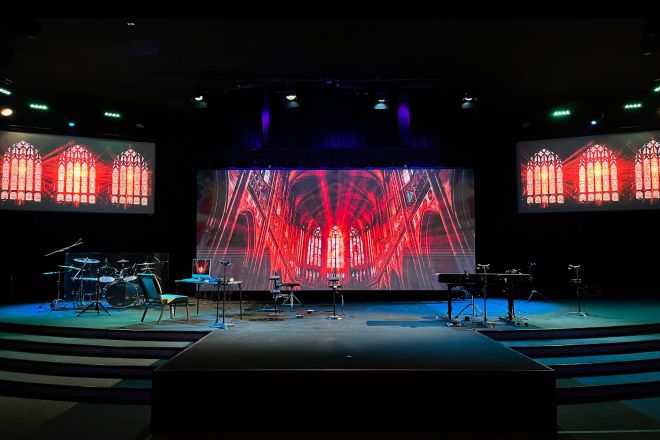
Many changes in European and American churches are not actually about “becoming more complex,” but rather transforming from static spaces into renewable spatial systems.
First, it is gradually replacing traditional projections and static screens. Previously, it might have involved a projector, a screen, and printed lyrics sheets.
Now, it’s replaced by a full-screen Pantalla LED. Content can be changed instantly without adjusting focus, replacing paper, or worrying about visibility issues under bright lights.
To illustrate, before services, staff had to adjust the projector and confirm the lyrics; now, a simple click on the control system automatically switches the entire content—from hymns to scripture to announcements—all in one click.
Secondly, it enhances the church’s modern image. Many young people entering a church for the first time naturally have expectations about the visual experience.
A well-designed yet clear LED screen makes the space appear cleaner and more organized, rather than “stuck in an old-fashioned projection environment.”
Furthermore, it supports flexible content updates and management. For example, holiday decorations, themed services, and community events can all have their content changed quickly without reprinting or rearranging visual materials, making operations much lighter.
More interestingly, this upgrade makes the church’s “information expression” more like a modern media space, rather than a traditional static venue.
For example, the same screen can be used for worship lyrics in the morning, community event announcements in the afternoon, and even special ceremonies in the evening.
Finally, LED displays are adapting to the trend of integrated online and offline communication.
Many churches now broadcast worship services live, and the LED screen itself becomes the core visual background of the live stream.
Allowing online viewers to see a unified, clear, and modern image, rather than simply “a camera filming a projection screen.”
To give a more vivid example: previously, “offline churches + online live streams were two different worlds”; now it’s more like “the same visual system serving both the people on-site and those on the other side of the screen.”
Simply put, LED displays have transformed the digital upgrade of churches from “replacing equipment” to “updating the entire information system.”


 English
  Español
  简体中文
简体中文  Français
  日本語
日本語  한국어
한국어  العربية