
Introducción
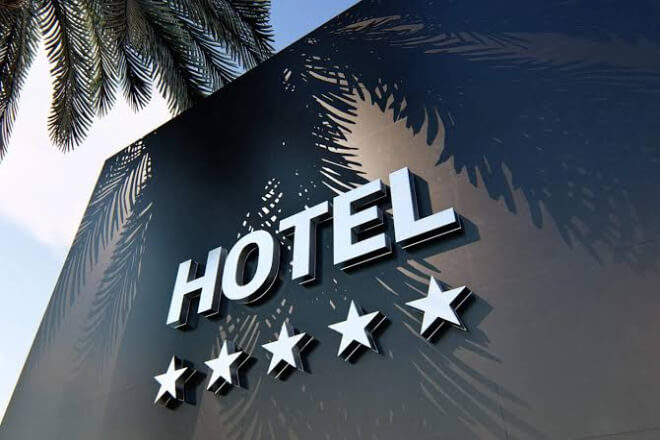
El hotel lobby is the first thing guests see upon entering the hotel.
Si una Pantalla LED simply hangs quietly on the wall, it might only be considered “having a screen”;
But if it curves along the wall, blends into the glass, and even changes shape with the guests’ movements, the effect is completely different.
Today, LED displays in hotel lobbies are evolving from simply “playing content” into an integral part of the spatial experience.
Tabla de contenido
1. Curved LED displays

What’s the worst thing for a hotel lobby? A meticulously designed curved wall, suddenly interrupted by a square LED display.
The space is clearly designed for luxury, but the screen looks like it was “temporarily placed.”
Curved LED displays solve this problem perfectly. They can extend along curved walls, reception backdrops.
And other architectural structures, seamlessly connecting the screen with the space.
Continuous images also create a stronger sense of visual immersion.
For example, high-end hotels can display flowing water, city skylines, or natural landscapes, allowing guests to immediately feel the atmosphere of the space upon entering.
This design is particularly suitable for the lobbies of high-end hotels, resort hotels, and branded hotels.
In real-world projects, solutions combining flat LED displays with 120° curved LED displays have emerged.
By connecting screens at different angles, the overall background gains more depth.
In this way, the Pantalla LED no longer appears as a “device mounted on the wall,” but rather as if the wall itself has suddenly learned to display content.
The architecture defines the shape; the LED display brings that shape to life.
2. Columnar/cylindrical LED displays

With so many columns in a hotel, it’s somewhat wasteful to simply “support the roof.” Why not let the columns also “support the visual appeal”?
Columnar or cylindrical LED displays can be directly integrated around existing columns to create digital display surfaces, transforming ordinary building structures into content-playing LED screens.
Compared to traditional flat screens that only face one direction, cylindrical screens can achieve 360° or multi-directional displays.
Ensuring guests have a chance to see the content whether they are approaching from the lobby entrance, rest area, or elevator direction.
For example, the pillars in a hotel atrium can display slowly flowing natural landscapes, switch to holiday themes for festivals, and showcase event information or brand content during events.
Especially for hotels with many pillars in the space, instead of trying to hide them, it’s better to make them a visual part of the environment.
This design is also particularly suitable for open public areas because the screen doesn’t need to “take up a wall” but directly utilizes the existing spatial structure.
Previously, it was about “walking around the pillars”; now it can be—the pillars themselves become “businesses.”
3. Transparent LED displays

Glass curtain walls in hotels are meant to make the space appear more transparent.
Suddenly placing a large, ordinary LED display screen would be somewhat like “pasting a blackboard” on a floor-to-ceiling window.
Pantallas LED transparentes are much more flexible. They can be installed on glass curtain walls, glass partitions, etc.
Preserving natural light and a sense of openness while displaying brand, event, and visual content.
For example, the glass curtain wall at the hotel entrance can remain light and transparent during the day, allowing sunlight to continue to stream in;
At night, the transparent LED display lights up, transforming the ordinary glass facade into a giant brand display.
The lobby atrium can also display slowly flowing artistic images, giving guests the immediate impression that “this hotel is a little different.”
For high-end hotels, this is especially suitable for designs that want the visual impact of LED displays without sacrificing the sense of space.
Simply put, a regular LED display is like placing a screen in a space; a transparent LED display is more like letting the glass itself “speak and emit light.”
4. Creative irregularly shaped LED displays
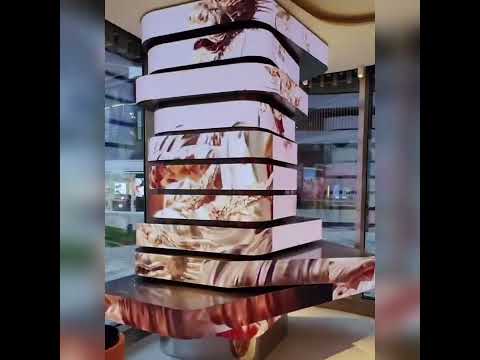
Si el hotel logo is a leaf, does the LED display have to be a square “television”?
Creative irregularly shaped LED displays can be customized to the hotel logo, brand symbols, or even the lines of the building itself.
For example, waves, rings, free curves, and even bolder, unique structures transform the LED display from an ordinary backdrop into an art installation within the space.
For example, hotel design could incorporate a curved or wave-shaped LED display screen, allowing the image to flow naturally with the building’s lines.
Luxury hotels could integrate the brand logo’s outline into the LED display installation, making the visual symbol instantly memorable for guests.
When hotels hold new product launches or themed events, the same irregularly shaped screen can be used to display different content, continuing to serve its purpose.
In this way, the LED display screen is no longer just a backdrop “responsible for displaying images,” but directly participates in spatial design.
Truly valuable irregularly shaped LED displays are not simply about making the screen oddly shaped.
But about making the design appear as it was meant to be when it’s integrated with the architecture and brand visuals.
5. Interactive/immersive LED displays
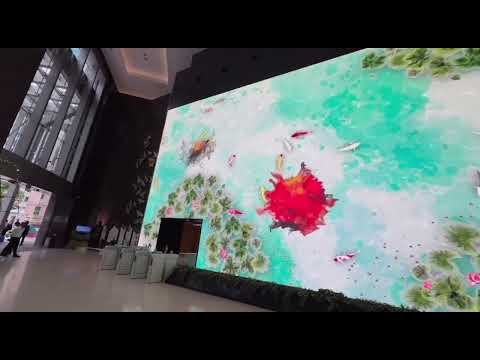
If an LED screen only displays images, guests glance at it and leave. But if the screen “responds” to a guest’s approach, the experience is immediately different.
Interactivo pantallas LED can combine cameras, sensors, and other devices to change the image in real time based on the guest’s approach, movement, or even interactive actions.
Por ejemplo, una hotel lobby can feature a digital art screen where light points on the screen move with guests as they approach;
Branded hotels can have welcome animations unfold in sync with guest movements, or even turn the brand story into a mini-interactive experience.
Moreover, it’s not just suitable for everyday displays. When hotels host press conferences, weddings, or brand events.
The same LED display can switch to become the event’s main visual, a live animation, or an immersive background.
Today it’s a digital art wall welcoming guests; tomorrow it might become a “dream backdrop” for a wedding.
LED displays are no longer just about “playing” content; they’re starting to “interact” with guests.
When the screen responds to people, guests are more likely to become part of the experience rather than just passive observers.
6. Conclusión
Choosing an LED display for a hotel lobby isn’t simply about “bigger is better.”
Sometimes, a slightly curved, translucent, or unique screen can be more memorable.
A good, creative LED display isn’t just about displaying images; it’s about making guests feel, “This hotel is different,” from the moment they enter.
Finalmente, por favor contáctenos if you would like to learn more about LED displays.


 English
  Español
  简体中文
简体中文  Français
  日本語
日本語  한국어
한국어  العربية