
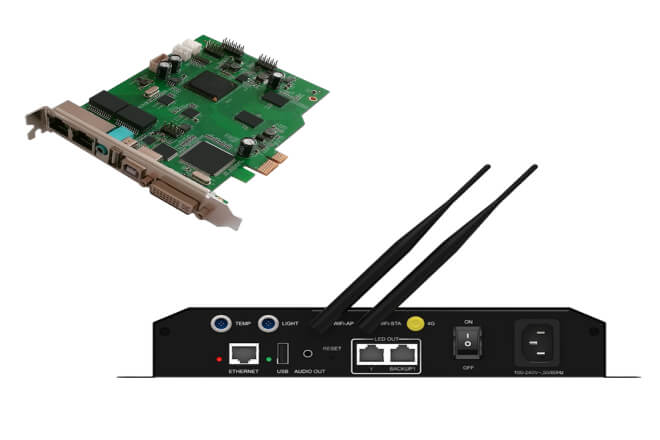
When purchasing pantallas LED, what do you focus on first? Screen size, pixel pitch, brightness, or price?
These are certainly important, but there’s another crucial part that’s easily overlooked—the control system.
It’s like the “brain” of the LED display, responsible for receiving, processing, and transmitting the displayed content.
Even with the best screen configuration, an unsuitable control system can prevent it from achieving its intended display effect.
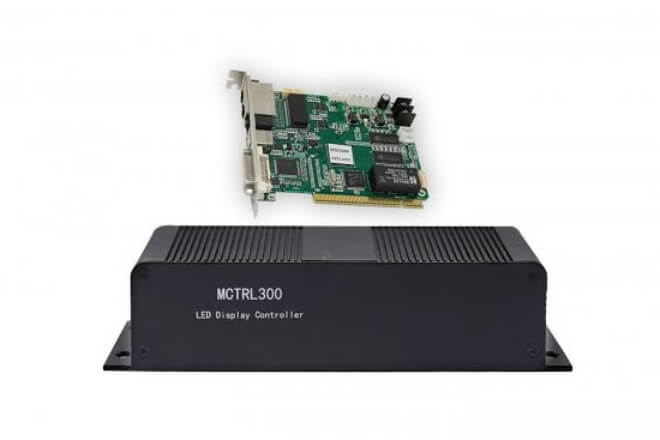
Simply put, the LED display control system is responsible for converting video, images, text, and other content into display signals that the screen can recognize.
And then transmitting them to the display modules according to the set requirements, ensuring that each pixel accurately presents the corresponding image.
A typical Pantalla LED control system usually includes transmitting equipment, receiving equipment, and related control software.
The specific composition and functions of different systems may vary, but the basic task is to coordinate content input, signal processing, and image output.
You can think of it as a performance: the video content is the program, the Módulos LED are the actors on escenario.
And the control system is the director responsible for scheduling when each actor appears and what actions they perform.
If the director doesn’t clearly convey instructions, the visuals on stage will naturally become chaotic.
The control system primarily undertakes the following tasks:
Recepción de señal: Receives content transmitted from computers, players, or other video devices.
Image processing: Processes image data and output parameters according to display requirements.
Data distribution: Sends display data to the corresponding receiving devices and display areas.
Screen control: Coordinates the display content, brightness, and related parameters of different areas.
Device management: Some systems also support status monitoring, remote management, and fault indication.
Therefore, the control system is not a dispensable accessory to an LED display screen, but a crucial component ensuring the normal operation of the entire display system.
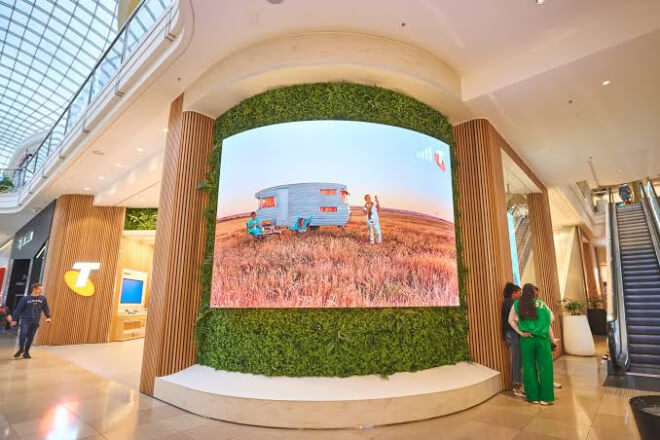
Why might two LED displays with similar hardware configurations offer different user experiences?
Besides the LED chips and driver ICs, the configuration of the control system is also a significant factor.
First, image clarity and display effect.
The control system needs to correctly process input signals and match the screen’s resolution, aspect ratio, and output format.
If the input signal does not match the screen specifications, problems such as image stretching, abnormal aspect ratio, or incomplete display may occur.
For example, a company installs an LED display screen in its conference room to showcase product design drawings and data reports.
If the control system cannot correctly handle the input resolution, the originally clear text and charts may not display as expected.
Second, frecuencia de actualización and grayscale performance.
The control system needs to work in conjunction with the driver IC, scanning method, and display modules to achieve the appropriate refresh rate and grayscale performance.
This matching is especially important for scenarios such as stage performances, sporting events, and studios.
Third, multi-screen synchronization and image coordination.
If a project uses multiple pantallas LED, or needs to divide a large screen into multiple display areas, the control system needs to have corresponding image management and synchronization capabilities.
Otherwise, problems such as image asynchrony, content misalignment, or unreasonable allocation of display areas may occur.
Fourth, operation management and stability.
Some control systems support equipment status monitoring, anomaly alerts, and remote management.
Helping staff to understand the equipment’s operating status in a timely manner and reducing the difficulty of troubleshooting.
It is important to note that the control system does not determine all display performance alone.
The final effect also depends on the LED chips, driver IC, power supply design, module structure, and overall system configuration.
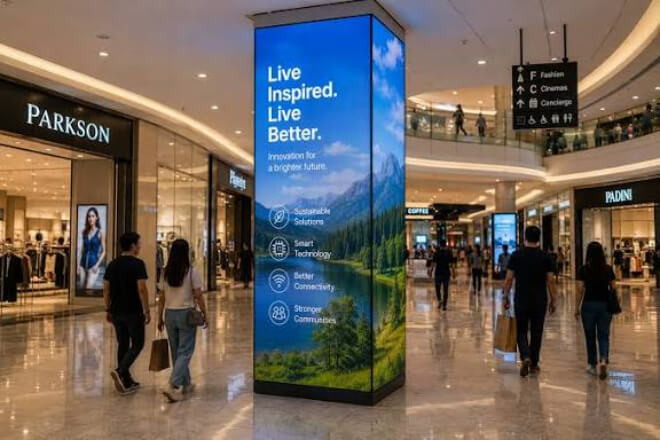
Not all pantallas LED require the same control system. Just as office computers and large data processing equipment have different uses, control systems need to be selected based on project requirements.
- Corporate conference rooms: Simplicity of operation and signal compatibility are paramount
Conference rooms typically require connections to computers, video conferencing equipment, and other signal sources.
When purchasing, attention should be paid to input interfaces, resolution support, signal switching, and ease of operation to avoid requiring technicians to be on-site for debugging at every meeting.
- Deportes venues: Multi-area management and real-time display are indispensable
Sports venues may simultaneously use the main display screen, surround screens, and other information screens, requiring different display tasks to be assigned to different areas based on the game content.
The control system should have sufficient output capacity and corresponding synchronous management functions.
- Commercial advertising: Content updates and remote management are more critical
Shopping malls, shopping centers, and outdoor advertising projects frequently require changes to advertising content.
If the control system supports network management, scheduled playback, and remote updates, operators can more easily arrange advertising content without having to be on-site every time.
- Escenario performances: Signal processing and on-site coordination are important
Stage projects typically require video playback, dynamic backgrounds, and visual effects, and may involve multiple display areas.
The control system needs to be compatible with the on-site video equipment and playback flow to ensure the visuals are presented correctly according to the performance schedule.
- Command center: multi-signal access and unified management are key
The command center needs to simultaneously display maps, monitoring screens, and data charts;
Therefore, it’s crucial to focus on multi-signal access, screen splitting, signal switching, and system scalability.
Clearly defining the actual application scenario before procurement is essential to avoid spending money on unnecessary features or hindering project operation due to insufficient functionality.
Inappropriate control system configuration may not cause problems on the day of installation.
Some issues may only gradually emerge when the equipment is put into use, playing complex content, or when new equipment is added.
For example, a commercial enterprise purchased a large LED advertising screen, initially considering only basic video playback functionality.
Later, the enterprise wanted to add remote content updates and scheduled playback.
But found that the existing system could not meet the requirements, necessitating the purchase of additional equipment or even adjustments to the entire solution.
Common problems include:
Signal incompatibility: Incompatibility between input devices and control system interfaces or signal formats leads to display failure.
Image abnormalities: Incorrect resolución, display ratio, or output parameter settings cause image distortion or incomplete display.
Multi-screen asynchrony: Lack of a suitable synchronization solution between multiple screens affects the overall display effect.
Operación compleja: The system interface and management methods do not conform to actual user habits, increasing the operational burden on staff.
Difficulty in expansion: The existing system may not be able to support future increases in screen area, signal sources, or management functions.
These problems not only affect the display effect but may also increase later procurement, debugging, and maintenance costs.
Therefore, companies should consider future needs during the procurement phase, rather than discovering that the system is insufficient after the project is put into use.
After understanding the importance of the control system, purchasers also need to know how to determine whether a system is suitable for their project.
It is recommended to focus on the following aspects:
First, confirm the signal input and output capabilities.
First, confirm the system’s supported interface types, input formats, and output resolutions based on the actual signal sources used.
Such as computers, media players, and cameras, and verify the actual connection methods.
Second, check the screen resolución and load capacity.
The control system needs to be able to handle the pixel data of the entire LED display screen.
When purchasing, confirm the load capacity of the transmitting and receiving devices, and whether the system supports the current screen size and resolution.
Third, ensure the functions meet application requirements.
If the project requires multi-window display, timed playback, remote management.
Or multi-screen synchronization, confirm in advance whether these functions are supported and whether additional software or hardware is needed.
Fourth, consider future expansion capabilities.
If the company plans to increase the display area or connect more signal sources, it’s best to assess the system’s expansion capabilities in advance to avoid replacing the entire system later.
Fifth, understand technical support and after-sales service.
Control systems involve hardware, software, and signal configuration; professional assistance may be needed when problems arise.
Before purchasing, understand whether the supplier provides installation and commissioning, operation training, troubleshooting, and subsequent upgrade support.
Most importantly, do not make a decision solely based on the brand or model of the control system.
To determine the true suitability of a system, it’s essential to have suppliers provide complete solutions tailored to the specific screen parameters and usage scenarios, followed by on-site or simulated testing.


 English
 Español
 简体中文
 Français
 日本語
 한국어
 العربية