
Many Pantalla LED projects don’t suffer from “inadequate products,” but rather from “misguided design from the outset.”
Incorrect size selection, excessive brillo, mismatched content… these seemingly minor issues often become magnified after project implementation.
Therefore, more important than “choosing the right screen” is avoiding these common pitfalls.
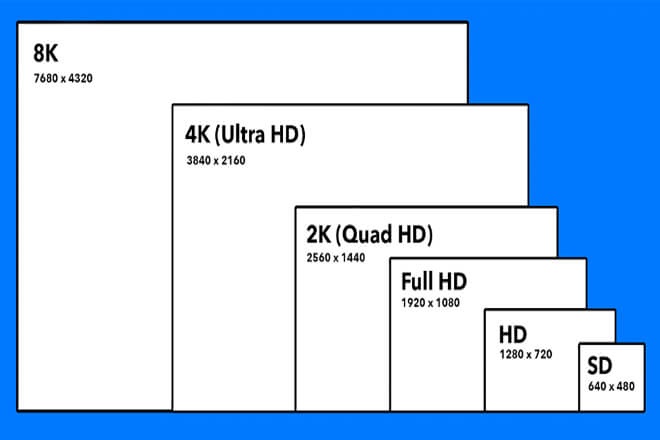
Many people’s first reaction when choosing an LED display is: “The bigger the better, the more impressive it looks.”
However, the reality is—a larger screen doesn’t necessarily mean clearer images, and may even be more of a “waste of potential.”
What truly affects the viewing experience isn’t just size, but the relationship between viewing distance and pixel pitch.
First, a larger screen doesn’t necessarily mean better results. If the viewing distance is close, an overly large screen can easily make image details appear “obviously rough,” even creating a sense of visual oppression.
Viewers standing close don’t see a stunning effect, but rather “pixels working hard.”
For example, installing a super-large outdoor-grade LED screen in a conference room might feel to those sitting in the front row that.
While the image is large enough, the details are somewhat blurred, offering no improvement in the viewing experience.
En segundo lugar, la distancia de visualización determines the tamaño de píxel selection. The clarity of an LED display largely depends on the pixel pitch.
The closer the distance, the smaller the pixel pitch needed; the farther the distance, the larger the pixel pitch can be.
If the two are mismatched, it’s easy to end up with “seeing the dots but not the image.”
For instance, if a large pixel pitch screen is used in an indoor exhibición hall, viewers will clearly see graininess when viewing closely.
While in a stadium setting, where viewing is done from a distance, a small pixel pitch screen is less cost-effective.
More importantly, the size needs to match the scenario. Different scenarios have different visual requirements:
Conference rooms emphasize clear reading, shopping mall atriums emphasize attracting attention, and stadiums emphasize long-distance visibility.
If you only focus on “size” and ignore the usage environment, you’re likely to end up with “a large screen, but uncomfortable to use.”
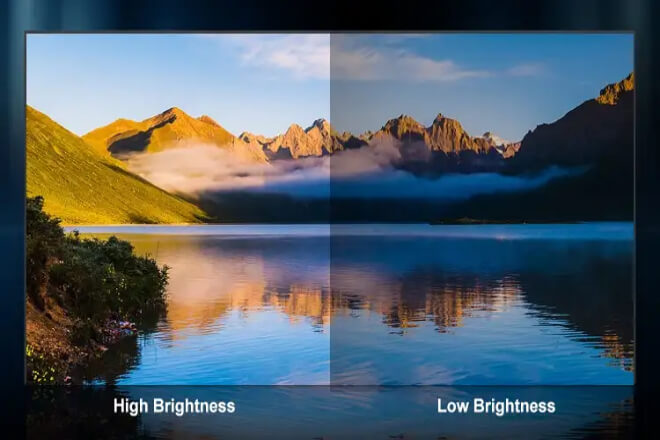
Many people have a simplistic aesthetic when choosing LED displays: the brighter the better, the more sophisticated the display.
However, the reality is often that if the brightness is “overdone,” the viewer’s first impression isn’t so much so that it’s “overworking their eyes.”
First, indoor and outdoor brillo requirements are completely different.
Outdoors, higher brightness is indeed needed to combat sunlight, but if the same “outdoor high-brightness configuration” is used indoors.
The effect will be—it’s fine during the day, but at night it feels like looking at a screen with its own built-in supplemental lighting.
For example, if a centro comercial has an ultra-bright screen, once the mall lights are off at night, the screen becomes the “visual centerpiece.”
Passersby’s first reaction isn’t “The content is so clear,” but rather “Is this screen giving me eye strain?”
Second, excessive brightness easily causes visual fatigue. The human eye has a “tolerance limit” for high-brightness images. It may feel impressive for a short time, but over time, it begins to protest:
Blinking becomes more frequent, attention span decreases, and even the viewing interest automatically diminishes.
For example, in a press conference, the content is crucial, but if the screen brightness is too high, the front-row audience will be squinting throughout the event.
They might not remember the presentation content, but rather, “That screen was really glaring.”
More importantly, different scenarios require different parameter configurations. Conference rooms, shopping malls, stadiums, and exhibition halls all have different lighting conditions.
If you blindly pursue “the brightest of all,” you risk “turning on the right light in the wrong setting.”
For example, using outdoor-level brightness in a conference room is like having a meeting in an office with spotlights on—the atmosphere is great, but attention might be drawn away by the light first.
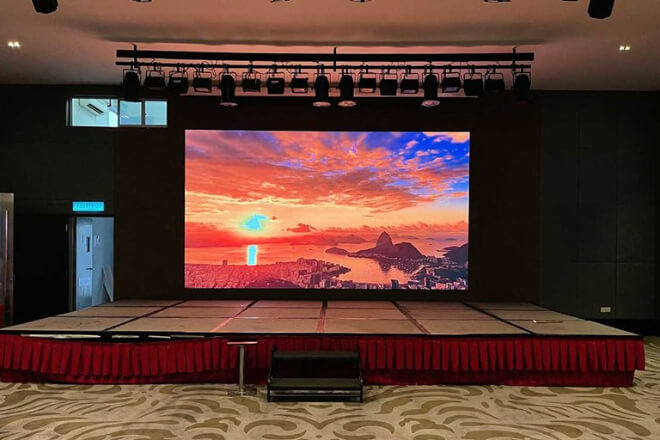
Many people prioritize “equipment” when designing LED display solutions:
Is the pixel count high enough?
Is the frecuencia de actualización fast enough?
Is the screen clear enough?
A set of parameters gives them peace of mind.
However, the final on-site effect might be summed up in one sentence: the screen is top-of-the-line, but the content looks haphazardly done.
First of all, a good screen also needs good content to support it. The role of an Pantalla LED is to “amplify information,” but it doesn’t automatically make the information look better.
If the content itself is logically flawed, even the most advanced screen will only amplify the chaos.
For example, a large ultra-high-definition screen in a centro comercial might display promotional information.
But the screen simultaneously includes “discount details, event rules, brand introduction, and a QR code.”
Viewers standing at a distance will only have one unified feeling—”I saw it, but I don’t know what I saw.”
Secondly, font, color, and layout affect the effect. Many people are used to directly “copying” PPTs or posters onto the screen.
But LED screens are viewed from a greater distance and in a more complex environment. Without redesign, the problem of “not being able to see the key points” easily arises.
For example, a promotional advertisement with small light gray text superimposed on a complex background might look fine on an office computer.
But on a shopping mall screen, it becomes: “I know you wrote the words, but I need to get closer to understand them.” The communication efficiency is directly reduced.
More importantly, inappropriate content reduces communication efficiency.
The same message, if optimized according to LED logic (large font, strong contrast, less information, clear rhythm), might be understood in 3 seconds.
But if the original design is copied verbatim, viewers may need to “stop and read carefully.” In reality, viewers of large screens usually don’t stop watching.
To illustrate this more directly: Optimized version: “Limited time offer: 3 hours, 50% off everything”—easy to understand at a glance.
Unoptimized version: A screen densely packed with promotional information—just “too much information, but forget it.”
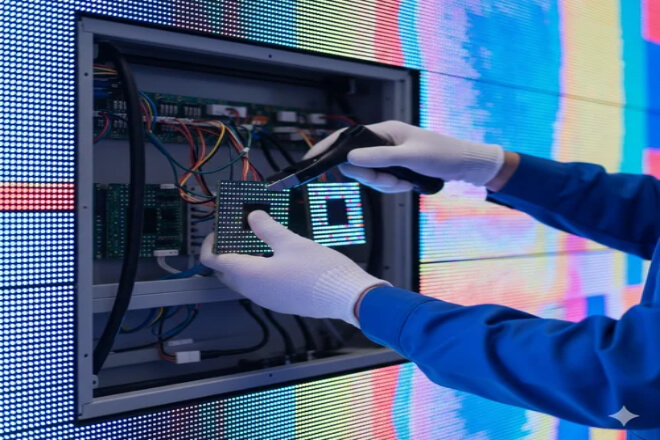
Many LED display projects initially adopt the approach of “install the screen first, then worry about repairs.”
However, during later maintenance, it’s discovered that the problem isn’t the screen itself, but rather the difficulty in repairing it.
Firstly, there’s insufficient space for maintenance.
If enough space isn’t reserved during installation, maintenance personnel will find themselves in an awkward situation where they can’t reach or access their tools if a module or fuente de alimentación malfunctions.
For example: A large screen in a centro comercial atrium is installed compactly and looks neat, but once a section went black.
Repairs required disassembling half of the structure—what should have been a 10-minute task turned into a “half-day project.”
Secondly, the installation structure affects safety. LED screens are inherently heavy, and an improperly designed support structure can lead to long-term safety hazards.
Especially in high-altitude, suspended, or large outdoor LED screen applications, structural design isn’t just about aesthetics, but about stability.
For example, some projects, in pursuit of a minimalist look, completely conceal the support structure, only to find during later maintenance that the load-bearing points are unclear, requiring additional reinforcement—a costly and time-consuming process.
More importantly, neglecting heat dissipation and power supply layout is a significant issue. LED screens generate heat during continuous operation.
Insufficient ventilation will cause internal temperatures to rise, directly impacting stability and lifespan. Similarly, an improper power supply layout can increase the failure rate.
To illustrate with a more relatable analogy: imagine stuffing a computer into a completely enclosed cabinet.
It might work initially, but over time, it will likely overheat and trigger an alarm. The same principle applies to LED screens; they need “breathing space.”

Many LED display projects often involve a classic dialogue during decision-making:
“How much is this?”
“Let’s choose this one if it’s cheaper.”
Then, a few years later, the question arises: “Why did it cost more later than initially?”
The problem often lies in only considering the “purchase price,” not the “usage price.”
First, long-term maintenance costs are easily underestimated. LED screens are not “installed and done” devices.
Module replacements, system maintenance, and inspection services are all ongoing costs.
If only the lowest-priced option is chosen initially, the total cost will actually increase with frequent repairs later.
For example, A shopping mall advertising screen might be purchased 20% cheaper, but after a year of operation, it frequently experiences partial malfunctions.
Each repair requires labor, spare parts, and downtime losses—in the end, the money saved may have been “quietly given back.”
Second, energy consumption affects long-term budgets. Different LED screen configurations have significant differences in power consumption.
Especially in long-term operating scenarios (Centros comerciales, publicidad exterior, estadio screens). Electricity costs are a continuously accumulating cost.
For example, consider two screens of similar size. One features an energy-efficient design, while the other uses a traditional, high-energy-consuming solution.
The difference in electricity costs might not be immediately apparent, but after a year or three, the difference could translate into a substantial bill.
More importantly, stability determines the actual return on investment. The less stable the equipment, the more maintenance, downtime, and lower effective utilization.
Seemingly inexpensive equipment may have its actual value diminished due to constant repairs.
For instance, an advertising screen might be inexpensive, but if it frequently goes black or displays abnormal colors.
Advertisers will have a poor experience and be less willing to continue advertising, ultimately impacting not only equipment costs but also overall revenue.


 English
  Español
  简体中文
简体中文  Français
  日本語
日本語  한국어
한국어  العربية