

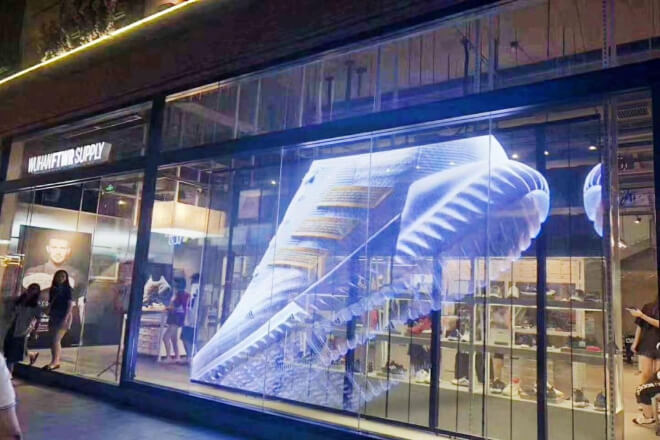
In retail and centro comercial environments, customers’ attention spans are actually very short and scattered. If they can’t grab your eye within seconds, a lot of information will be ignored.
The advantage of pantallas led lies in using dynamic content to turn “passing by” into “stopping to take a look.”
First, videos are more attractive than static posters and are naturally easier to notice. Static posters are “fixed information,” while dynamic videos are “continuously changing information.”
For example, a piece of clothing simply hanging on a poster might be easily overlooked, but if it’s showcased on a screen through a fashion show, rotating close-ups, and styling transitions, it’s much more likely to attract attention.
For example, a customer might simply walk past a store, but be drawn in by the constantly changing dynamic visuals in the window, stopping to look for a few more seconds.
Secondly, it quickly grabs the customer’s attention, establishing a “first impression” in the shortest possible time.
LED dynamic displays, through color changes, rhythmic transitions, and visual impact, can convey information within seconds.
Compared to text or static images, this method aligns better with modern people’s “quick browsing” habits.
Simply put: it’s not that customers aren’t interested, but that you must be seen “faster.”
At the same time, increasing the initial dwell time creates the possibility of subsequent purchases.
If a customer is willing to stop for even a second, there’s a chance they’ll look again; once the dwell time is extended, it’s easier to enter the store, browse, or even make a purchase.
To put it more interestingly: Previously, advertising was “Look closely,” now LED dynamic content is—”I’ll make you take a second look, then I’ll slowly tell you the story.”
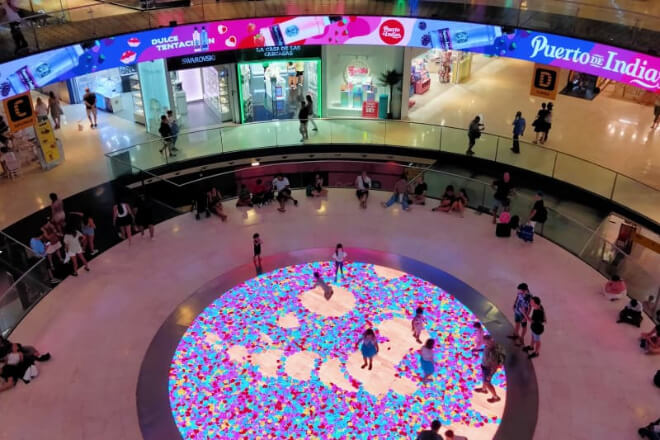
En Centros comerciales and retail spaces, the real value isn’t just “people passing by,” but how long people are willing to stay.
The role of interactive LED display content is to transform a brief stop into a “participatory stop.”
First, QR code scanning activities, interactive games, and on-screen prize draws transform customers from passive viewers into active participants.
For example, customers scan a QR code to participate in a prize draw, with the results displayed in real-time on a large screen.
Or they participate in a mini-game challenge, with the leaderboard directly displayed. This design creates a sense of “I’m already involved.”
For instance, a customer who was just passing by sees a “Scan QR code to win milk tea” sign, scans the code.
And finds their name appearing in the waiting area on the large screen. They don’t leave immediately but continue to follow the results.
Second, enhancing customer engagement transforms the experience from “passive reception” to “active interaction.”
Compared to one-way advertising, interactive content prompts customers to respond, such as clicking, scanning, sharing, or voting.
This feeling of “I did something” significantly increases the willingness to stay.
Simply put, static advertising is “see and leave,” while interactive content is “participate and want to see the results.”
Furthermore, turning “passing by” into “staying” naturally extends the consumption window.
When customers linger longer in front of the screen, they are more likely to be drawn to nearby stores, perhaps stopping by to browse, order a drink, or participate in other activities.
To put it more interestingly: Previously, customers would “glance and leave,” now they’ll “play around first, see how it goes, and maybe take a stroll.”
In modern commercial spaces, customers don’t just “come to shop,” they also want engaging experiences and social capital.
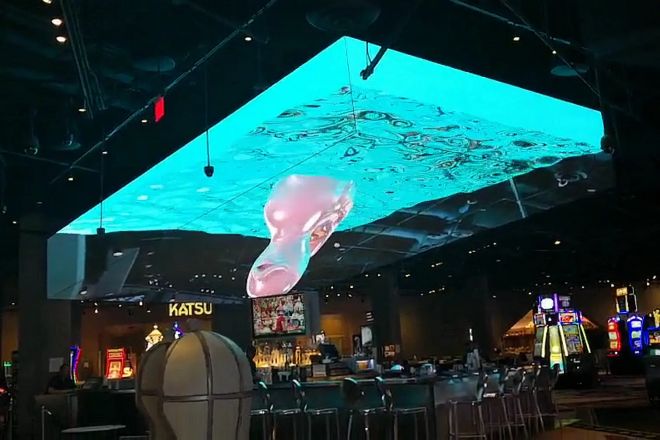
pantallas LED, through creative visual design, can instantly transform ordinary shopping malls or stores into “Instagrammable hotspots,” attracting customers to stop, take photos, and share them.
Primero, 3D a simple vista and immersive content displays create a stunning visual experience. Unlike traditional flat screens, this type of creative content gives customers the feeling that “the image jumps out of the screen.”
Whether it’s numbers floating in the air, rotating product displays, or immersive scenes extending from the ground to the surroundings, they all evoke a direct “Wow!” feeling in customers.
For example, a large LED screen in a shopping mall atrium plays a 3D animation of a swimming whale.
Customers not only stop to watch but also take out their phones to take photos or record videos, sharing them on social media platforms like WeChat Moments or short video platforms. Instantly, the mall is not only seen but also “spread” online.
Secondly, attracting photos and social media sharing extends customer dwell time. To find the best shooting angle, customers will move around, linger, and interact with friends multiple times.
Thus, what might have been a few seconds of passing by can become an experience lasting several minutes, while also increasing their chances of browsing nearby shops.
Simply put, creative visual design not only makes the screen content “seen” but also encourages customers to actively “participate,” creating social interaction.
Furthermore, creating “check-in” scenarios can generate secondary dissemination. When customers take photos and share them, the mall and brand’s exposure expands to online social media platforms, bringing in more potential customers.
To put it more interestingly: Previously, mall advertising was “You see it, that’s it,” but now creative LED content is—”Stop and take a picture, then let your friends be envious.”
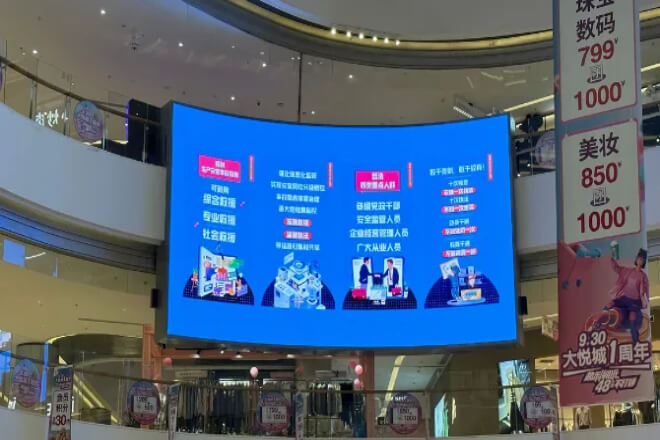
En Centros comerciales and retail spaces, customer attention is often fragmented—a quick glance, a quick browse, and then they’re gone.
LED displays, through real-time information updates, constantly provide customers with “new reasons to stop,” thus extending their stay.
First, the dynamic display of promotions, performances, and new product launches keeps the information fresh.
For example, in the morning, it might be a preview of new product launches; at noon, it might be restaurant deals.
In the afternoon, limited-time discounts; and in the evening, live performance announcements.
This continuous update rhythm makes customers feel like there’s something new every time they look up.
For instance, a customer might initially just be looking at promotional information, but while waiting or browsing, they continuously see new event reminders.
Such as “Limited-time lucky draw starting soon” or “New product experience area open on the 3rd floor,” naturally extending their stay.
Second, it guides customers to explore more areas, making traffic flow within the space.
pantallas led are not only information dissemination tools but also “guide the mall.” For example, prompts might include:
- “The food festival is on the 5th floor.”
- “The children’s interactive area is open for a limited time.”
- “The new brand pop-up store is located in Zone B.”
Simply put, it continuously provides customers with new “place suggestions,” encouraging them to move and explore beyond a single area.
Simultaneously, it increases the length of time customers spend in the mall or store, enhancing overall consumption opportunities.
The longer the dwell time, the more brands customers encounter, and the higher the likelihood of being attracted into the store.
This is one of the key reasons why many shopping malls are willing to invest in LED systems—it’s not just about “broadcasting information,” but about “extending the consumption path.”
To put it more interestingly: Previously, shopping in a mall was like “completing a task at a fixed point.”
Now, with real-time LED information reminders, it’s more like “an exploration game with constantly updated task lines.”
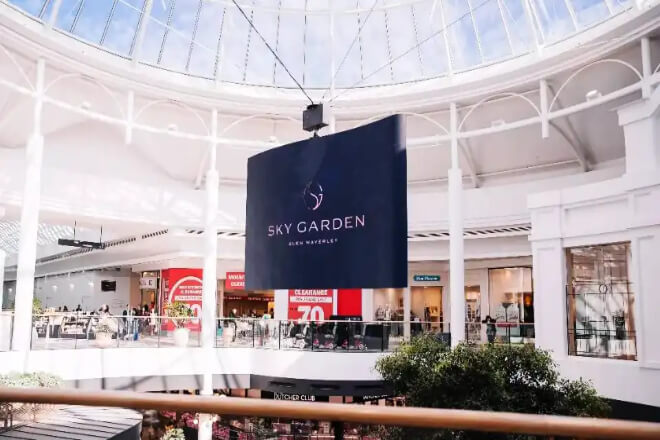
In many Centros comerciales and stores, a common misconception is: “The bigger and brighter the screen, the more attractive it will be.”
But the reality is quite the opposite—what truly determines the effect is not the screen itself, but what is being displayed on it.
First, the length of time spent in a store essentially depends on the value of the content. If the content is just a simple, repetitive advertisement, customers will glance at it and leave.
However, content with rhythm, a story, and visual impact is more likely to keep them lingering for seconds or even minutes.
For example, consider two pantallas led: one simply repeating “promotional discounts,” while the other showcases new product stories, immersive scenes, or interactive content. Customers will naturally be more drawn to the latter.
Secondly, avoid playing the same advertisement repeatedly, as this easily leads to visual fatigue.
When content remains unchanged and appears repeatedly, customers gradually “automatically ignore” it, even treating the screen as background noise. Simply put: they don’t see it, but they’ve “gotten used to it.”
At the same time, continuously updating content is crucial to maintaining attractiveness and keeping the screen fresh.
For example, constantly adjusting the content structure to incorporate holiday themes, brand events, real-time promotions, or interactive features ensures a new visual experience every time a customer passes by.
This is also one of the key reasons why many high-traffic shopping malls remain consistently popular—the content is constantly changing, not static.
To put it humorously: LED screens are like a stage in a shopping mall. If the actors perform the same story every day, the audience will quickly leave.
But if new content is presented daily, the audience will be willing to return repeatedly to “see what’s on today.”


 English
  Español
  简体中文
简体中文  Français
  日本語
日本語  한국어
한국어  العربية