
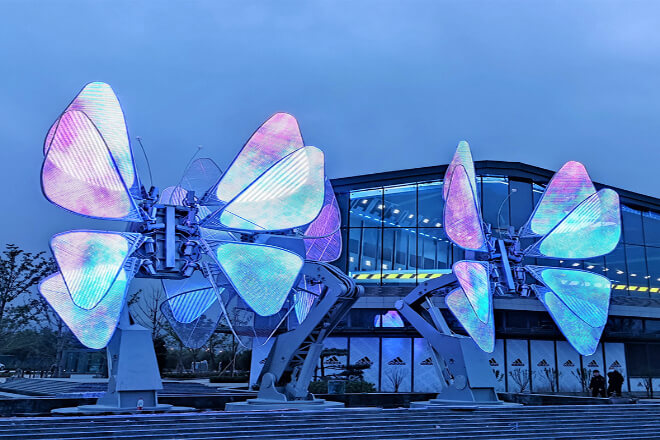
The answer is basically: Yes, and not just a little—but it is precisely because of this that the final effect is more “design-oriented.”
First, irregular shapes and curved surfaces require higher splicing precision. Unlike standard square screens that can be “neatly assembled,”
Creative LED screens may be curved, cylindrical, or even irregularly shaped, requiring each module to be precisely placed like a jigsaw puzzle piece.
Even a slight deviation will be magnified in the overall effect, affecting the continuity and visual appeal of the image.
Second, the module structure itself is more “personalized.” Many creative LED screens use customized modules or flexible structures, no longer a simple splicing of uniform specifications.
This means that the design logic must be considered from the initial design phase.
And installation is more about “reproducing the design” than making on-site adjustments, requiring a higher level of coordination between the design and installation.
Finally, alignment and flatness control demand more on-site experience. Due to the irregular shape, constant fine-tuning of angles, curvatures.
And seams is necessary during installation to ensure both structural stability and a smooth, seamless visual appearance.
This process is somewhat like a refined version of “on-site assembly art.”
Overall, creative LED displays do increase installation complexity, but the result is a more distinctive and visually impactful display effect—more complex often means more outstanding.
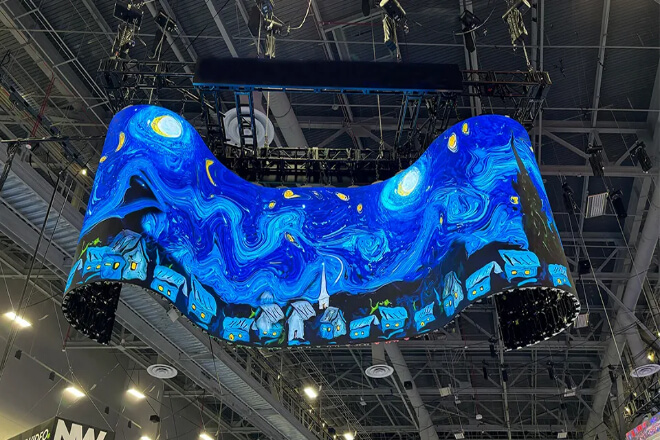
The answer is yes—the installation scenario directly determines the construction difficulty and the “heart-pounding” factor.
Different environments and methods can turn what should be a simple assembly into a mini-challenge.
First, there are differences between indoor and outdoor environments. Indoor environments are relatively controllable; temperature, humidity, lighting, and ventilation are easily adjusted.
Outdoor installations, however, face wind, rain, strong sunlight, and even temperature fluctuations, which not only affect screen lifespan but also increase the complexity of protective and mounting structures.
Secondly, wall mounting, suspended mounting, and high-altitude installation each present their own challenges.
Wall mounting requires precise alignment and flatness, suspended mounting needs to consider weight distribution and safety support.
And high-altitude installation adds additional construction risks and operational difficulties.
Each method is like solving a different “spatial puzzle,” and a slight mistake can lead to safety or visual problems.
Finally, the spatial structure imposes limitations on construction. Some 創造的な LED スクリーン need to fit curved walls or irregular spaces, or even be embedded in ceilings or stair gaps.
The construction team needs to plan the installation sequence, module orientation, and maintenance access in advance to ensure the final effect is both stable and aesthetically pleasing.
Overall, the installation difficulty of creative LED displays depends entirely on the scenario—the more complex the environment, the more it tests the “spatial magic” and experience of the designer and construction team.
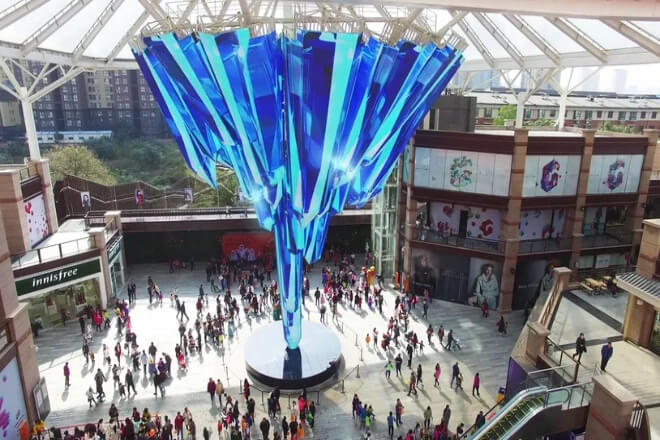
Creative LED displays may seem like a symbol of “free rein,” but in practice, their implementation is more like “conditional creation”—a well-prepared environment is crucial for stable and outstanding results.
First, load-bearing and structural safety are paramount. No matter how creative the display, it’s still essentially a complete system with specific requirements for the load-bearing capacity of the installation foundation.
Whether it’s a wall or a suspended structure, it needs to be sufficiently stable, and reinforcement design may be necessary. Simply put, it must “stand firmly” before it “looks good.”
Second, power and wiring conditions are critical. Creative LED displays typically involve a multi-module, multi-area power supply and signal transmission.
Insufficient power capacity or unclear wiring planning can easily affect operational stability.
Planning power distribution, wiring, and interface locations in advance not only ensures a smoother system but also minimizes maintenance issues later on.
Finally, construction space and on-site operating conditions are essential.
Whether the installation site has sufficient space, easy access for equipment, and adequate operating and maintenance access all directly impact the installation experience.
A cramped space not only increases installation difficulty but also makes subsequent maintenance more challenging.
Overall, the environmental requirements for creative LED displays are more like “laying the foundation.”
The more solid the foundation, the freer the creativity can be, without being limited by the site conditions.
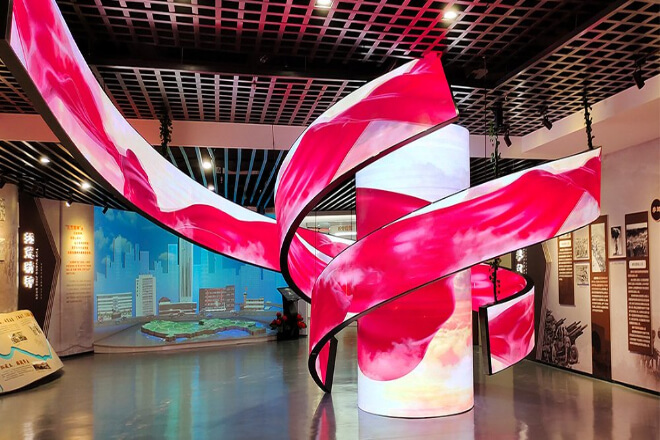
The installation process of a creative LED display is more like an advanced operation, “from building blocks to creating a precision jigsaw puzzle,” with each step laying the groundwork for the final effect.
First, positioning and structural construction. Before the actual screen is installed, the “framework” needs to be built.
Including confirming the installation location, positioning the overall shape, and constructing the supporting structure.
This step is somewhat like drawing the outline before filling in the content; if there are deviations here, subsequent adjustments will be less effective.
Second, module splicing and debugging. During the actual installation phase, the modules are spliced together piece by piece according to the design, while continuously adjusting the spacing, angle, and curvature.
This process requires patience, requiring fine-tuning as installation progresses to ensure a natural, seamless image, appearing as a single, continuous display surface, rather than a patchwork of elements.
Finally, a power-on test and overall calibration are performed. After installation, a power-on test is conducted to uniformly calibrate brightness, color consistency.
And screen flatness, while also checking for any abnormal points or display deviations.
Through this round of “check-up and color adjustment,” the entire screen achieves a visually consistent and smooth state.
Overall, these three stages are like the “three-step process” of installation: first, build the structure.
Then, assemble the details; and finally, perform unified optimization. Each step must be done steadily for a more stunning final product.
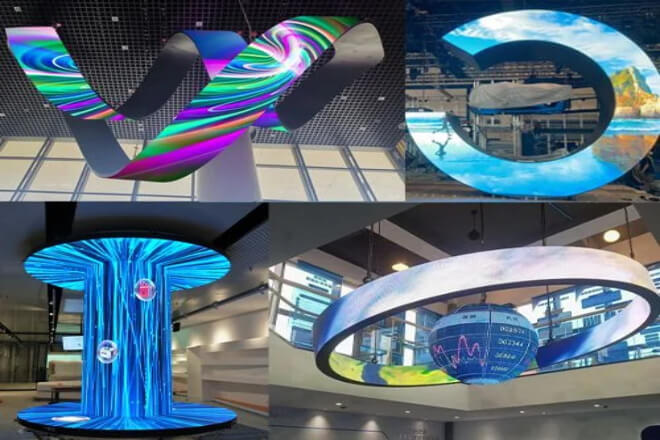
The answer can be understood as follows: the more customized the 創造的な LED 表示, the more “one step ahead” is required, and the installation difficulty often increases accordingly.
It’s not that it can’t be done, but it relies more on overall coordination.
First, customized designs directly increase the complexity of construction. When the screen is no longer a standard rectangle.
But an arc, irregular shape, or even an embedded structure, the position, angle, and splicing method of each module may be different.
On-site adjustments are required one by one; a simple “standard process” cannot be quickly replicated, and the construction pace will be more meticulous.
Secondly, good coordination between design and construction significantly reduces the difficulty. If the initial design fully considers site dimensions, structural stress.
And installation paths, the construction team can proceed more smoothly along the design lines.
Conversely, information asymmetry can easily lead to repeated adjustments on-site, or even “modifications during installation.”
Finally, the difference between having done overall planning beforehand and not is significant. For example, how the structure will be supported, how the power supply will be routed.
How the signals will be laid, and how to maintain them later—if these are clarified in advance, installation will be smoother.
Adding solutions on-site will significantly increase uncertainty.
Simply put, customization isn’t the problem; what truly affects the installation experience is whether the “how to install” process was clearly planned beforehand.
 English
  Español
  简体中文
简体中文  Français
  日本語
日本語  한국어
한국어  العربية