

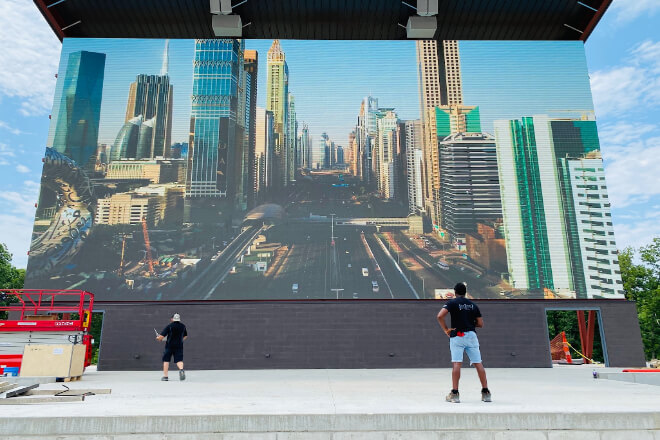
The advantage of a large screen is not essentially “bigger,” but rather its ability to maintain presence and clarity at different viewing distances, thus continuously attracting attention.
Firstly, there’s the visual impact and coverage provided by size. In spaces like commercial streets, plazas, or stadiums, people and screens are often “at a distance.”
The advantage of a large-sized LED screen is that even if you pass by dozens of meters away, it will still enter your field of vision; you don’t need to deliberately get close to see it.
For example, a large screen in a plaza allows you to perceive its content from afar—this is “long-distance visibility.”
Secondly, it boasts excellent performance at both close and long distances. When viewed up close, the large screen can display rich details, such as product texture, close-ups of people, or dynamic videos.
At a greater distance, it ensures the overall image remains clear and legible, avoiding a blurry appearance due to its size.
This ability to be clearly visible from afar and up close is difficult for ordinary small screens to replicate.
Another advantage is the enhanced effect brought by high definition and color reproduction.
At different distances, high résolution prevents the image from “scattering” at a distance, while rich colors enhance the visual impact at close range.
For example, a brand logo is a striking symbol from a distance, but details and textures become apparent upon closer inspection.
To put it more intuitively, a large LED screen is like a “visual landmark that won’t be ignored whether you’re standing at an intersection or right in front of it.”
In short, its appeal comes from three key points: visibility from a distance, detail up close, and versatility across different locations.
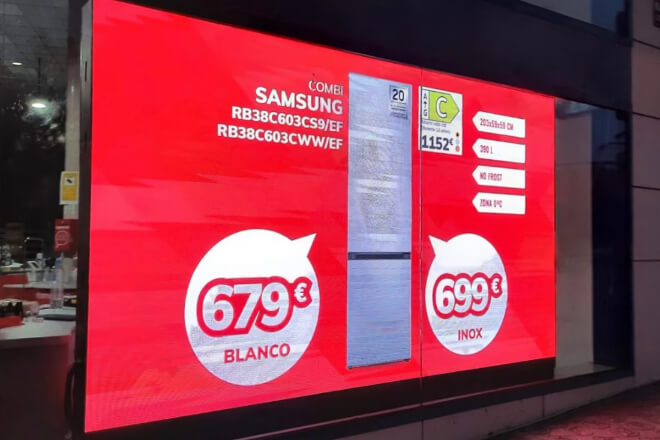
If the first point is about “making people stop and take a look,” then this point is more like: making people remember something after they see it.
First, there’s the ease of content updates. Large-size LED screens are like “electronic bulletin boards with content that can be changed at any time,” without needing to change posters or reprint.
For example, a new product launch in the morning can be changed to a limited-time discount in the afternoon.
And then to a holiday theme in the evening—the content switching speed is so fast it’s almost like “changing the copy in the backend and going live.”
For brands, this flexibility means they can quickly adjust to the market rhythm without waiting for cycles.
Second, there’s the “creative expression” of multiple display formats. It’s not just about displaying pictures; it can also use videos, animations, and text combinations simultaneously. For example:
Videos explain “how to use it” (contextuality);
Animations tell the “brand story” (memorability);
Images showcase “product details” (quality);
Text highlights “discount offers” (stimulating decision-making).
The same screen can “speak in different ways” at different times, making information more three-dimensional.
Furthermore, the wide coverage is a “natural advantage.” Large LED screens are typically not located in corners, but rather in high-traffic areas such as centre commercial atriums, subway passages, and stade entrances.
You don’t need to consciously look for them; they will naturally appear in your line of sight. Even more interestingly.
Many people who might have been just passing by will glance at the screen for a couple more seconds because the content “moved.”
To put it more vividly, it’s like a “public information broadcaster who doesn’t say hello but constantly updates content,” refreshing its presence wherever you go.
Simply put, its dissemination efficiency doesn’t rely on “shouting loudly,” but rather on three things: quick updates, frequent communication, and perfectly timed appearances.
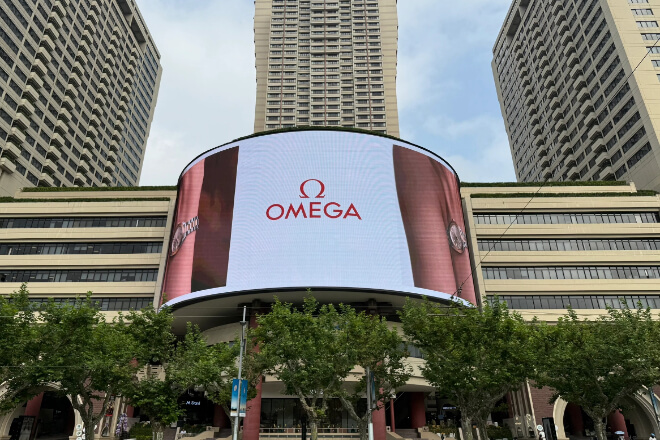
If the first two points address “visibility and speed of dissemination,” this point is even more interesting—it begins to determine “what a brand looks like and whether it has a memorable element.”
First, there’s the unique design that allows for the expression of brand personality. Large-size LED screens are no longer just flat display tools.
They can be made into curved screens, irregularly shaped screens, écrans transparents, and various other forms.
For example, curved screens can wrap around architectural structures, creating a more immersive viewing experience.
Irregularly shaped screens can break away from the conventional “square” impression, making the space itself part of the advertisement.
Transparent screens can overlay images with physical spaces, creating a “fusion of reality and illusion” effect.
These designs don’t just make things “more visually appealing,” but rather make them stand out from the crowd.
Secondly, there’s the attention-grabbing power of creative content. The advantage of large screens is that they don’t just display information, but can “play with content.”
For example, interactive ads allow passersby to participate and trigger changes in the visuals; themed scene displays make the entire screen part of a festival or brand atmosphere.
Even storytelling can be used to create a continuous visual presentation of a brand’s history or philosophy. Viewers aren’t passively watching, but are “drawn in.”
Furthermore, this creative expression itself strengthens memorability. Compared to ordinary static ads, the dynamism, change.
And interactivity of large screens make it easier for people to stay for a few more seconds, and those few seconds often determine whether someone “remembers” or “forgets.”
To put it more intuitively, it’s not like “showing an ad,” but more like “performing a short visual performance,” where the brand just happens to be part of the performance.
In short, the core value of this type of display lies in three points: a more unique form, more engaging content, and deeper memorability.
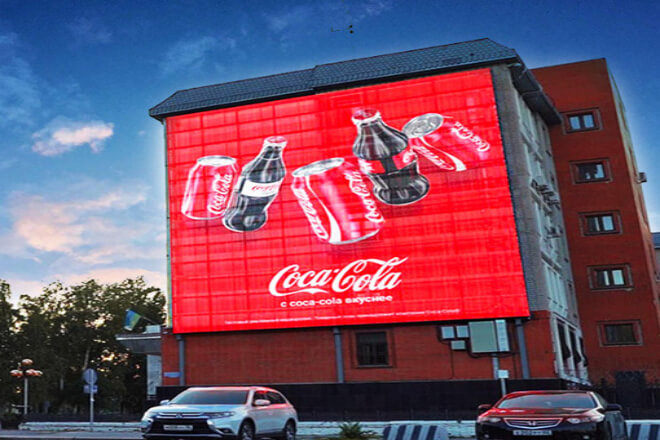
A very real advantage of large-sized LED displays is that they are not “limited to one type of place,” but can be used almost anywhere, and they look quite good.
Firstly, there’s their application in commercial environments. Dans centres commerciaux, commercial real estate, and brand stores, large screens often appear at entrances, atriums, or main passageways.
Their function is direct: to attract customers’ attention and encourage them to take another step.
For example, a large screen at a store entrance, if displaying information about new products or limited-time events, can easily turn “passersby” into “store visitors.”
It doesn’t solve the display problem, but rather “draws attention in.”
Secondly, there’s their ability to spread information in public places. Dans aéroports, train stations, subway passages, and city squares, there’s high foot traffic and a fast pace, with short dwell times.
Here, large screens act more like “visual landmarks.” They don’t need much explanation; simply continuously playing brand content creates memorability through repeated exposure.
For example, if a passenger looks up while waiting for a train and sees the same brand appear repeatedly, even for just a few seconds, it will gradually leave an impression.
Another advantage is its performance in sporting events and large-scale activities. In stadiums or on organiser, large screens are not just advertising tools, but also participate in building the overall atmosphere.
For example, pre-match promotions, inter-match advertising, halftime interactive content, and even match replays can all be done through large screens.
The characteristic of this environment is “highly focused attention,” so brand exposure efficiency is extremely high; a single appearance can be seen by thousands of viewers simultaneously.
To put it more intuitively, it’s like a “public display window that appears wherever there are crowds,” switching identities in different scenarios, but its core function is always to ensure that more people see the brand.
Simply put, the key to this capability lies in three points: it can enter shopping malls, transportation hubs, and large stages. The wider its adaptability, the more stable its communication value.
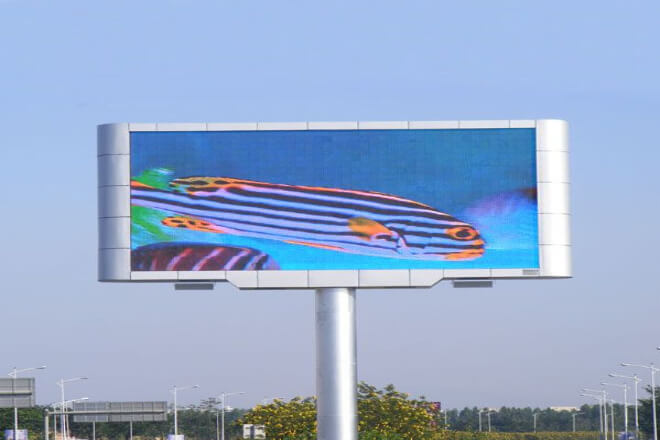
The power of large-sized LED displays is not just about “displaying” itself, but about their ability to work with other marketing methods, turning communication into a chain.
First is interaction and linkage with social media. For example, the screen can display QR codes for participation, topic challenges, or real-time interactive content.
After seeing this on-site, attendees can directly scan the code to participate in the online activity.
This step is crucial; it transforms “passersby who only glance at the screen” into “people who can sustainably engage online.”
For instance, if a topic is featured on the screen and then photographed and shared, it easily spreads further on social media, turning offline exposure into online dissemination.
Secondly, it plays a synergistic role in integrated marketing campaigns. Large screens can serve as the “main visual entry point” for offline events.
For example, in press conferences, pop-up events, or brand roadshows, they are responsible for showcasing the theme, event schedule, and brand information, guiding on-site audience participation.
Simultaneously, online advertising can in turn guide users to “see the large screen content on-site,” creating a mutually reinforcing relationship rather than a one-way communication.
Furthermore, this synergy amplifies the overall communication effect. When offline large screens, online advertising.
And social media content work together, users will see the same brand information repeatedly in different scenarios, thus reinforcing memory rather than just seeing it once.
To put it more intuitively, it’s no longer just “a screen playing ads on the street,” but a “transfer station” connecting offline foot traffic and online traffic.
Simply put, the core of this capability lies in three points: offline traffic generation, online dissemination.
And two-way linkage, making communication no longer a single-point exposure, but a complete set of coordinated actions.


 English
  Español
  简体中文
简体中文  Français
  日本語
日本語  한국어
한국어  العربية