

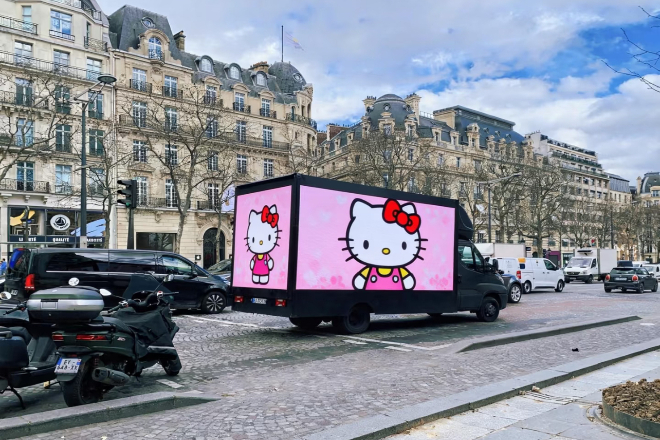
Before choosing an LED display for a mobile advertising vehicle, don’t rush to compare brightness, pas de pixel, and price.
It’s more important to understand: where will this vehicle primarily be used, and what kind of audience do you hope to attract?
Different operating methods will directly impact the screen type and configuration.
- If primarily used for urban road parades, long-distance visibility is paramount.
For example, when a brand promotion vehicle parades in commercial streets, main urban roads.
Or around large events, the screen needs to ensure that pedestrians and other vehicles on both sides of the road quickly notice the advertising content.
For such projects, outdoor luminosité, screen size, viewing angle, and the clarity of dynamic images should be prioritized.
- If primarily used for plaza events and brand roadshows, the display effect becomes even more important
When mobile advertising vehicles are parked in centre commercial plazas, exhibition venues, or promotional areas, viewers may view the screen from different directions.
In this case, it’s advisable to evaluate dual-sided LED displays, multi-screen combinations, or screen layouts better suited for on-site display, allowing advertising content to cover more viewing areas.
- If primarily used for promotions and temporary advertising, content update efficiency is also crucial
For example, a retail brand might promote new products in the morning, display limited-time offers in the afternoon, and switch to other promotional information in the evening.
If the screen can quickly update content through a control system, it reduces the hassle of repeated production and on-site operation.
Furthermore, it’s necessary to confirm the vehicle’s usage pattern. Will the screen display while the vehicle is moving, or only after parking? This is a crucial question to clarify during the selection process.
The display, source de courant, and operation methods during travel must comply with local traffic regulations and vehicle safety requirements;
Simply installing a regular écran publicitaire extérieur onto a vehicle and putting it into use is insufficient.
For project decision-makers, clearly defining the primary purpose of the advertising vehicle is essential to avoid purchasing equipment with numerous features that are not actually needed.
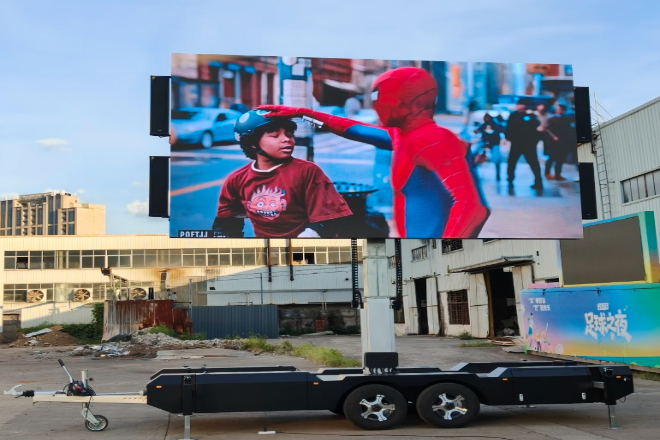
Mobile advertising vehicles often need to operate under varying lighting conditions. In the morning, the vehicle might be parked in a shady commercial street.
But in the afternoon it will face strong sunlight, and in the evening it might participate in dimly lit outdoor activities. Therefore, brightness selection cannot be based solely on a single time period.
First, the usage environment of the vehicle must be considered.
If the mobile advertising vehicle is mainly used outdoors, the screen needs to have luminosité suitable for daylight conditions to ensure the advertisement remains clear even under sunlight.
Especially when the vehicle is parked in a square or by the roadside, if the image is grayish and the text is unclear, even a large screen size will hardly achieve the desired advertising effect.
However, higher brightness is not always better.
Excessive brightness may increase energy consumption and heat dissipation pressure, and may also cause glare at night.
Therefore, when purchasing, the brightness adjustment capability of the product should be understood, and tests should be conducted in conjunction with the actual viewing environment.
Second, it is recommended to prioritize écrans LED extérieurs that support automatic or time-based brightness adjustment.
For example, when the vehicle is used for outdoor promotion during the day, the brightness can be adjusted according to the ambient light;
At night, the brightness can be appropriately reduced to ensure the advertisement remains visible while avoiding affecting pedestrians and drivers.
Third, the angle de vue must be considered.
Mobile advertising vehicles are not fixed billboards facing one direction.
Vehicles may be parked on the edge of the road, at the entrance of a plaza, or in the center of an event venue, and viewers may view the screen from the side.
Therefore, in addition to frontal brightness, the screen’s color and contrast performance when viewed from different angles should also be checked.
Finally, on-site testing should be conducted in conjunction with the content.
It is recommended to test using actual advertising videos, brand logos, promotional prices, and large headlines, observing the display effects during both day and night.
Don’t just rely on the brightly colored demonstrations played by the supplier.
For mobile advertising vehicles, appropriate brightness should ensure that the advertisement is clearly visible at the required time and location.
While also considering energy consumption, viewing comfort, and equipment operational stability.
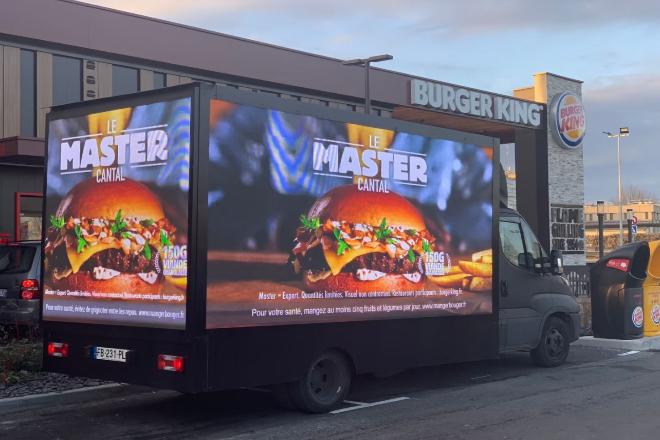
One of the most common selection misconceptions for mobile advertising vehicles is that a larger screen necessarily means better advertising results.
In reality, the screen size needs to be matched with the vehicle size, installation location, viewing distance, and road conditions.
First, the installable size should be determined based on the vehicle’s structure.
The available installation space differs significantly between small advertising vehicles, large advertising trucks, and trailer-mounted mobile advertising vehicles.
The screen must not obstruct the driver’s view, vehicle center of gravity, body structure, or necessary safety equipment.
For larger vehicle-mounted LED displays, the impact of the added weight on vehicle load, axle load.
And driving stability must be assessed, and the installation structure must be confirmed by professionals to meet requirements.
Secondly, the pas de pixel should be selected based on the viewing distance.
Pixel pitch is the distance between the centers of adjacent pixels.
All other things being equal, a smaller pixel pitch generally results in a more detailed image, but may also be more expensive.
If the mobile advertising vehicle is primarily used for long-distance displays along roadsides, an appropriate pixel pitch can be chosen based on the viewing distance;
If the vehicle is frequently parked in centres commerciaux or plazas where viewers can view it at close range, greater attention should be paid to the clarity of text edges, brand logos, and video details.
Thirdly, the screen ratio and content layout must be considered.
Mobile advertising vehicles frequently play horizontal videos, brand promotional videos, and event information.
If the screen ratio does not match the content, issues such as image cropping, black borders, or compression of important information may occur.
Therefore, the production ratio of the advertising content should be planned in advance when determining the screen size.
Fourthly, single-sided or double-sided display should be considered based on operational needs.
Single-sided screens are suitable for scenarios where the audience’s direction is relatively fixed;
If the vehicle is frequently parked in open squares or commercial districts, double-sided displays may help cover audiences from different directions.
However, double-sided screens also mean higher equipment weight, source de courant requirements, and structural complexity, requiring comprehensive evaluation based on vehicle conditions.
A truly reasonable mobile advertising vehicle LED display solution is not about installing the largest screen on the vehicle.
But about ensuring that the target audience can clearly see the advertising content while guaranteeing vehicle safety.
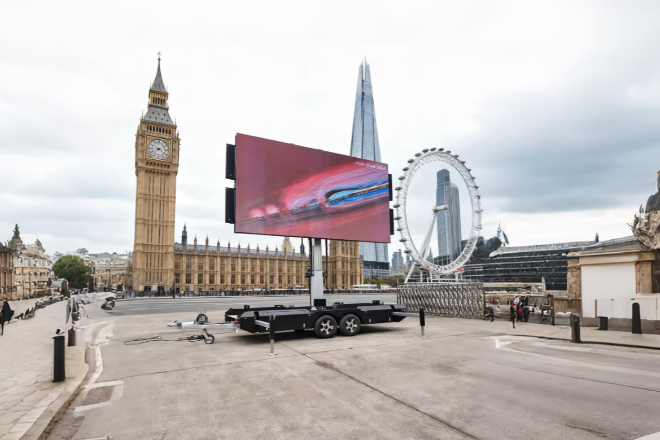
Mobile advertising vehicles are used outdoors for extended periods, and the screen may be affected by sunlight, rain, dust, temperature changes, and vehicle vibration.
Therefore, in addition to good display effects, the product needs to be adaptable to the mobile usage environment.
First, outdoor protection capabilities should be considered.
If the vehicle frequently operates in open-air environments, an LED display suitable for outdoor use should be selected.
And the protective design of the cabinet, module seams, power interfaces, and cable connections should be confirmed.
When purchasing, you can request the supplier to provide the corresponding protection rating and test data, but you cannot rely solely on a waterproof rating.
The actual usage environment, installation direction, and cable layout will also affect the equipment’s protective effect.
Secondly, vibration resistance and structural stability are crucial.
Vehicle movement generates vibrations, and uneven road surfaces can cause significant impacts.
If the screen support structure is poorly designed, long-term use may increase the risk of loose connections or component damage.
Therefore, a professional should assess the screen mounting method, vehicle body connection structure.
And vehicle driving conditions. Safety during vehicle turning, braking, and road roughness should also be considered.
Thirdly, power supply and heat dissipation must be considered.
LED displays on mobile advertising vehicles may require long-term operation. Larger screens and higher luminosité typically place higher demands on the source de courant system.
During procurement, the screen’s consommation d'énergie, the vehicle’s power system capacity, and whether a separate power supply is needed should be evaluated.
If a generator or other auxiliary power source is used, noise, ventilation, and maintenance issues must also be considered.
Furthermore, the screen installation must not interfere with the vehicle’s existing electrical system, cooling channels, or safety equipment.
Fourthly, control systems and content management are important.
If the fleet needs to switch advertising content between different cities and events, a control system that supports remote updates, scheduled playback, or centralized management should be evaluated.
For example, operators can pre-plan advertising sessions at different locations, reducing the workload of on-site vehicle-by-vehicle operation.
However, specific functions should be based on product and system compatibility.
For project procurement managers, outdoor protection, structural adaptability, power supply, and control systems must be considered together.
The screen not only needs to look good when parked but also adapt to the actual usage conditions of the vehicle.
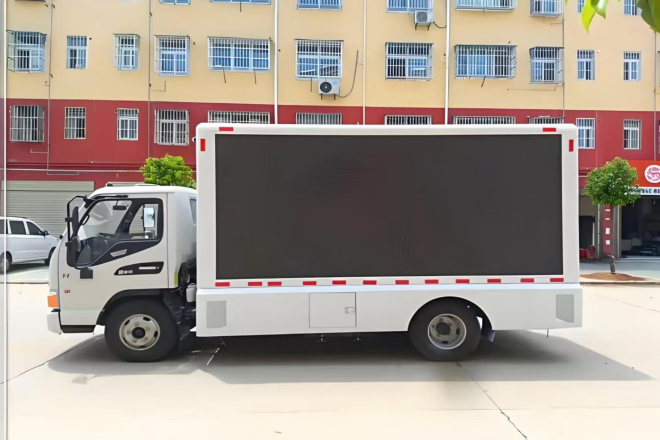
The purchase cost of the LED display screen for mobile advertising vehicles is only part of the overall project investment.
After the equipment is installed, there will be continuous costs for electricity, maintenance, content production, and vehicle operation.
Therefore, when selecting products, the focus should shift from simply comparing prices to evaluating long-term value.
First, understand the actual power consumption.
Screen size, luminosité settings, playback content, and operating time all affect energy consumption.
It is recommended that suppliers provide data such as typical consommation d'énergie and maximum power consumption, and then estimate power demand based on daily operating time.
If the vehicle is cruising and displaying for long periods every day, a reasonable brightness adjustment function may help control energy consumption.
Second, consider ease of maintenance.
Mobile advertising vehicles often need to be used across regions. If the screen malfunctions, repairs may not be possible at familiar locations.
Therefore, when purchasing, it’s crucial to understand the replacement methods for modules, power supplies, and control components, as well as the supplier’s availability of spare parts and technical support.
For larger fleets, it’s also advisable to prepare commonly used spare parts to minimize equipment downtime.
Third, assess content update costs.
One advantage of mobile advertising vehicles is their ability to switch promotional content based on events and locations.
However, if each update requires reproducing the entire video, or if the operational process is complex, it can increase daily operational burden.
Therefore, content production specifications, playback system compatibility, and update processes should be clearly defined in advance, enabling the advertising team to efficiently manage materials for different events.
Fourth, consider vehicle modification and compliance costs.
Screen installation may involve adjustments to the vehicle’s structure, electrical system modifications, weight changes, and related approval requirements.
Regulations may vary by region; project owners should verify requirements regarding vehicle modification, road use, display content, and nighttime brightness in advance.
Ignoring these issues may prevent the screen from being deployed as planned, even if its performance is excellent.
Finally, compare the overall return on investment.
For example, two LED displays may have different initial quotes.
But one that is easier to maintain, has more reasonable energy consumption, and is better suited to the vehicle’s structure may have a more advantageous long-term operating cost.
For advertising operators, the ideal LED display for a mobile advertising vehicle should not only attract attention but also be easy to manage, operate reliably, and continuously generate value with each advertising campaign.


 English
 Español
 简体中文
 Français
 日本語
 한국어
 العربية