
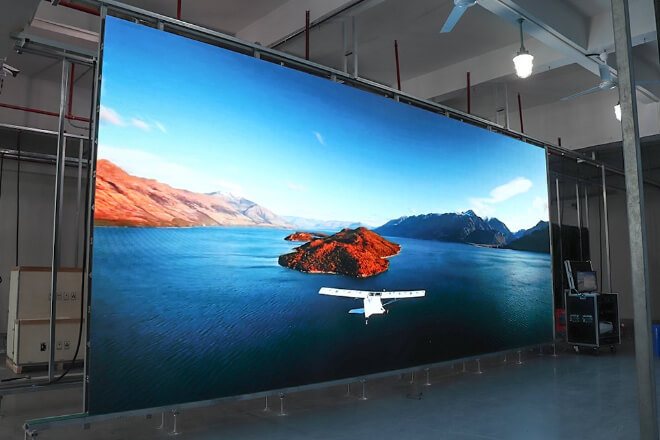
Afficheurs LED appear to “stably emit light,” but true stability is actually determined by many unseen variables.
The same screen can perform completely differently in different scenarios:
Some remain clear even after years of continuous operation, while others frequently experience flickering, blackouts, or color differences.
The problem often lies not in the “screen itself,” but in the underlying system conditions.
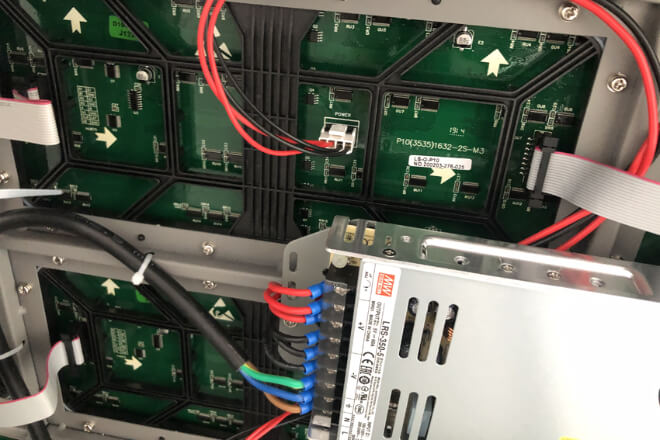
Afficheurs LED appear to “illuminate,” but their stability is truly determined by the underlying power supply system.
Unstable power often leads to problems that directly impact the entire screen’s performance.
First, voltage fluctuations can cause flickering or blackouts. When the voltage fluctuates wildly, the screen may flicker visibly, or even briefly go out.
In competitions or events, this can severely affect the viewing experience and even interrupt crucial footage.
Second, uneven power load can easily cause localized failures. If some areas experience excessive source de courant while others receive insufficient power.
Inconsistent luminosité, abnormal module overheating, or even sudden failure, it may occur in some areas.
Meanwhile, aging power modules also reduce overall stability. As usage time increases, power efficiency decreases, and power supply capacity weakens.
A previously normal screen may begin to experience intermittent problems, such as intermittent flickering or signal abnormalities.
More importantly, these problems, when combined, can affect the long-term reliability of the entire screen.
For scenarios requiring continuous operation for extended periods (such as sporting events, commercial performances, and outdoor advertising).
An unstable power supply acts as a “hidden risk,” invisible under normal circumstances, but potentially disrupting the entire event once triggered.
Interestingly, these problems often don’t “suddenly break down,” but rather “gradually become unstable”—a flicker today, a dim area tomorrow, a freeze the day after, leaving operators constantly in a cycle of “to repair or not to repair.”
In short, the stability of an LED screen depends not only on the screen itself, but also on “where the power comes from and its stability.”
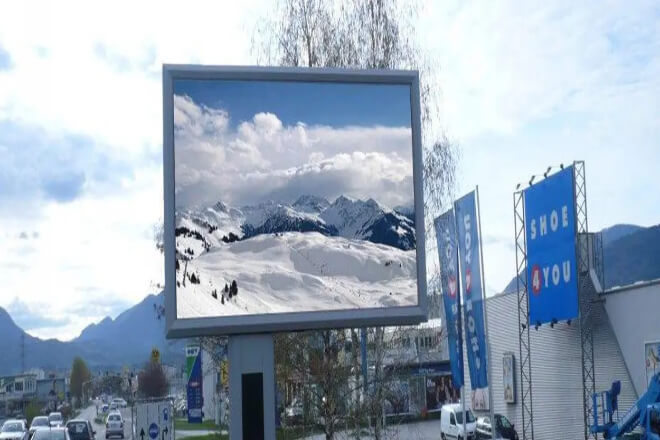
LED displays often appear “as stable as a lighthouse,” but once the ambient temperature and humidity start to “act up,” their condition changes accordingly, and often not suddenly, but gradually becomes unstable.
First, high temperatures cause components to collectively slow down.
For example, during outdoor events in summer, prolonged exposure to direct sunlight can cause screens to become less bright, colors to fade, or even trigger localized automatic luminosité reduction as a protection mechanism.
Just like a phone automatically reduces its clock speed after prolonged use, the screen also enters a “self-protection mode.”
Second, low temperatures slow down startup. For example, during outdoor activities on a winter morning.
The screen may experience a slight delay and less smooth visuals when first turned on, similar to a computer “buffering” after booting up. It gradually returns to normal as the temperature rises.
Meanwhile, excessive humidity is a more subtle problem.
For example, during the rainy season or in coastal cities, when the air is too humid, moisture can seep into the modules, causing occasional flickering or localized abnormalities.
Sometimes it’s not a complete malfunction, but rather an occasional bout of malfunction.
A more realistic example is this: The same screen might perform stably in an indoor esports arena, but when moved to an outdoor commercial event.
It might work normally during the day, start flickering slightly in the evening when temperatures drop, and then experience uneven brightness in certain areas the next day due to humidity.
Maintenance personnel would then begin to wonder, “Is the weather working against the screen today?”
Interestingly, these problems usually don’t all occur at once, but rather appear in batches depending on the weather, giving the impression of troubleshooting an “environmental bug.”
In short, the environment doesn’t directly damage the LED, but rather makes its performance “unstable.”
LED displays are constantly generating heat during operation. If the heat dissipation design is inadequate, it’s like leaving a continuously high-speed machine without a fan—the problems won’t immediately surface, but they will accumulate gradually.
First, localized overheating leads to luminosité decay. For example, if a module doesn’t dissipate heat well, it will dim faster than the surrounding area.
Eventually resulting in a “discontinuous brightness” on the screen, disrupting image uniformity and making it look like an inconsistent filter has been applied.
Secondly, prolonged operation may lead to LED “dead light” issues. When temperatures remain consistently high, the LED beads age faster, and individual pixels may fail.
Forming small black or bright spots visible to the naked eye, like the screen “dropping stars.”
Simultaneously, insufficient heat dissipation significantly reduces the overall screen lifespan. While designed for stable operation for many years.
Prolonged high temperatures accelerate component wear, causing the screen to enter performance degradation earlier, essentially “aging prematurely.”
More importantly, it also affects stability under high load. During sporting events, performances, or long advertisements.
If the screen accumulates heat too quickly, it may trigger brightness reduction, stuttering, or even localized protection mechanisms, resulting in unstable overall performance.
Interestingly, these problems often don’t “suddenly fail,” but rather “gradually worsen.” For example, initially only the corners are slightly darker, then gradually spread;
Or it works normally during the day, but starts to “overheat and lose performance” when displaying bright content, as if the screen is saying, “I’m getting a little hot, I need to slow down.”
To illustrate with a vivid scenario: During a crucial team fight in an esports match, the large screen suddenly dims slightly for a moment—not as a special effect, but as a reminder of the heat dissipation pressure.
Simply put, poor heat dissipation doesn’t immediately damage the screen, but rather makes it increasingly unstable.
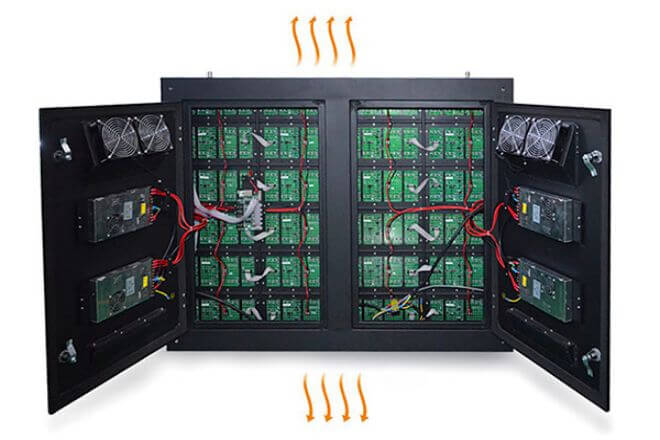
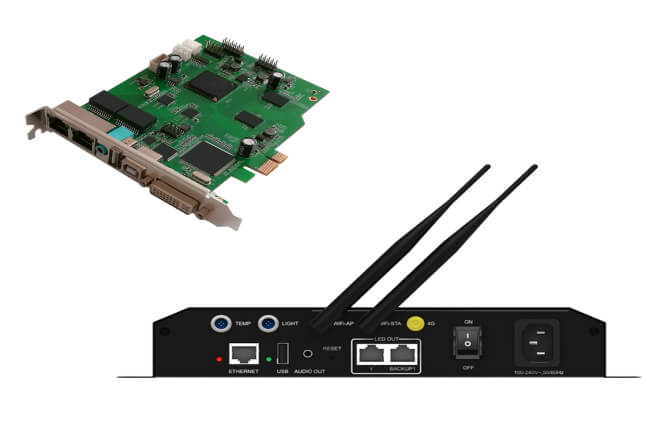
While Afficheurs LED appear to be “playing images,” they are essentially conducting a real-time “information relay race.” If the signal or control system falters, the image becomes unresponsive.
First, signal delays or packet loss will cause image anomalies. For example, in an esports match, just as a team fight reaches its most critical second, the large screen suddenly freezes, the image appearing “briefly frozen.”
Before the audience can react, the scene has already switched to another shot—the atmosphere is instantly disrupted.
Second, insufficient control card performance will affect refresh stability. For example, when playing fast-paced scenes or complex animations.
The screen may exhibit slight ghosting or frame drops, appearing as if the image is “breathing,” unable to keep up with the intensity of the match.
Meanwhile, line interference can cause display misalignment or anomalies. Sometimes it’s not that the screen is broken, but rather that a row of pixels suddenly “goes off-track.”
With slight color shifts or localized jumps, like a player on a team suddenly being a beat behind.
More complex is the issue of multi-screen synchronization. In large-scale sporting events, the main screen might be showing a team fight replay.
While the side screens are still stuck on the previous push, and the floor screens have already switched to atmosphere effects—each screen is showing its own content.
Making the audience feel like they’re watching a match on “different timelines.”
Even more interestingly, viewers often can’t pinpoint the technical reason for these problems, but they’ll intuitively feel: “Something just happened a moment ago.”
For example, a visual climax that should have occurred simultaneously becomes a “segmented performance.”
A very real example: in an esports match, at the moment of a kill, the main screen is already showing a slow-motion effect.
While the side screens are still displaying the previous laning phase, and the floor screens have just started lighting up—the entire stage is like a “band out of sync.”
Simply put, the consistency of an LED display depends not only on the screen itself, but also on “whether all signals are in place simultaneously.”
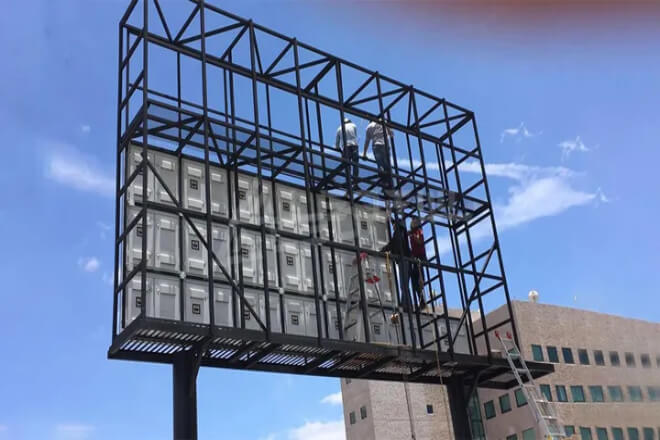
An LED display screen may appear as a single “wall of light,” but its stability largely depends on the underlying structural system that supports its stability, continuity, and long-term operation.
First, an unstable structure can easily lead to poor module contact. For example, insufficient frame rigidity or insecure fixing can cause slight deformation during long-term use.
Resulting in poor contact in some modules, causing flickering, partial blackouts, and making the screen appear “intermittently working.”
Second, installation errors directly affect splicing accuracy. If misalignment occurs during construction, small gaps or misalignments may appear between modules.
These problems are magnified in high-luminosité environments, making the edges of the image look like “pieces of a puzzle that don’t fit perfectly.”
Furthermore, untimely maintenance accelerates overall aging. For example, dust accumulation, blocked heat dissipation channels.
And loose connections not addressed promptly—these small problems accumulate and gradually degrade screen performance, like the equipment “running with minor flaws for a long time.”
Interestingly, vibrations in the operating environment can also increase the failure rate. For example, in performance venues, transportation hubs, or outdoor large-screen areas.
Prolonged exposure to even slight vibrations can easily lead to problems such as loose screws and unstable interface contacts, making the screen less stable.
To illustrate, a screen installed with perfect precision and a robust structure can emit light stably for years.
However, if the installation is slightly less precise, it may become unstable later—a section bright today, a corner loose tomorrow, requiring localized adjustments the day after.
Simply put, the stability of an LED display depends half on its technical parameters and half on whether it is securely installed, properly managed, and adequately maintained.


 English
  Español
  简体中文
简体中文  Français
  日本語
日本語  한국어
한국어  العربية