
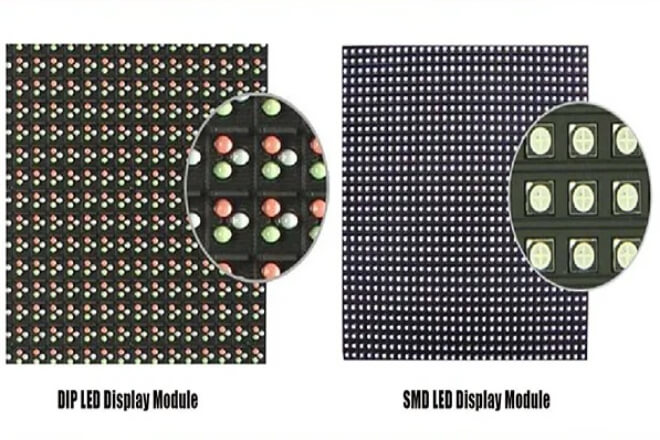
Have you ever noticed that advertising screens in centres commerciaux and large screens in stadiums look similar.
But upon closer inspection, the effects and experiences are completely different? This is due to the differences between SMD and DIP Affichage LED technologies.
What exactly are the differences between SMD and DIP? Why are some suitable for close-range high-definition displays, while others are better suited for large-area outdoor advertising?
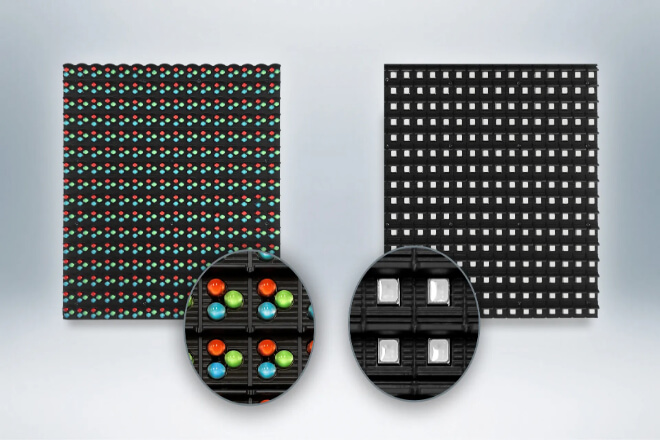
In the world of LED displays, SMD and DIP are like two stars with “different personalities,” each with its own characteristics and fans.
SMD displays are like those exquisitely compact devices. Each pixel contains red, green.
And blue pixels, all tightly packed together, resulting in a delicate image and natural color transitions. Even up close, you can’t find any flaws.
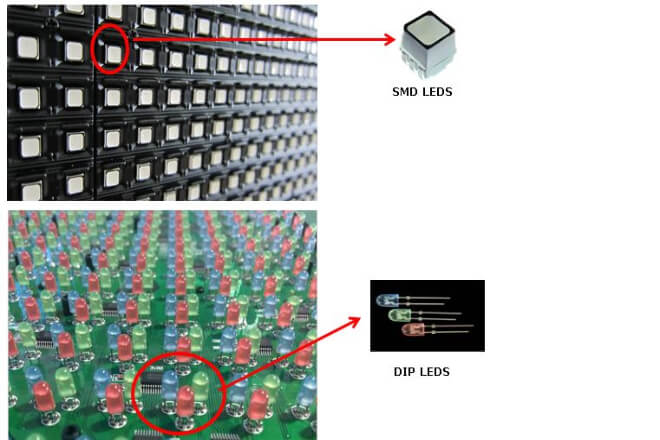
Its assembly method is also very high-tech—using surface mount technology, tiny LED “patterns” are directly soldered onto the circuit board.
Like assembling a precision jigsaw puzzle, saving space and resulting in a thin and lightweight design.
DIP displays are more like large, independent stars; each LED in a through-hole package is a separate unit, with red, green.
And blue pixels occupying their own space, maintaining a certain “social distance” between pixels.
While the image may not be as detailed up close as SMD displays, it boasts high brightness, is resistant to wind and sun, and performs exceptionally well from a distance, making it ideal for outdoor large screens or stadiums.
In terms of circuit design, SMD screens excel in multi-channel driving and high refresh rates, resulting in smooth and natural animation and video playback.
DIP screens are simpler and more direct, more like “bold yet bright,” focusing on making each pixel dazzlingly bright and visible from a distance.
Simply put, SMD excels at high-definition, detailed close-up displays, while DIP excels at high-brightness, durable long-distance performances.
Therefore, SMD and DIP each have their own style: one is small and exquisite with a soft, beautiful image, while the other is bold, bright, and durable.
Understanding their differences allows you to choose the most suitable LED screen based on your actual needs, ensuring the most ideal effect for advertisements, competitions, or performances.
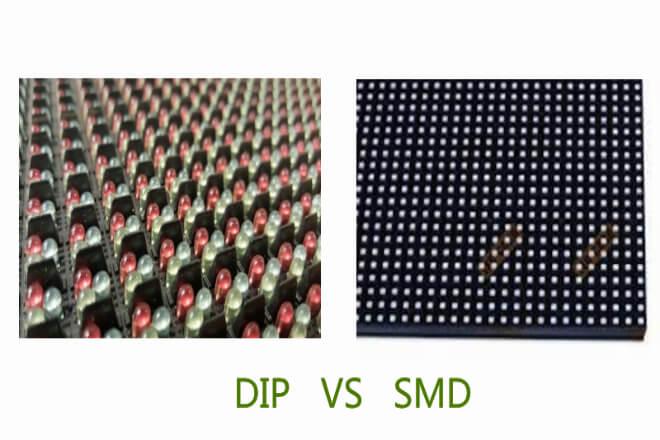
In the world of LED displays, SMD and DIP displays differ significantly in brightness and display effect, primarily in the following aspects:
1) Luminosité Performance
- CMS DIRIGÉ Display:
Uniform brightness and soft light. Due to the close arrangement of pixels, the red, green, and blue chips in each pixel emit light within the same small package.
Resulting in uniform light distribution and reducing the likelihood of dark areas or color blocks.
- PLONGER DIRIGÉ Display:
Extremely high brightness, especially suitable for large outdoor screens or long-distance viewing.
Each LED emits independently, making it highly visible even in direct sunlight, but the light spots may appear scattered at close range.
2) Résolution and Detail Performance
- CMSDIRIGÉ Display:
High pixel density and delicate image. Whether it’s text, charts, or video animation, details are very clear, making it suitable for close-range viewing and high-definition display scenarios.
- PLONGER DIRIGÉ Display:
Larger pas de pixel, limiting detail. Graininess may appear at close range, and color transitions are not smooth enough, making it more suitable for long-distance viewing.
3) Differences in Applicable Scenarios
- CMS DIRIGÉ Display:
Suitable for scenarios requiring high resolution and clear details, such as indoor advertising, close-range spectator seating at sporting events, or high-definition dynamic content displays.
- PLONGER DIRIGÉ Display:
Suitable for scenarios emphasizing brightness and long-distance visibility, such as large outdoor billboards and stadium perimeter screens.
Simply put, SMD displays are more like a sophisticated “high-definition stage,” with uniform brightness and delicate image quality, suitable for close-range displays.
DIP displays are more like a “high-brightness stage for distant views,” with high brightness, sun resistance, and durability, suitable for long-distance viewing.
Choosing the appropriate type based on actual application needs is crucial for the LED display to achieve its best effect.
Imagine walking into a centre commercial and seeing a small LED display playing advertisements or event information. The image is clear, the colors are vibrant, and every detail is clearly visible.
This is the charm of SMD displays. The pixels of an SMD screen are densely packed, allowing for high-definition images even when small, making it ideal for close-range viewing.
Even better, it can be easily bent into curved or irregular shapes, perfectly integrating into walls, shop windows, or organiser backdrops, allowing for limitless creative design.
In another scenario, standing in a football stadium stand, your gaze sweeps across a giant écran LED extérieur.
Jhe advertising image remains clearly visible, the light bright enough to be discernible even in sunlight. This is the strength of DIP displays.
Each pixel is individually encapsulated, resulting in high luminosité and strong weather resistance, making it ideal for large-area installations and long-distance viewing.
Whether it’s a stadium perimeter screen or a city’s outdoor billboard, DIP screens ensure that viewers at a distance can see the image at a glance, remaining stable and reliable even in wind and sun.
Therefore, if your needs are for indoor use, limited space, or a pursuit of high-definition, detailed images, SMD displays are the best choice.
While for large-area displays emphasizing brightness and weather resistance, DIP displays are more suitable.
Choosing the right screen type is like selecting the right “stage lighting” for different scenarios—it delivers the best effect and ensures value for investment.
One of the most important considerations when choosing an LED display is the application scenario.
SMD and DIP technologies each have their advantages, and they are suitable for different environments and uses.
SMD LED displays, due to their dense pixel density and fine image quality, are ideal for locations requiring a high-definition display.
Examples include shopping mall windows, indoor advertising screens, organiser backdrops, and stade screens.
SMD screens can display detailed text, images, and videos, maintaining high-definition image quality even when viewers are close.
Many large centres commerciaux choose SMD displays to showcase promotional activities or dynamic advertisements because they not only have beautiful visuals but also allow for diverse creative designs within limited spaces.
In contrast, DIP LED displays are better suited for applications requiring high brightness and strong weather resistance.
They are suitable for outdoor billboards, large plaza screens, or peripheral screens for large sporting events, especially for optimal viewing from a distance.
The wider pixel pitch and individual encapsulation of each LED in DIP screens ensure clear visibility even in direct sunlight or in inclement weather, making them ideal for large-area display needs.
Many stadiums and urban outdoor screens choose DIP displays to ensure clear display of advertising or event information in various environments.
In practical applications, the choice between SMD and DIP screens primarily depends on viewing distance, environment, and content.
For indoor close-up viewing or displaying high-definition dynamic images, SMD displays are the best choice.
For outdoor environments requiring long-distance viewing and large-area, high-brightness displays, DIP displays are more suitable.
By choosing the appropriate screen type based on the specific scenario, you can ensure the best visual effect and maximize the value of the LED display.
 English
  Español
  简体中文
简体中文  Français
  日本語
日本語  한국어
한국어  العربية