
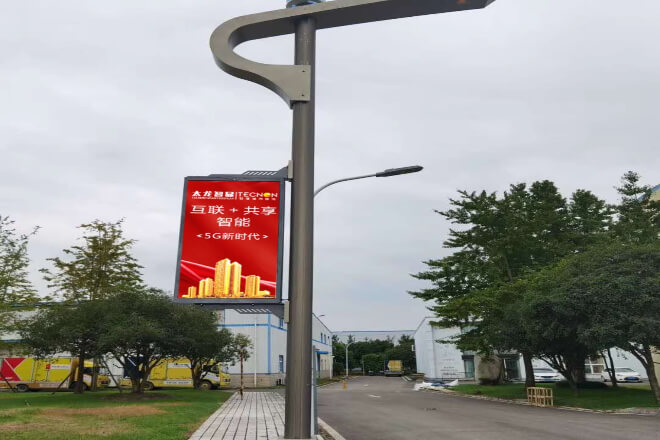
A key advantage of affichages à LED sur poteau is that they don’t require building a complex structure from scratch; they can be added to existing light poles.
This can be understood as flexibly adding an information display module to the existing “infrastructure skeleton” of the city.
This approach avoids occupying additional road space and reduces the construction and approval complexities associated with independent supports.
In many road environments, the light poles themselves are already rationally distributed and structurally stable.
Through adaptive installation, deployment can be completed without “starting from scratch.”
From a practical application perspective, this installation method is also more flexible.
For example, in key road sections or areas with high pedestrian and vehicular traffic, displays can be selectively installed on some light poles to achieve targeted coverage without requiring large-scale modifications to the entire road.
To give a more intuitive example: Originally, a row of light poles only provided illumination.
But after installing LED displays, some of these poles “incidentally” take on the role of information dissemination.
Seamlessly integrating information delivery capabilities into the urban environment without altering the original road structure.
Simply put, this approach is more like “adding functionality” to an existing system rather than “rebuilding the system.”
Maintaining the cleanliness of urban spaces while making information dissemination more flexible and natural.
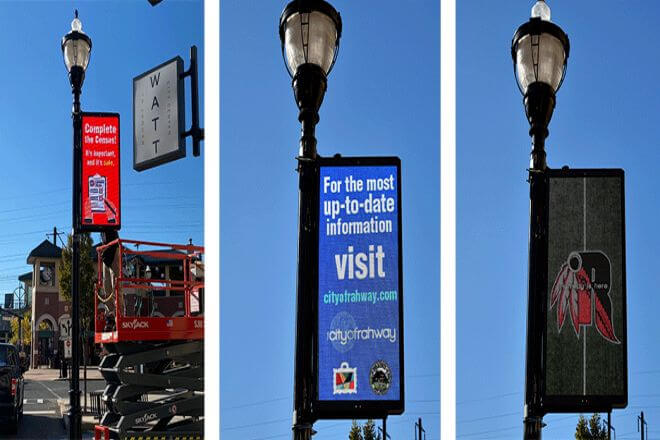
Pole LED displays are not just “advertising boards” in the city; they are more like “city loudspeakers” on standby, constantly delivering important information to people and vehicles on the road.
They can publish real-time traffic alerts, road control measures, weather information, emergency announcements, and even small urban reminders.
For example, during rush hour, a message like “Congestion ahead, detour recommended” can pop up on the screen, allowing drivers to easily avoid congested areas.
In the event of an emergency, it can provide immediate evacuation route information, much faster than paper notices.
Even more interestingly, this information doesn’t just sit idly by in some corner; it keeps pace with the city’s rhythm, moving close to roads and people.
Like a “city information errand runner,” it ensures pedestrians and drivers can always see the most relevant content.
Compared to screens solely for advertising, pole LED displays are more like “the city’s helpful assistants,” serving daily commutes while making urban information dissemination easy and efficient.
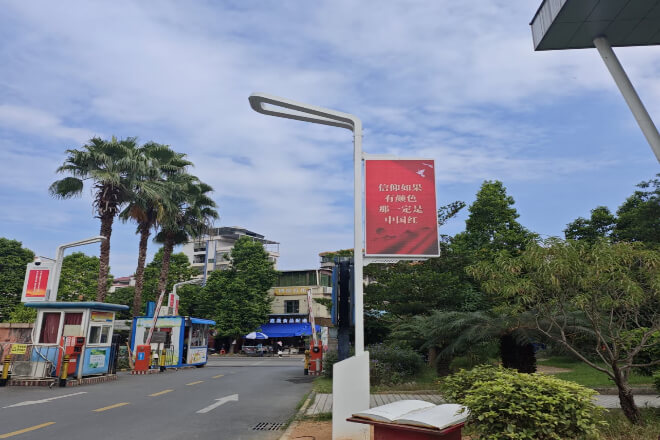
Another major highlight of pole LED displays is their ability to be remotely and centrally managed, acting like a “city commander.”
Multiple screens no longer operate independently but can be uniformly controlled through a backend system.
Content distribution, updates, and even status monitoring can all be completed within a single system.
For a concrete example: if multiple affichages à LED sur poteau are deployed along a main road, during the morning rush hour when traffic alerts need to be issued.
A single operation in the backend will synchronize the content across all relevant screens.
If an anomaly occurs at a particular location, the system can provide real-time status feedback.
Alerting maintenance personnel to address the issue promptly without requiring on-site investigation.
Simultaneously, this remote management capability supports content strategies based on region and time of day.
For example, different information can be displayed on different road sections, or different content can be switched between day and night, making information delivery more targeted and flexible.
Compared to a single LED screen, this model is more suitable for large-scale deployment at the city or road network level.
It can be understood as a “remotely dispatchable distributed information system,” where each pole LED display is a node.
And the backend is responsible for unified coordination, making information dissemination more efficient, stable, and controllable.
Simply put, multi-point linkage makes urban information dissemination no longer fragmented, but like a uniformly dispatched network.
Operating in an orderly manner, responding in real time, and facilitating long-term operation and management.
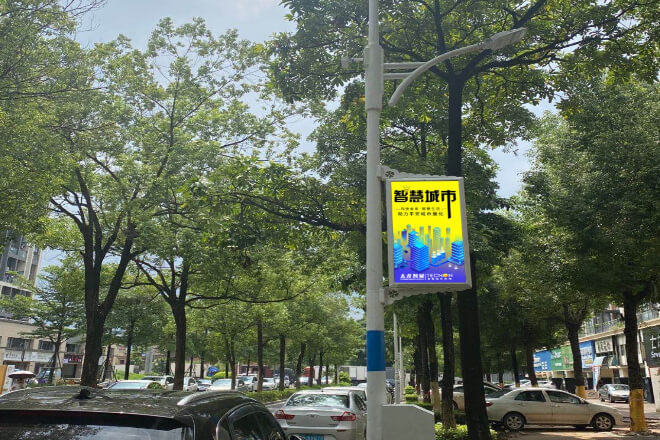
A major feature of pole LED displays is their ability to integrate well into the distributed space of a city, unlike large advertising screens that need to be concentrated in fixed locations.
It is more suitable for application scenarios with “many points and wide coverage,” such as roads and streets.
From an aesthetic standpoint, lampposts are an integral part of urban infrastructure. Adding LED displays doesn’t appear obtrusive.
Instead, the overall visual harmony is enhanced, allowing for a more natural integration with the surrounding environment.
It neither disrupts the streetscape nor places excessive visual burden on the urban landscape.
In practical deployment, its installation is relatively flexible. Based on road structure, pedestrian and vehicular traffic density.
And information dissemination needs, targeted placement at different locations achieves broader coverage without relying on a single large-scale installation.
For example, on a main urban road, instead of installing a large, fixed screen, it’s more efficient to distribute small displays along multiple lampposts.
This allows information to “naturally extend” along the road, reaching different groups of people in different locations, resulting in more even coverage and better aligning with actual traffic flow.
Compared to indoor screens or large advertising screens, pole LED displays emphasize “emergence with the scene,” flexibly integrating into the daily environment without altering the existing urban structure.
Making information dissemination more natural and aligning better with the usage logic of urban spaces.
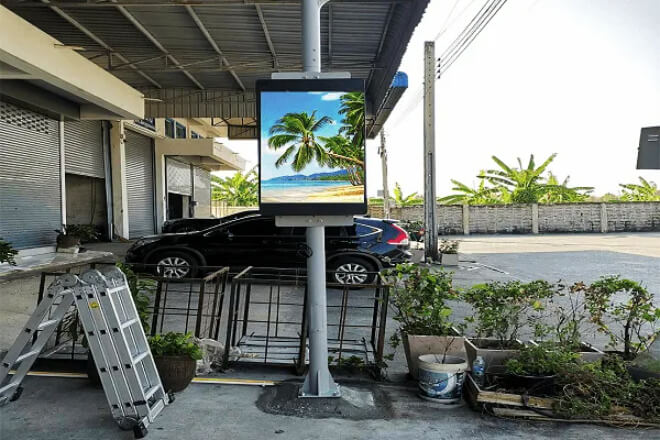
Pole LED displays not only “display information” but also become nodes in the city‘s smart neural network.
They can connect to urban management systems, IoT platforms, and even link with various sensors.
Transforming collected data into visualized information in real time, providing reliable support for city operations.
Imagine: On a busy main road, pole LED displays can automatically update their content based on data such as traffic flow, air quality, and weather conditions.
They can alert you to congested areas during the morning rush hour, broadcast air quality indexes at midday, and immediately push warning messages in case of emergencies.
It’s like equipping each light pole with a “little brain,” constantly sensing the environment and responding quickly.
Compared to traditional LED screens, it’s not just a “display tool” but also a scalable smart city terminal, capable of forming a network with other systems.
Making city management smarter, information dissemination more accurate, and upgrading LED screens from simple “billboards” into an integral part of city operations.
In short, pole LED displays are not just lit screens; they are “intelligent nodes” for urban information flow.
Making the city understand you better and information dissemination smarter and more efficient.
 English
  Español
  简体中文
简体中文  Français
  日本語
日本語  한국어
한국어  العربية