

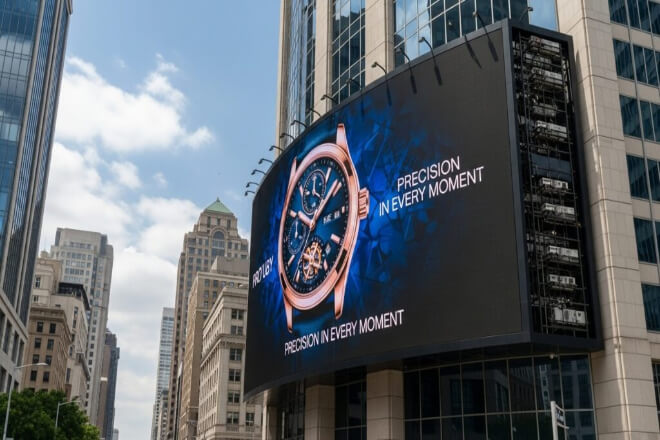
At night, more and more buildings are beginning to “speak”—not through lighting, but by transforming their facades into giant, dynamic canvases using entire LED curtain walls.
Firstly, LED facades create dynamic visual landmarks. When the entire facade of a building is illuminated as a continuous Ecran LED, it is no longer just a “building,” but one of the most easily noticed elements in the city.
For example, some urban landmarks display flowing light and shadow, breathing-like changing colors, and even change over time like a “city skin,” making them instantly memorable.
Secondly, they display artistic images and digital content. LED curtain walls not only play advertisements but can also carry artworks, digital animations, and even city-themed content.
Sometimes it’s the abstract flow of light and shadow, sometimes it’s a visual narrative with a festive theme.
Such as dynamic fireworks during the Spring Festival or digital video projections during art exhibitions, turning the building itself into a “changing art installation.”
Simultaneously, this application is also enhancing architectural recognizability and urban influence.
What were originally just functional commercial buildings are gradually becoming urban landmarks through the visual expression of LED curtain walls.
Many people stop to take photos and record their observations as they pass by, even making the buildings the content shared on social media, transforming them from “existing in the city” to “being remembered by the city.”
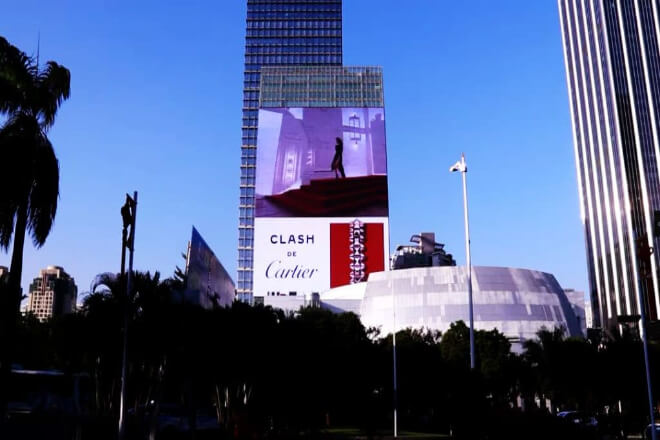
In art galleries, exposition halls, or brand spaces, LED displays are doing something very interesting: turning “static spaces” into breathing art scenes.
First, there’s the digital art display in art galleries and exhibition halls. Traditional exhibitions rely more on physical works, but the addition of LED screens makes the space itself part of the artwork.
For example, a wall is no longer just a background, but a constantly changing digital image—abstract light and shadow, artistic images.
And even dynamic visuals generated based on a theme, allowing viewers to continuously “enter new scenes” as they move.
Second, dynamic images enhance the immersive experience. As visitors enter the space, the LED content can change over time or along the visitor’s route.
Evolving from gentle color gradients to more dynamic visual impacts, and finally to richly detailed video presentations.
This variation encourages immersion, preventing visitors from simply “seeing and leaving,” and instead motivating them to linger, observe further, or even revisit the space from a different perspective.
Simultaneously, this approach enhances the space’s artistic expression. LEDs are not merely display tools, but integral parts of the spatial narrative.
They can make exhibition themes more complete and create a more unified atmosphere within the space.
For example, a technology theme might lean towards cool colors and structural elements.
While an art theme might emphasize fluidity and abstract expression, making the entire space feel like a “complete work of art” rather than a collection of individual pieces.
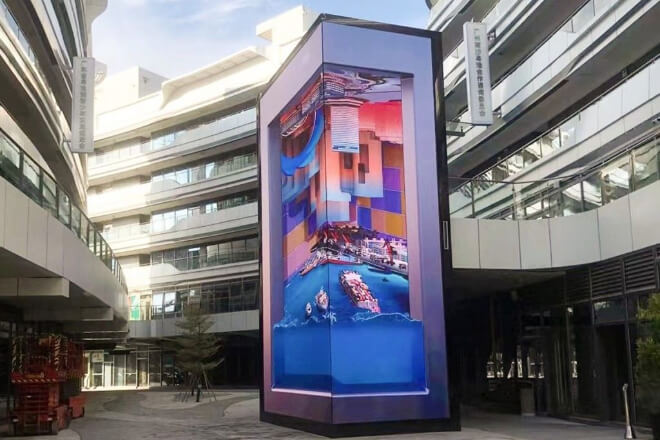
As LED displays move beyond simply being “square screens,” architectural expression becomes increasingly imaginative.
Firstly, there’s the application of curved screens, transparent screens, and custom-designed irregularly shaped screens. For instance, curved LEDs extend naturally along the building’s exterior walls, resembling a flowing ribbon of light.
Transparent LED screens are embedded in glass curtain walls, displaying dynamic images without obstructing natural light.
There are even custom-shaped screens tailored to the building’s contours, making the screen “grow” into the building rather than “attached” to it.
Secondly, there’s the integration with the building structure. Good irregularly shaped LEDs aren’t added later; they’re involved from the architectural design stage.
For example, in commercial complexes, LED screens might extend along building corners or be embedded in the atrium structure, allowing light and shadow to change with the building’s movement.
The images seen by viewers differ from different angles, somewhat like the building “changing expressions.”
Simultaneously, this design creates a unique visual language. Compared to traditional square screen advertisements, irregularly shaped screens are more likely to create memorability—you know “this place” at a glance.
For example, a city landmark might use a ring-shaped LED structure to create a floating halo when lit up at night, or a wave-shaped screen might simulate the flow of water, giving the building itself a narrative quality.
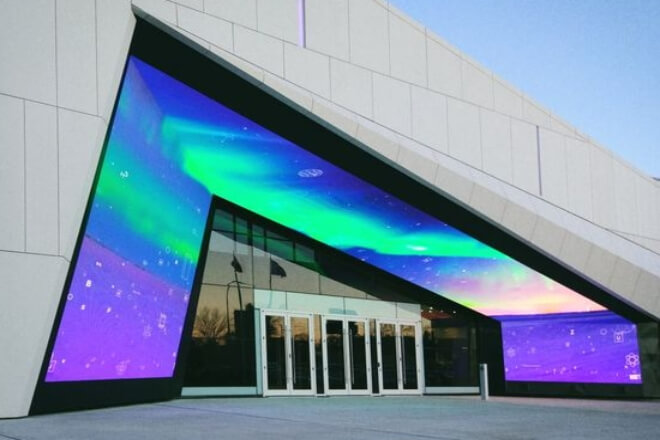
In many modern commercial spaces, exposition venues, and even urban public spaces, LED displays are transforming from mere “screens for displaying content” into interactive installations that respond to the audience.
Firstly, there’s the application of human-screen interactive art installations. Audiences are no longer just standing in front of the screen watching.
They can “participate.” For example, the image expands as someone approaches, water ripples change with footsteps, or the screen content changes with a gesture.
Some exhibitions even make the audience part of the scene, automatically generating dynamic art effects the moment a photo is taken—it’s like “the scene starts working for you the moment you appear.”
Secondly, there’s real-time sensing and dynamic feedback. Through infrared sensors, cameras, or radar technology, LED screens can recognize a person’s location, actions, and even the duration of their stay, then adjust the image accordingly.
For example, the more people there are, the more “lively” the scene becomes; the longer people stay, the richer the visual changes.
This “how you participate, that’s how it responds” mechanism transforms the screen from a one-way output into a two-way communication.
Simultaneously, this interactive design also enhances the audience experience and memorability. Compared to simply watching a video, participatory experiences are more easily remembered.
Many people may forget the specific content after leaving the exhibition, but they will remember, “I was standing there, and the image moved with me.”
This experiential aspect itself becomes part of the communication and may even be captured and shared on social media.
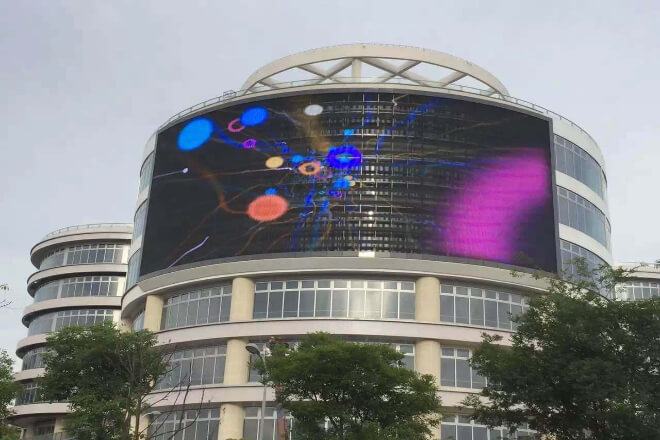
At night, city buildings are not merely “illuminated,” but enter a more expressive state. The addition of Afficheurs LED transforms nighttime scenes from simply “brightening up” to “moving and emotional.”
Firstly, there’s the linkage between dynamic lighting and LED content. The lighting on building facades is no longer fixed in color temperature or a single mode, but can change synchronously with the LED screen.
For example, if the screen displays flowing light and shadow, the lighting responds rhythmically.
When the screen switches to a holiday theme, the building’s lighting adjusts its color accordingly, making the entire building seem to “breathe with the image.”
Secondly, it enriches the visual layers of buildings at night. Traditional nighttime scenes rely more on “brightness contrast,” but with the addition of LED content, buildings exhibit a layered effect of foreground, background, and dynamic content.
For example, the upper layer might feature soft light strips, the middle layer dynamic images, and the lower layer architectural structural lighting effects.
The overall effect is no longer monotonous but rather a layered, rhythmic, and varied visual experience.
Simultaneously, this approach enhances the value of the city’s nightscape. A building with LED expressive capabilities often becomes a highlight of urban nighttime tours.
Attracting people to stop, take photos, and check in, transforming the building from mere “background lighting” into a “city landmark.”
Some cities even use festival-themed content to create a unified nighttime atmosphere for entire areas, further amplifying the city’s image.


 English
  Español
  简体中文
简体中文  Français
  日本語
日本語  한국어
한국어  العربية