

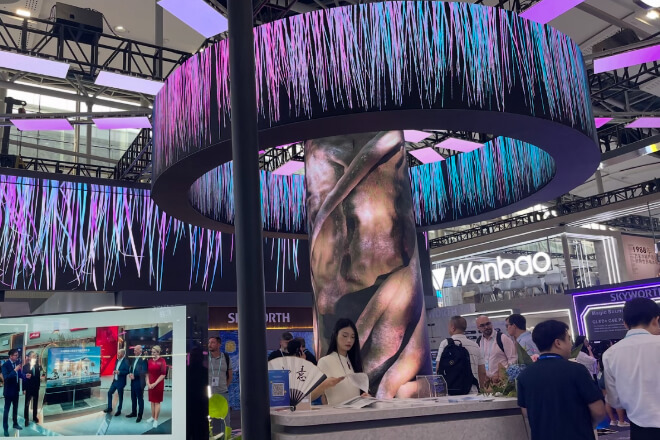
Ordinary LED screens have some “directional” feel—the most comfortable to view from the front, but the effect diminishes from the side.
But people in centres commerciaux, exposition halls, and aéroports won’t obediently stand in line directly in front of the screen.
A 360° surround LED screen is different. It allows content to unfold around the entire structure, visible from different directions.
Making it particularly suitable for open spaces such as shopping mall atriums, exhibition hall centers, hôtel lobbies, and transportation hubs.
For example, placing a cylindrical LED screen in a shopping mall atrium means customers passing by escalators, corridors, or shops are likely to see the advertisements and event information on the screen.
Brands don’t need to worry about “which side is the main screen,” because it essentially has no “back side.”
In high-traffic areas, this multi-directional display expands content coverage. The same advertisement doesn’t need a larger flat screen to cover the space; instead, the wraparound structure allows more eyes to naturally reach the content.
Even more interestingly, a 360° screen can make the content itself part of the space. For example, when playing flowing light effects, brand animations.
Or city visuals, the image can continuously unfold around the screen, creating a more complete visual experience than a single wall.
Therefore, the key to a 360° wraparound display isn’t just “more directions to see,” but transforming the screen from a visual plane into a three-dimensional content carrier.
An LED screen without a back panel might truly be “visible from all sides.”
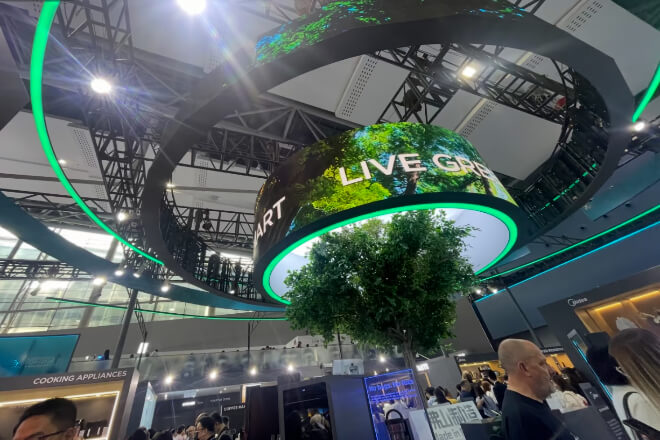
The biggest advantage of a regular square LED screen is its stability, but the problem is also obvious—everyone has seen it before, and it’s easy to forget after seeing it.
A circular LED screen, however, already has a certain presence simply because of its shape.
The circular structure reduces the flatness of traditional rectangular screens, transforming the screen from a “device mounted on the wall” into a visual installation within the space.
Especially in open spaces like centre commercial atriums, showrooms, and hôtel lobbies, a suspended or wraparound LED screen easily becomes a focal point.
For example, a circular LED screen can be suspended in a shopping mall atrium to play brand advertisements, holiday animations, or dynamic light and shadow effects. Customers may notice the “glowing ring” even before they see the content.
Hotel lobbies can use circular screens to display artistic visuals, adding a touch of technology to the space;
In technology showrooms, circular displays can showcase data, product information, or brand stories.
Another interesting aspect is that the ring shape itself is easily remembered.
When brand logos, dynamic content, and lighting effects are combined with the circular structure, the screen can even become a visual landmark of the venue.
Therefore, the value of a circular LED screen is not just “changing the shape,” but transforming the space from: “There’s an LED screen here” to: “There’s a very special visual center here.”
After all, people might glance at a square screen and move on, but a 360° illuminated ring suspended in mid-air will inevitably draw attention.
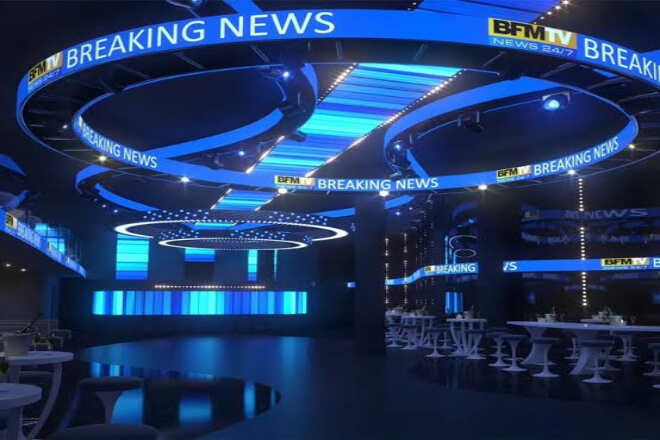
Using LED screens on organiser merely as a “backdrop” is a waste of their potential.
Especially in concerts, galas, and press conferences, audiences are not just watching the performance, but also experiencing the lighting, music, and the overall mood of the space.
A circular LED screen can be placed above the stage, around the stage, or even as part of the stage’s visual structure.
Combined with lighting and music, the image can continuously rotate and change, extending the stage’s visual effect from a single plane to the entire space.
For example, at the start of a concert, the circular screen can play rapidly rotating light effects that change with the rhythm of the music;
At a brand launch, new product images, logos, and promotional content can unfold along the circular structure.
Before the host even says “Welcome everyone,” the visuals have already created an atmosphere.
For large events, a circular LED screen has another advantage: it doesn’t fix the audience’s gaze in one direction.
Audiences in different areas can see parts of the image, making the stage feel more cohesive.
If you add lighting, sound, and dynamic content, the entire stage is no longer just “screen + program,” but rather a constantly changing digital scene.
Therefore, the value of a circular LED screen on a stage goes beyond simply making the background cooler;
It helps the event establish a stronger visual rhythm and a more immersive experience.
The stage remains the same, but when the LED screens start rotating around it, the atmosphere becomes anything but quiet.
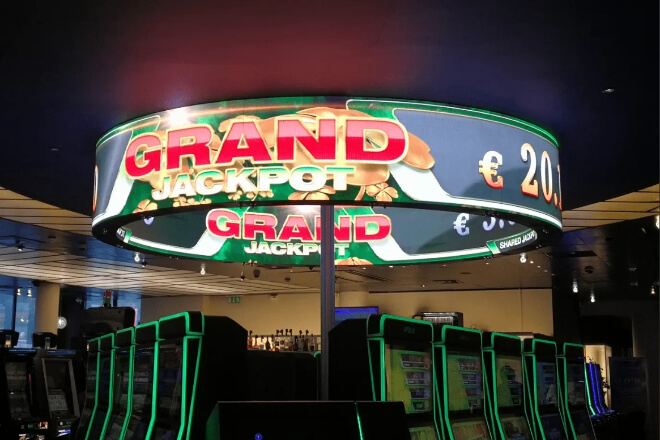
Advertising spaces in centres commerciaux are always vying for attention. Ordinary flat advertisements can only wait for customers to walk right in front of them.
But a circular LED screen offers a different approach—since customers come from all directions, the advertisement doesn’t have to face only one direction.
Circular LED screens are particularly suitable for high-traffic spaces such as mall atriums, commercial complexes, and brand experience zones. T
hey can display brand advertisements from multiple directions, giving customers on different paths a chance to see the content and making it easier to become a visual focal point in the space.
For example, a circular LED screen hanging in a mall atrium can play brand advertisements and new product promotions on ordinary days;
At Christmas, it can switch to holiday-themed animations; and during Black Friday or anniversary sales, it can quickly switch to promotional information.
The same advertising space doesn’t need to be rebuilt; simply changing the content can give it a “new identity.”
Moreover, dynamic content is easier to create visual variation than static posters.
For example, a car brand can have its vehicles “circle” around the circular screen, while a fashion brand can have its new product visuals continuously appear in a circular pattern.
Customers may just be passing by, but their peripheral vision has already been “caught” by the advertisement.
For business operators, this also means that a circular LED screen can handle more content: brand advertising, event promotion, holiday marketing, and even business collaborations can all be flexibly adjusted according to time and needs.
Therefore, its commercial value is not just “brighter advertising,” but rather, through multi-directional display + dynamic content + flexible updates, it allows limited space to have more exposure opportunities.
An advertising screen that moves around is at least more likely to be glanced at by customers than a poster stuck there waiting to be seen.
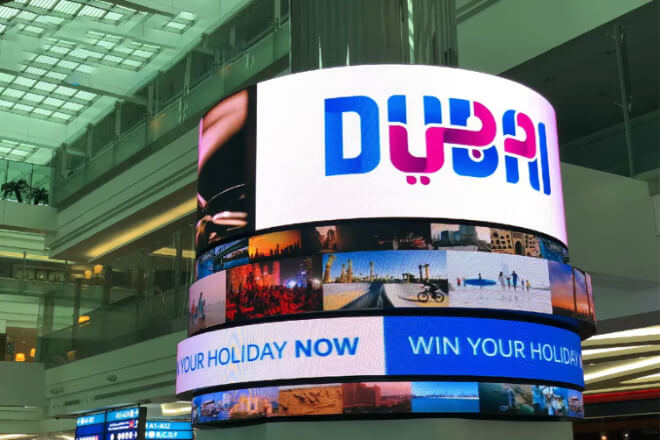
Some spaces look beautiful, but not much of them is actually usable.
For example, the circular structures and central hanging areas in aéroports, train stations, and exposition halls may just be “occupying space” most of the time.
If it’s already there, why not make it work too?
Circular LED screens can transform previously underutilized spaces into digital content carriers, displaying navigation information, event announcements, real-time updates, and venue introductions.
Especially in high-traffic areas like airports and train stations, multi-directional displays ensure information is visible to people on different routes.
For example, a circular LED screen suspended in the center of an exhibition hall can display the current exhibition theme, event times, and visitor information;
In airport lobbies, it can be combined with flight information and directional guidance, allowing travelers to quickly access content while moving.
It doesn’t necessarily broadcast announcements every day. When there’s no important information, it can switch to digital art, cityscapes, brand visuals.
Or interactive content, allowing the circular screen to simultaneously serve as an information display and a space atmosphere creator.
For instance, a technology exhibition hall can use it to display real-time data and exhibition information during the day, and switch to digital art effects like starry skies and particles at night.
By day, it resembles an information center; by night, it’s a luminous art installation.
Therefore, the advantage of circular LED screens is not just “an extra screen,” but rather the revitalization of previously idle or difficult-to-use three-dimensional spaces.
What might have been just a ring in the past can now be a navigation sign, an information center, or the most eye-catching digital installation in the entire space.


 English
  Español
  简体中文
简体中文  Français
  日本語
日本語  한국어
한국어  العربية