
Introduction
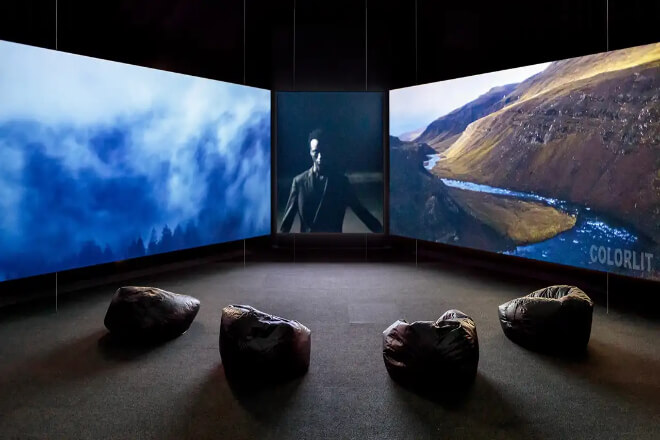
In many scenarios, data itself is not lacking; what is truly scarce is the “efficiency of being understood.”
Whether it’s a corporate meeting, a showroom exposition, or operational monitoring, data that remains merely on reports or small screens is unlikely to generate real value in a short time.
This is why more and more organizations are introducing Afficheurs LED—not to “display more data,” but to make data more intuitive, timely, and persuasive.
When data is better presented, it is easier to understand, discuss, and even translate into decision-making.
Table des matières
Advantage 1: Large-screen visualization improves data understanding efficiency.
Often, the problem isn’t a lack of data, but rather incomprehensibility. Dense tables, complex numbers, and lengthy PowerPoint presentations easily cause people to lose focus.
L'émergence de grands écrans LED acts like a “translator” for data, transforming complex content into intuitive and easily understood visual information.
In conference rooms, command centers, or data monitoring scenarios, large-sized LED displays can transform data into charts, dynamic graphs, trend lines, and even real-time visualizations.
Compared to traditional display methods, large screens are not only clearer but also amplify key information, allowing viewers to grasp crucial details at a glance—requiring minimal explanation and enabling everyone to quickly follow along.
More interestingly, large screens not only enhance the viewing experience but also transform the way we communicate.
For example, in reporting or decision-making scenarios, when data is presented dynamically in real-time, trends and anomalies become immediately apparent.
Teams no longer spend time explaining “what does this table mean,” but instead jump straight into discussion: “What should we do next?”
Furthermore, large screens have a hidden advantage—they act as a “focus amplifier.” When everyone’s attention is focused on the same screen, information becomes more unified, and discussions become more efficient.
Compared to individuals staring at computer screens, large screens facilitate consensus and create a stronger sense of “doing something important.”
In short, LED large screens are not just display tools but powerful tools for simplifying data. They make complex information more intuitive, communication smoother, and every analysis and decision more efficient and organized.
Advantage 2: High Brightness Ensures Clear Data Visibility
In some scenarios, information isn’t undisplayed, but rather—”unreadable.”
Especially in exposition halls, trade shows, or brightly lit environments, ordinary screens are easily obscured by ambient light, and even important content may be overlooked.
This is where the high luminosité advantage of LED displays becomes apparent. Even in strong light, the image remains clear and has high contrast, ensuring key information isn’t lost.
Whether it’s product data, demonstration content, or real-time information, it can be consistently and accurately conveyed to the audience.
More interestingly, this clarity isn’t limited to close-up viewing. Even from a distance, data and charts on the large screen can still be easily read.
This is particularly important for trade shows or large spaces—no matter where the audience is standing, they can “see and understand.”
This not only enhances the display effect but also strengthens the reliability of information delivery.
You don’t need to worry about audiences missing key points due to poor visibility, nor do you need to repeatedly explain the content.
The screen itself has already “clearly explained” the information for you.
In short, high-brightness LED screens are like adding a layer of “magnification and bolding” to information.
They’re not afraid of light or distance, ensuring that every key data point is accurately received, making presentations more reliable and professional.
Advantage 3: Dynamic Displays Enhance Data Expressiveness.
Many data points are not inherently complex, but once transformed into static charts, they can easily become dull and difficult to grasp.
The dynamic display capabilities of LED screens solve this problem—making data “speak” rather than “lying still.”
Through animation effects, trend changes, and real-time updates, data can be presented more intuitively.
For example, a slowly rising growth curve, a key indicator dynamically highlighted, or even data updating in real time.
These details naturally attract attention, making it easier for viewers to understand “what changes have occurred.”
Even more interestingly, dynamic displays can help you “highlight key points.” Compared to a static chart that requires human explanation.
Animation automatically guides the eye—where the key points are and where changes are occurring are immediately apparent.
Viewers don’t need to spend time deciphering complex information; instead, they naturally understand the content by following the rhythm of the visuals.
Dans exposition halls, conferences, or data monitoring scenarios, this form of presentation is also more appealing.
People are more willing to see “moving content” and are more likely to remember dynamically presented information.
Compared to static charts, dynamic displays not only improve comprehension efficiency but also enhance the overall attractiveness and professionalism of the presentation.
Simply put, LED dynamic displays are like adding “life” to data, making information clearer, more rhythmic, and easier to see, understand, and remember.
Advantage 4: Ultra-large size supports multi-dimensional data display
In many business scenarios, data is never singular but rather a collection of information from multiple systems and dimensions.
If traditional small screens or scattered devices are used for display, it is easy to encounter situations where “you can see it, but not all of it,” requiring frequent page switching, which reduces efficiency.
The advantage of ultra-large LED screens is that they can integrate multiple data modules into a single display.
For example, in a monitoring center, operational status, key indicators, alarm information, trend analysis, and other content can be presented side-by-side.
In an operations platform, information from different dimensions, such as sales data, traffic changes, and user behavior, can also be viewed simultaneously. A single screen can provide a comprehensive view.
Even more interestingly, this “panoramic” display not only increases information density but also improves decision-making efficiency.
Managers no longer need to switch between different systems; instead, they can access complete information simultaneously and in the same space, making holistic judgments rather than being limited by single data points.
Furthermore, the large size not only allows for more data to be displayed but also for clearer viewing.
A well-planned layout ensures each data module has a clear hierarchy and focus, preventing overcrowding or chaos and making information presentation more orderly and intuitive.
Simply put, a super-large LED screen acts like a “data control center,” integrating scattered information, simplifying complexity, unifying disparate elements.
And making information management and decision-making processes more efficient and clear.
Advantage 5: High Refresh Rate Ensures Smooth and Stable Data Display
In today’s increasingly dynamic data display landscape, “clear viewing” is no longer enough; “smooth viewing” is also crucial.
If the image stutters, ghosting, or skips frames, it not only affects the viewing experience but may also create an unstable perception of the information.
Le haut fréquence de rafraîchissement of LED displays perfectly solves this problem. Whether it’s real-time data changes, continuously updated charts, or rapidly switching screens.
A smooth presentation is maintained, ensuring that every data change flows naturally rather than appearing disjointedly.
This smoothness is especially important in dynamic scenarios. For example, in real-time data from a monitoring center, presentation content in a meeting, or changes in operational platform metrics.
A high refresh rate ensures stable, flicker-free, and ghosting-free visuals, allowing viewers to focus on the content itself rather than being distracted by visual clutter.
More interestingly, this “smooth” experience subtly enhances the credibility of the information.
When the screen is stable and transitions are natural, the overall presentation appears more professional and reliable, making the displayed data easier to accept and understand.
Simply put, a high refresh rate is not just a technical parameter, but a guarantee of user experience.
It makes data display more coherent and clear, and ensures that every piece of information is transmitted more stably and reliably, a significant advantage in critical scenarios.
6. Conclusion
The value of LED displays in data presentation is not just about being “bigger and brighter.”
It changes the relationship between data and people—making complex information easier to see and key metrics easier to understand.
As data transforms from static information to dynamic expression, and from fragmented presentation to centralized display, its role shifts from a “display tool” to “decision support.”
In a digital environment, how data is presented is becoming as important as the data itself.
Finally, for more information about LED displays, veuillez nous contacter.
 English
  Español
  简体中文
简体中文  Français
  日本語
日本語  한국어
한국어  العربية