
Introduction
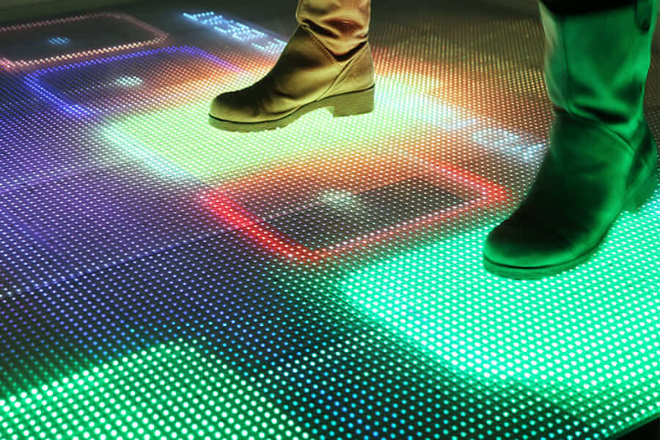
When an Ecran LED “lies” on the ground, the way it’s used changes.
It’s no longer just something to be “seen,” but something that can be stepped on, interacted with, and truly experienced.
This is why Écrans de sol LED are becoming a new tool for attracting attention in more and more spaces.
Table des matières
Scenario 1: Interactive Traffic Generation in Commercial Complexes

Dans des endroits comme centres commerciaux, people are actually “on their way”—shopping, looking for stores, going to eat—and often don’t intentionally stop.
This is where LED floor displays come in: turning the “path underfoot” into an attractive interactive space.
First, interactive content on the ground is naturally more eye-catching. Wall advertisements might be ignored, but when moving images suddenly appear underfoot, it’s hard not to look down and glance at them.
For example, as customers enter the mall atrium, the floor tile screen under their feet suddenly displays a “water ripple” effect, spreading out with each step.
Or it “blooms” when stepped on. Many people’s first reaction is, “Hey, this is interesting,” and they naturally stop.
Secondly, it’s particularly suitable for mall atriums and brand pop-up events. When brands hold events, LED floor screens can be transformed into interactive zones, allowing customers to not just “watch the event,” but “step into it.”
For example, in a sports brand pop-up store, the floor screen can be designed to resemble a running track, making customers feel like they’re running on a “racetrack” when they step on it.
Or it can be made into a mini-game where stepping on a designated area triggers brand animations, creating a strong sense of interaction.
More importantly, it significantly increases dwell time and consumer interest. People stopping means more opportunities to look at nearby brands, participate in activities, or even casually browse the stores.
For example, someone might initially just be passing through the atrium, but then stop for a few minutes because of the interactive floor tile screen.
And notice the new store next door—this is where the real “traffic generation” happens.
Scenario 2: Enhanced Visuals for Stage Performances

In stage performances, the audience focuses on the “overall feeling.” If there’s only a background screen, the image might be large, but it always feels like it lacks a sense of “immersion.”
In this case, the addition of Écrans de sol LED transforms the stage from a “flat” space into a “three-dimensional space.”
Firstly, it interacts with the background screen, creating a stronger sense of immersion.
The images displayed on the walls change synchronously with the floor tiles, transforming the organiser from a mere screen into a living, breathing space.
For example, a singer stands in the center of the stage, the backdrop displays a starry sky, and the LED floor screens simultaneously transform into a flowing galaxy effect.
Making the audience feel as if the stage is “floating in space”—the visual impact is immediate.
Secondly, it’s particularly suitable for concerts, galas, and product launches.
Different scenes can be quickly switched using the floor LED screens, eliminating the need for rebuilding sets and allowing the stage to instantly “change scenes.”
For instance, at a product launch, as the product is introduced, the floor LED screens gradually extend from the brand logo into a path of light.
Complementing the backdrop and lighting, instantly maximizing the sense of ceremony.
More importantly, it adds depth and dimension to the stage. Performers aren’t standing on an “ordinary floor,” but within a “changing visual tapestry,” giving the stage more depth.
For example, wherever a dancer moves, the visuals beneath their feet change, as if they’re stepping on water, flames, or clouds, making it easier for the audience to be immersed in the performance.
Scenario 3: Immersive Experience in Cultural and Tourism Scenic Spots
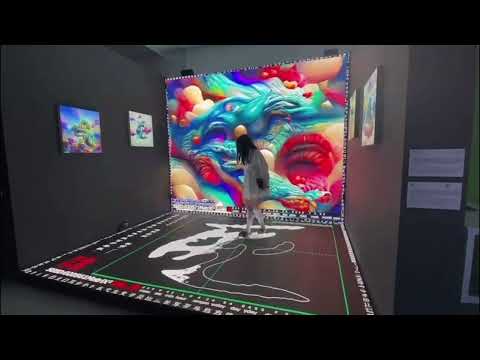
Many scenic spots and exhibition halls are now competing not just on “what to see,” but on whether visitors feel like they are “walking in.” The role of floor LED screens here is to make the “ground” part of the experience.
Firstly, it’s particularly suitable for nighttime tours of scenic spots, themed exposition halls, and museums.
Previously, people mainly looked at walls and exhibits; now, even the ground beneath their feet can “tell stories,” creating a more immersive space.
For example, in a nighttime scenic area, as visitors walk along a path, the Affichage LED au sol ripple with “water ripples” or “starlight,” giving them the feeling that “I’m not just walking, I’m entering a scene.”
Secondly, dynamic ground content significantly enhances the experience. Compared to static floors, LED floor displays can change content according to the theme.
For example, in an ocean-themed pavilion, visitors walk on the floor and see schools of fish swimming beneath their feet; in a forest-themed area.
It transforms into falling leaves and the interplay of light and shadow in the woods, making even walking feel engaging.
More importantly, it enhances visitor interaction and creates memorable experiences.
Often, what visitors remember isn’t necessarily the text on the display panels, but rather, “That interactive element was really fun!”
For example, children chasing after “runaway animals” on their feet, while adults film and laugh.
Is an experience that’s more memorable and easier to share on social media than simply “looking at the exhibit.”
Scenario 4: Creative Interactive Exhibition Displays

What’s the worst thing about exhibitions? It’s not a lack of visitors, but people walking too fast.
People browse des expositions “walking and looking,” and if you can’t immediately grab their attention, they’re easily passed by. The role of LED floor displays is to “stop” people in the first place.
Firstly, they’re particularly suitable for exhibition booths and brand experience centers. Compared to ordinary display panels, LED floor displays are dynamic and interactive, naturally making it easier for people to stop and look.
For example, as visitors approach a booth, the screen displays the brand logo spreading outwards with their steps.
Or extends into the product area like a “lit path,” subconsciously guiding them in—a very natural form of guidance.
Secondly, human-screen interaction makes product displays more engaging. It’s not about “standing and looking at the product,” but rather “walking in and the product interacting with you.”
For example, at a car brand booth, when a visitor steps onto a designated area, the floor tile screen immediately displays animated tire tracks, speed lines, or vehicle parameters.
The product information instantly comes alive, no longer just a static display.
More importantly, it significantly enhances brand appeal. In the information-dense environment of an exhibition, whoever grabs attention first is more likely to be remembered.
For example, given two booths, one simply displays products, while the other has an interactive floor tile screen, visitors are more likely to go to “the one that moves.”
Scenario 5: Children's Entertainment and Educational Spaces

Children have almost no resistance to “moving things,” especially things that move under their feet.
Placing floor LED screens in children’s spaces often has a direct effect—children will run over to play on their own.
Firstly, it’s very suitable for science musées, children’s playgrounds, and interactive classrooms.
Compared to “sitting and listening, standing and watching,” floor LED screens allow children to run and play, greatly increasing their engagement.
For example, imagine a group of “escapable little fish” suddenly appearing on the ground. Children chase and stomp on them, the fish swimming away wherever they step, creating a lively, laughing atmosphere.
Secondly, interactive fun significantly increases participation. Often, children don’t dislike learning, but rather the feeling of being “taught.”
However, if the content is presented as a game, they will actively participate.
For instance, in an interactive classroom, the teacher guides children to step on the correct numbers.
A reward animation appears under their feet upon a correct answer, making the children feel like they are playing a game while actually memorizing the knowledge.
More importantly, it simultaneously enhances both entertainment and education. It has both a “fun” element and a “learning” element, making it more appealing to parents.
For example, in a science museum, children stepping on different areas triggers an introduction to the planets of the solar system, learning while jumping.
In an amusement park, they might step on musical notes or colors, naturally blending entertainment and learning.
6. Conclusion
The value of floor LED screens goes beyond simply displaying images on the ground.
What they truly bring is a stronger sense of interactivity and immersion, transforming the space from “viewable” to “participable.”
Sometimes, a truly engaging experience begins right where you step.
Enfin, pour plus d'informations sur les écrans LED, veuillez nous contacter.


 English
  Español
  简体中文
简体中文  Français
  日本語
日本語  한국어
한국어  العربية