

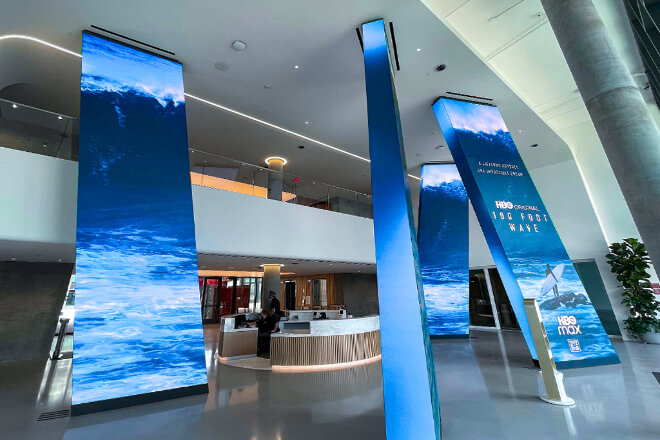
Many office building LED screens, after installation, fall short of expectations: Screens that are too large make the lobby feel cramped;
Screens that are too small fail to create the right atmosphere for the business space; and poorly chosen locations can interfere with pedestrian flow.
Therefore, the first step in planning a large screen is not to rush to determine the size, but to first determine what kind of screen is best suited to the lobby space.
The screen size needs to be determined by considering the lobby’s ceiling height, space area, distance de visualisation, decoration style, and pedestrian flow.
Installation methods such as recessed, wall-mounted, and suspended installations should be chosen based on site conditions to ensure the LED screen blends naturally into the architectural environment.
For example, in the spacious lobbies of high-end office buildings, large Écrans LED can display company logos, welcome messages, and brand promotional videos.
If the space is relatively compact, a more refined screen size can be chosen to avoid making the originally spacious lobby feel cramped.
Simply put, a large LED screen isn’t necessarily more impressive the bigger it is; it needs to “get along” with the lobby.
Appropriate size, comfortable location, and natural installation are essential to achieving a professional atmosphere without obstructing the space or hindering pedestrian traffic.
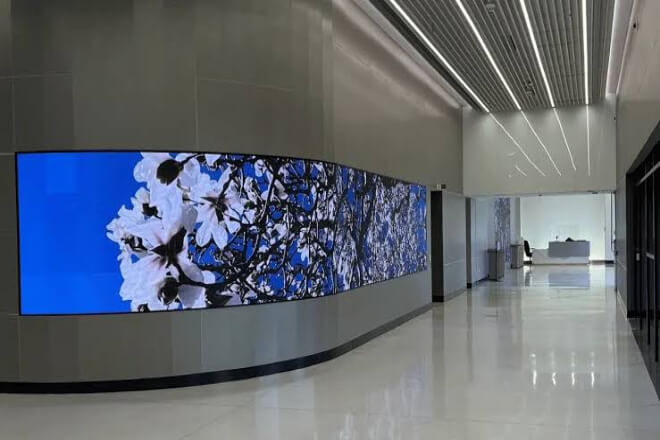
Office building lobbies typically have excellent natural lighting, especially in commercial buildings with many glass curtain walls.
During the day, when sunlight streams in, the LED screen is like it’s suddenly undergoing a “light test.”
If the display parameters are not selected correctly, problems such as glare, color distortion, and blurred details can easily occur.
Despite a significant budget being allocated to the screen, it ultimately failed to reflect the lobby’s sophisticated feel.
Lobby LED screens are typically used for company logos, brand promotional videos, business information, and visitor welcome messages, so the image quality cannot be taken lightly.
During planning, it’s crucial to consider the actual distance de visualisation, focusing on pas de pixel, luminosité, color gamut, and anti-glare capabilities to ensure a clear and natural display at all times.
For example, during the day, with sunlight streaming through the glass curtain wall, insufficient screen brightness can make brand promotional videos appear hazy;
Conversely, at night when the environment is dark, excessively high brightness can be glaring to receptionists and visitors.
Appropriate brightness and display parameters are essential for a comfortable viewing experience under varying lighting conditions.
Simply put, lobby LED screens aren’t about “the brighter the better,” but rather about achieving a harmonious relationship with light.
A screen that withstands sunlight during the day and doesn’t overshadow ambient lighting at night.
While maintaining a detailed image and true-to-life colors, is what truly elevates the business ambiance of the office building.
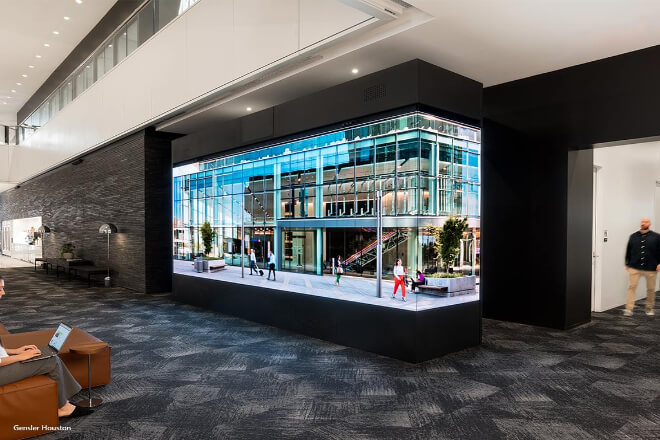
The LED screen in the office building lobby doesn’t need to be as loud and promotional as a shopping mall every day.
The focus here isn’t on discounted goods, but on the company image, building services, and business atmosphere.
If the content is too flashy or overly promotional, it can easily ruin the lobby’s original sophisticated feel.
Content planning can be simpler and more practical. On a daily basis, it can play company brand promotional videos, building announcements, time and weather, visitor welcome messages, friendly reminders.
And government information, making the screen not only visually appealing but also genuinely involved in building operations.
During holidays, it can switch to holiday-themed animations or visuals, changing the lobby’s mood with the holiday.
For example, when important clients visit, a company welcome message can be played in advance;
For meetings or large business events, the event theme and guidance information can be displayed;
And for holidays like Chinese New Year and Christmas, a simple holiday visual can be used to enhance the atmosphere.
In this way, an Ecran LED is not just a “backdrop,” but simultaneously fulfills three tasks: information dissemination, brand display, and atmosphere creation.
With content that can be flexibly changed according to different times and scenarios.
In short, office building LED screens don’t need to be constantly in the spotlight, but they also can’t be idle forever.
Content should be less promotional and more practical and high-quality to truly integrate into the office environment.
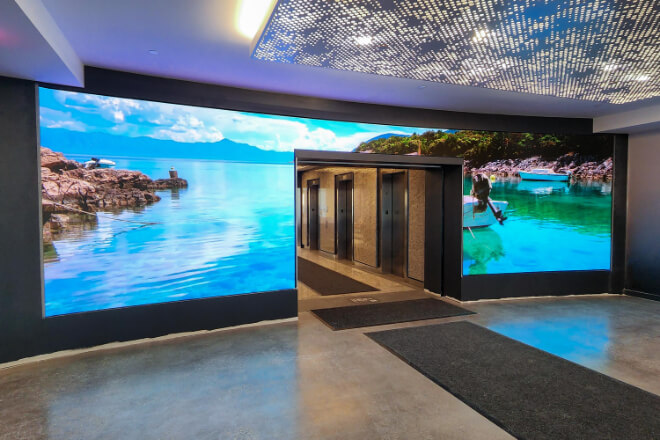
Office building lobbies are public areas open 24/7, and LED screens often operate for over ten hours at a time, or even continuously for extended periods.
In this case, the screen can’t start strong but then malfunction after a few hours. Stability, security, and durability are the real concerns for long-term use.
During planning, prioritize reliable, low-power, and low-failure-rate hardware, while also paying attention to dustproofing, moisture resistance, high-temperature resistance, and anti-aging capabilities.
Power supplies, wiring, and connectors should also be considered. Properly conceal wiring, implement anti-static measures.
And ensure proper heat dissipation to ensure stable operation without cluttering the lobby with a tangled mess of cables.
For example, if an LED screen operates for over ten hours a day, inadequate heat dissipation may not show immediate problems.
But over time, it could lead to decreased luminosité, localized abnormalities, or even system crashes.
Especially in high-end office buildings, if the screen suddenly goes black while a client is waiting at the reception, the company’s presentation hasn’t even started, and the embarrassment is already there.
Therefore, hardware selection shouldn’t just focus on how beautiful the image looks now; it’s also crucial to consider its long-term durability over the next few years.
Simply put, the ideal state for a lobby LED screen is: visually striking, yet as quiet as possible during operation.
Stable hardware, good heat dissipation, and safe wiring are essential for ensuring the screen’s long-term online operation and minimizing maintenance hassles for property management and operations personnel.
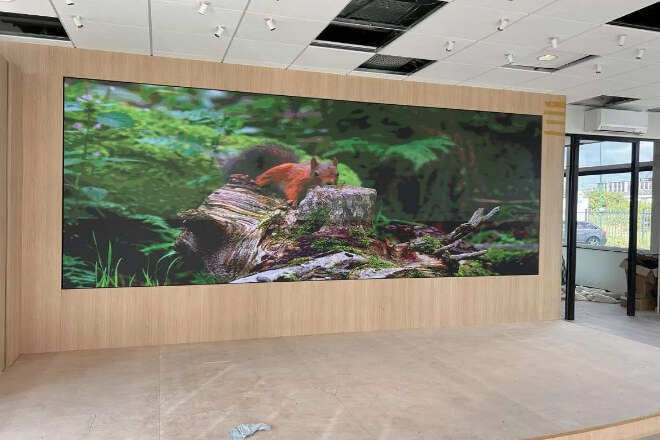
High-end office buildings emphasize efficiency and user experience. LED screens shouldn’t require staff to personally handle every screen change or brightness adjustment.
The more screens there are and the longer they are used, the more cumbersome this manual operation becomes.
Therefore, during the planning phase, an intelligent management system can be integrated, supporting functions such as remote content updates.
Scheduled power on/off, batch screen management, luminosité adjustment, operational monitoring, and fault alerts.
Property staff can complete most daily operations from their offices, saving considerable time spent traveling back and forth.
For example, the screen can automatically turn on at 8 AM to display a company welcome message and automatically turn off after office hours.
If an important client visits, the system can remotely switch between a welcome message and company promotional content.
If a screen experiences a signal anomaly, the system can promptly alert staff for quick troubleshooting.
Especially in office buildings with multiple LED screens, the intelligent system can manage the content across different areas.
Avoiding the awkward situation of “one screen being updated while another is still playing last month’s content.”
Simply put, the value of the intelligent system is to make LED screens more “sensible.”
It automatically turns on when needed, remotely updates content when necessary, provides timely alerts for problems.
Reduces the need for property management to make trips, and ensures the screens remain online at all times.


 English
  Español
  简体中文
简体中文  Français
  日本語
日本語  한국어
한국어  العربية