
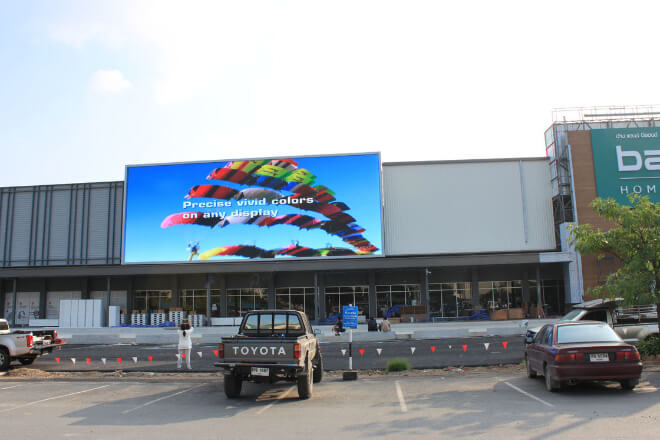
Do you sometimes stand in front of a dazzling array of Écrans LED and wonder, “Which one should I choose?” Don’t overthink it.
The key is to first clarify a few questions: Where will you place it? How far will the audience be? Will it display video or text information?
By grasping these key points, you can find the LED screen best suited to your business, one that is both eye-catching and cost-effective.
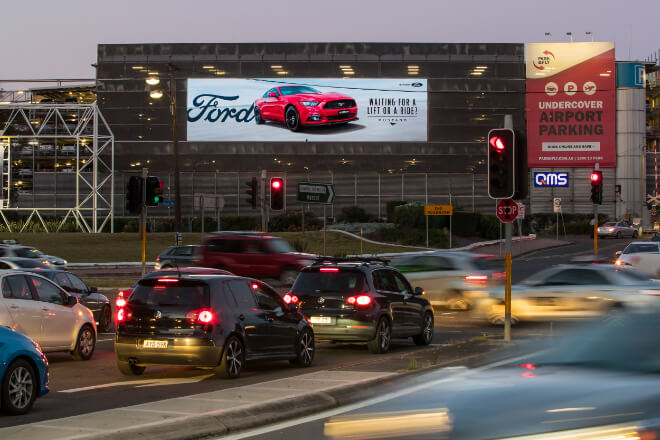
Before choosing an LED display, don’t rush to look at the price or model. First, think clearly about the most crucial question: Where will this screen actually be used?
Different usage scenarios have significantly different requirements for the screen.
If you don’t figure this out from the start, you might easily buy a screen that “looks high-end but feels awkward to use.”
1) The first step is to determine: Intérieur ou Extérieur?
If it’s for indoor use, such as in centres commerciaux, exposition halls, conference rooms.
Or retail stores, a small-pitch high-definition screen, such as P1.25–P4, is generally chosen.
The reason is simple—indoors, people are closer to the screen. If the pixel pitch is too large, it will look grainy, like watching a magnified mosaic.
Smaller pixel pitch screens offer a more detailed picture, making watching videos, product displays, or advertisements more comfortable.
For outdoor use, such as large screens in commercial streets, stades, or outdoor billboards, high-brightness, waterproof outdoor screens like P4–P16 are more suitable.
Outdoor sunlight is strong, and the environment is complex, so the screen not only needs high luminosité but also rain and dust resistance; otherwise, it will easily develop problems after a short period.
2) The second consideration is distance de visualisation.
Simply put: the closer you are, the more detailed the screen needs to be.
If the audience is within 5 meters of the screen, a screen with a small pas de pixel is recommended. This will result in clearer image details and a less grainy viewing experience for videos.
If the viewing distance is over 10 meters, a slightly larger pixel pitch is acceptable, as pixel differences are less noticeable at long distances, and it can save on costs.
3) Finally, a crucial point: what content do you plan to play?
If the screen is primarily used to display advertising videos, brand promotional videos, product displays, etc., then a higher résolution is definitely better, as it will produce a more textured image.
However, if it’s only displaying simple text, prices, time, or numerical information, there’s no need to pursue an exceptionally high resolution; a mid-range screen is perfectly adequate.
Having chosen the usage scenario and distance de visualisation, the next step is to consider the screen type.
Different types of LED screens not only differ in appearance, but also in display effects and interactive experiences.
It’s like choosing clothes for your “advertising darling”—the right choice instantly enhances the effect.
1) Standard LED Screen
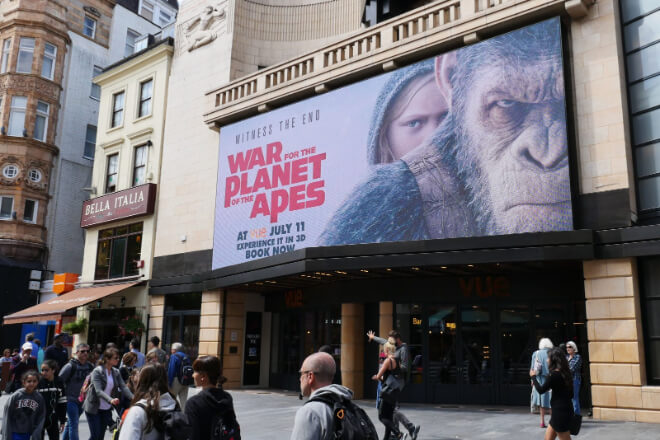
This is the most common type of LED screen. Flat and straightforward, it’s precisely this reliability that makes it a versatile choice.
Whether it’s a large screen in a centre commercial, a conference room, or an outdoor billboard, a standard screen can handle it all, providing a clear image and easily understandable information.
If your needs are more traditional, and the content is mainly advertising or information dissemination, a standard screen is the safest and most worry-free choice.

2) Flexible/Curved LED Screens
To make displays more interesting and eye-catching, try flexible or curved screens.
They can bend, wrap around, and even conform to specific spaces, making the screen more than just a “square.”
For example, in high-end retail store windows, art installations at des expositions, or brand pop-up events, curved screens can create a very cool visual effect, making customers want to stop and take a second look.
They can even integrate the screen with the space, making the entire store seem to “move.”
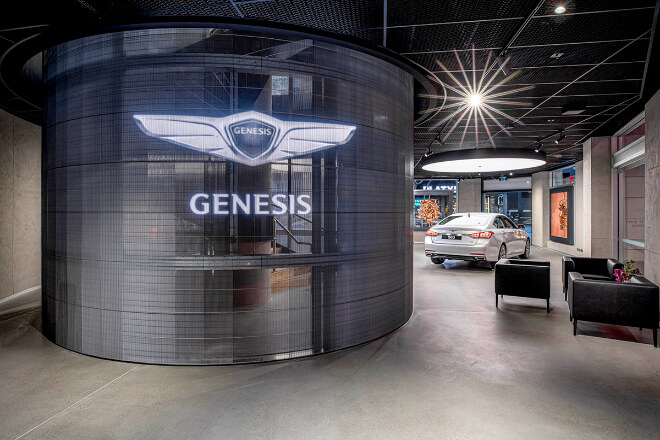
Transparent screens are a good friend to store windows, display cases, or glass curtain walls.
They can display dynamic content without obstructing the merchandise or view behind them, allowing customers to see the advertisements on the screen while simultaneously appreciating the actual products.
For example, in luxury brand windows, transparent screens play brand promotional videos, while customers can still see exquisite bags or watches.
The overall visual effect is modern and sophisticated, and it also increases interactivity—customers look at the screen.
And simultaneously stare at the merchandise, creating an experience that keeps their eyes glued to the screen.
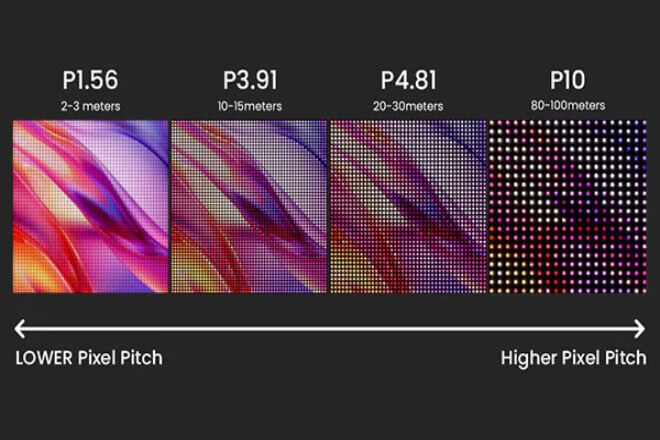
After determining the screen type, the next step is to consider the pas de pixel et résolution.
Simply put, this refers to the spacing between each “dot” on the screen, which directly determines the image clarity and viewing experience.
Imagine if the pixel pitch is too large, it will look like a mosaic when viewed up close; if it’s too small, it might be a waste of budget.
Close-range viewing (≤5 meters) → Small-pitch screen, recommended P1.25–P2.5. Suitable for showrooms, retail stores, or window displays, providing a delicate image where customers can see every detail of the product, even up close.
Medium distance (5–10 meters) → Medium-pitch screen, recommended P3–P6. For example, in centre commercial atriums, event stages, or food and beverage areas, ensuring clarity without wasting costs.
Long-distance billboards (over 10 meters) → Large-pitch screen, recommended P8–P16. Used for highway billboards and large plaza screens, ensuring the image remains clearly visible from a distance.
Here’s a rule of thumb for quick estimation: Screen size ÷ Pixel pitch ≈ Viewing distance × 1000.
This means that the physical size of the screen divided by the pixel pitch is roughly equal to the viewing distance (in meters) multiplied by 1000.
While a precise calculation isn’t necessary, it provides a reference point when choosing the pixel pitch, preventing you from buying too large or too small a screen.

Having chosen the screen type and pixel pitch, the next step is to consider practical questions: Can your wallet handle it? Is the investment worthwhile?
LED displays are certainly eye-catching, but they aren’t just decorative items that you can “place anywhere.” You must carefully weigh your budget against the return on investment.

After selecting the screen type, pixel pitch, and calculating your budget, the final step is to find a reliable supplier.
Don’t underestimate this step. Even the best LED screen can become a nightmare if you encounter an unreliable supplier.
Installation, debugging, and even later maintenance will turn into a series of troubles, causing not only stress but also potentially damaging your brand image.
1) Certifications and Case Studies
First, check if the supplier has formal certifications, such as ISO certification or product quality certification. This is like giving them a “grade.”
Then look at their case studies: Have they done similar projects? Do they have experience operating smoothly in similar environments?
Just looking at fancy promotional materials isn’t enough; real success stories speak for themselves.
For example, a supplier that installed an interactive LED window display in a large shopping mall, running it continuously for six months without problems, is more convincing than any advertising slogan.
2) Warranty and After-Sales Service
High-end LED screens represent a significant investment.
If the screen malfunctions, do you want an immediate response or a slow, drawn-out process? Therefore, check the warranty period and after-sales response speed.
Ideally, the supplier should provide on-site rapid handling or remote troubleshooting services. This way, even minor screen malfunctions won’t affect usage.
Imagine if your shop window screen breaks down, but your supplier can send someone to fix it the same day. You can continue operating normally, and your brand image won’t be affected.
3) Ease of Parts Procurement
Screens need parts to be replaced eventually. It’s crucial that the parts provided by the supplier are easy to procure and reasonably priced.
Modules, LEDs, and control cards should be readily available; otherwise, repairs will be troublesome and costly, and the screen might remain unused.
 English
  Español
  简体中文
简体中文  Français
  日本語
日本語  한국어
한국어  العربية