

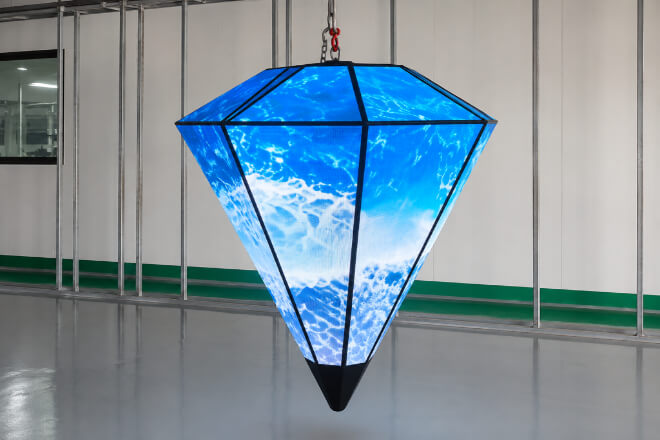
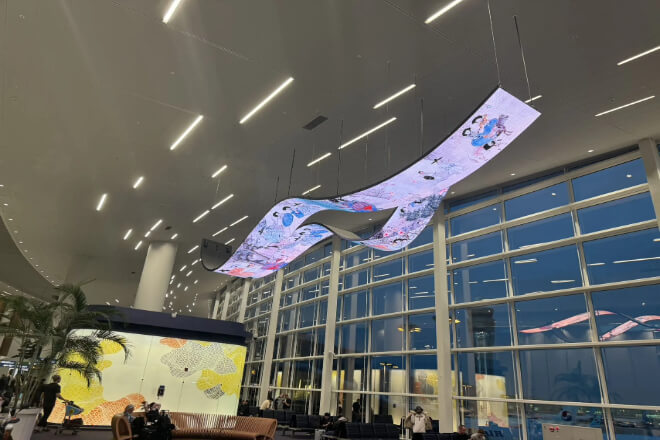
The biggest problem with irregularly shaped LED displays isn’t the “bend,” but the unattractiveness of the bend.
Spherical, curved, and wavy screens all have their own curvature, so the structure cannot be directly applied to ordinary flat screens.
From the design stage, the support structure should be customized according to the screen’s shape, precisely controlling the installation angle, spacing.
And position of each Module DEL to ensure the modules are as flat and continuous as possible, minimizing seams and height differences.
Especially for giant spherical LED displays, the larger the screen area, the more easily small installation errors are magnified—it might not look like much from a distance, but upon closer inspection, you might notice, “Something’s not right here!”
At the same time, the structure must consider load-bearing capacity, heat dissipation, source de courant, and future maintenance.
After all, LED displays aren’t just installed and then retired; they need to operate continuously, dissipate heat, undergo maintenance, and have modules replaced.
Therefore, the “aesthetics” of irregularly shaped screens don’t solely rely on the LED modules; the underlying structural design also determines whether it can ultimately “grow” beautifully.
Simply put: the shape can be imaginative, but the structure should be grounded in reality.
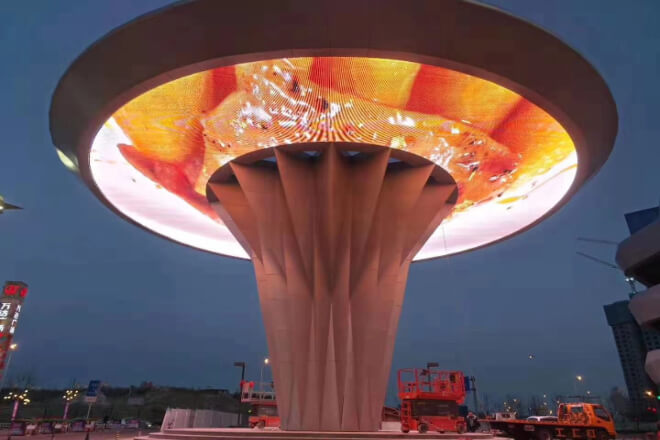
Watching an LED display is actually quite similar to watching television—if you’re standing right in front of the screen and still can’t see the text clearly, even the most beautiful design is somewhat embarrassing.
In stores, showrooms, and reception areas, first consider where the audience will typically stand. If viewing at close range, pay more attention to the image’s detail.
Text must be clear, images must not have noticeable graininess, and product details in videos must withstand close scrutiny.
For example, when displaying a new car in a showroom, the screen truly showcases the product’s quality if viewers can see details like the headlights and interior even from several meters away.
If the screen is primarily for long-distance viewing, it’s not necessary to obsessively pursue extreme detail. In this case, screen size, overall composition, and visual impact may be more important.
For instance, a grand écran LED in a reception hall, visible from tens of meters away, prioritizes overall visual impact over meticulously crafting every pixel for maximum clarity.
Of course, content also influences the choice. If frequently displaying text, product specifications, and information, clarity is paramount;
If primarily showing brand videos, artistic visuals, and dynamic content, the overall effect can be more important.
Simply put: it must withstand close scrutiny and hold its own from a distance.
The biggest screen isn’t necessarily the best; it’s about finding the right balance between the screen and the viewer’s viewing distance.
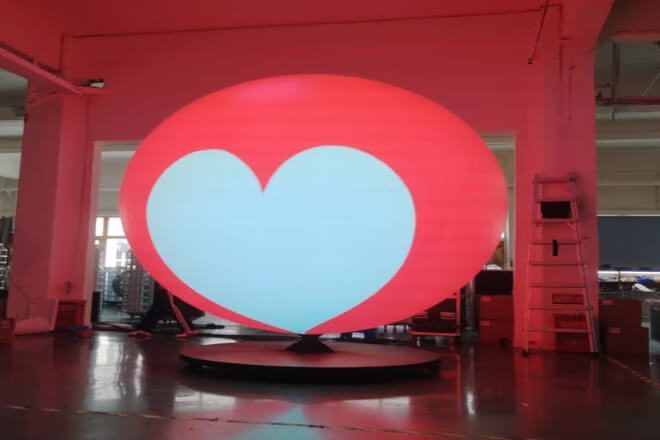
If creative LED displays are merely for aesthetics, quietly standing there as background, it’s like hiring an expensive employee only responsible for posing.
In brand stores, centres commerciaux, et exposition halls, creative LED displays can truly “get things done.”
They can play brand stories, new product introductions, and product content on weekdays; switch to advertisements, promotional information, and on-site content during events; and change to a different theme for holidays.
For example, a cylindrical LED display in a shopping mall can display brand advertisements on weekdays, become an event preview on weekends, and play dynamic art content at night, constantly changing the atmosphere of the same space.
Moreover, the content on irregularly shaped screens should also follow their shape. A spherical screen allows the image to move around the sphere.
A curved screen allows the visual flow along the wall, and a cylindrical screen can create a continuous effect as the viewer moves.
In this way, the screen’s unique shape is not just “aesthetically pleasing,” but truly participates in content display.
Ultimately, écrans LED créatifs are not just about adding a pretty decoration to a space, but about adding a functional visual tool to that space. The design draws people in; the content keeps them engaged.
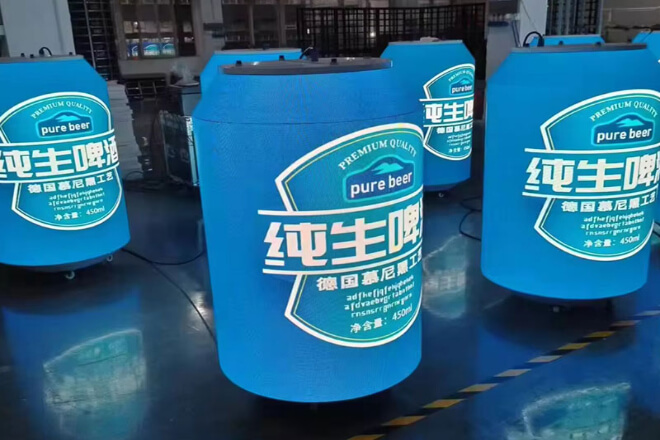
Creative LED displays shouldn’t just be “uniquely shaped and simply stand there emitting light.” What truly captivates is content that changes with the atmosphere.
In clubs, casinos, and experience centers, LED displays can quickly switch themes to suit different events.
For example, at the start of a party, the screen can play dynamic visuals with a stronger rhythm;
For brand events, it can switch to product animations and brand content; and for holidays, it can directly change to a holiday theme.
The same LED display, with a different set of content, can create a completely different atmosphere.
Combined with lighting and music, the LED display becomes more than just a video player; it becomes the visual rhythm center of the entire space.
As the music tempo quickens, the lighting effects on the screen change accordingly; as the lights sweep across the space, the LED display can respond synchronously.
Adding motion or sound sensors—people approaching, waving, or even making sounds—can all trigger changes on the screen.
For example, an experience center could be designed with an interactive LED display screen.
As visitors approach, the brand graphics on the screen expand outwards; the visual effect changes as multiple people enter the screen simultaneously.
In this way, the LED display screen transforms from a “playback device” into a truly interactive digital device.
This is also a crucial value of creative LED displays: the screen itself doesn’t need to be replaced, but the content can be constantly updated.
Today it’s a party screen, tomorrow an advertising screen, and the day after, it can become an interactive art screen—the LED display screen remains the same, but the interactive experience keeps evolving.
Installing and lighting up an LED display screen is only the first step. Only when it continues to function stably for several years is the screen truly worthwhile.
In indoor and outdoor commercial spaces, the structure, power supply, and heat dissipation must be planned before installation.
This is especially important for écrans LED créatifs; the more unique the design, the more crucial the installation structure must be.
Outdoor projects also need to consider waterproofing, dustproofing, wind resistance, and temperature variations.
Otherwise, it might look beautiful on a sunny day, but become a “test of luck” after a heavy rain, which is clearly not cost-effective.
At the same time, maintenance space must be reserved in advance. Modules LED, wiring, and alimentations may require inspection or replacement later on.
If everything is cramped up during installation, maintenance personnel might ask, “Who designed this in the first place?” a few years later.
Therefore, the long-term usability of an LED display screen isn’t just about its ability to play content;
It also depends on ease of maintenance, operating costs, and the speed of troubleshooting.
A good LED display solution should not only ensure the screen can be installed but also that it can be repaired and used for a long time.


 English
  Español
  简体中文
简体中文  Français
  日本語
日本語  한국어
한국어  العربية