
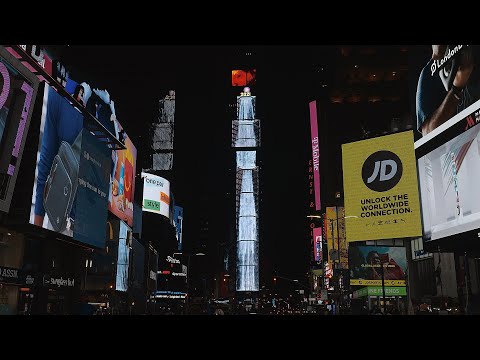
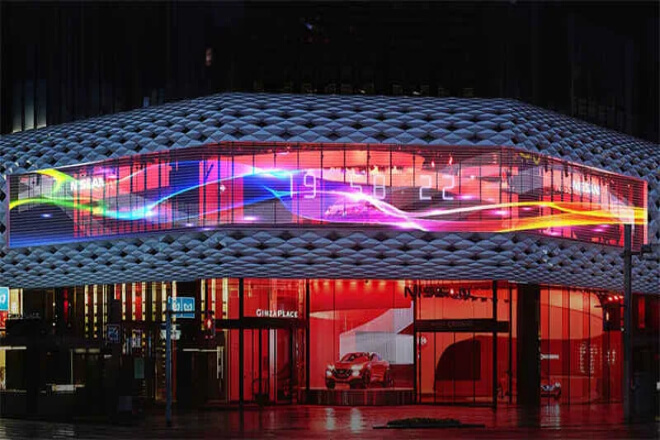
Many buildings look impressive during the day, but at night, if only a few lights illuminate the exterior, they easily become “bright, but lacking in narrative.”
LED screens with grid patterns can truly bring the otherwise static building facades to life.
They can be designed to follow the building’s grid, curtain wall, and facade structure, integrating the LED display into the exterior wall, rather than simply “hanging a screen on.”
During the day, the building retains its original openness and shape; at night, it can display dynamic light and shadow effects, brand content, holiday visuals.
Or even urban cultural themes, allowing the building to present different visual effects as the content changes.
For example, commercial complexes can transform their entire facades into themed visuals during holidays, while city landmarks can display local cultural or artistic content.
Passersby might simply be “walking by a building,” but after seeing the dynamic visuals, they can’t help but stop and take a picture.
Simply put, a regular facade “stands there,” while a grid LED screen makes the building “speak.”
By day it’s architecture, by night it’s a digital canvas—that’s what truly makes the city’s nightscape interesting.
The real headache for designers installing LED screens on building facades is often not whether the screen can light up.
But whether it will severely disrupt the building’s original lighting, ventilation, and structure.
After all, you can’t make the entire building a “glowing wall” during the day just to be more eye-catching at night.
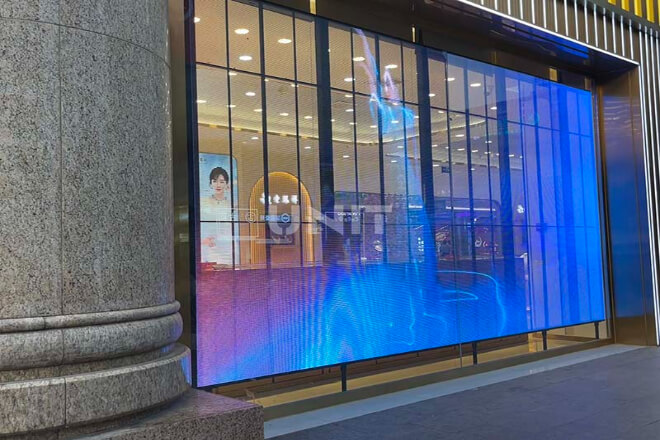
Grid LED screens use an open structure, preserving some transparency so that light and air can continue to pass through.
For buildings such as glass curtain walls, commercial complexes, and office buildings, large-area dynamic displays can be achieved without completely sealing off the exterior walls.
It is also more flexible in terms of weight and installation, typically reducing the structural stress on the screen and installation system.
Furthermore, the grid structure can be designed to integrate with the building’s own lines, curtain wall.
And facade, making the screen more like an integral part of the building, rather than a large television “forcibly” crammed on.
For example, if a glass curtain wall commercial building were to directly install a traditional LED screen, it might affect indoor lighting and the building’s original style;
However, with a grid LED screen, it can be installed using the curtain wall structure, maintaining transparency during the day and displaying brand animations, holiday visuals, or city lighting content at night, giving the entire building a “nighttime skin.”
Simply put, a grid LED screen is like giving a building a “glowing digital coat”: it minimizes light and air blockage during the day and transforms into a giant canvas at night.
The building provides the visual impact, while the LEDs ensure it remains active even at night.
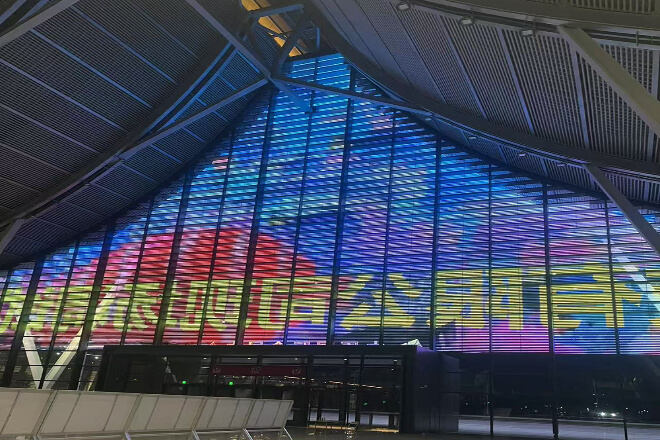
For city landmarks to stand out at night, simply “turning on the lights” is no longer enough. The biggest advantages of grid LED screens are their lightweight and transparent design.
Furthermore, they can integrate with the building’s silhouette, making the screen appear not as a large, abruptly attached “television,” but rather as part of the building’s facade.
They can be laid out along the building’s lines and structure, and dynamic visuals can create light and shadow effects that flow along the exterior walls.
For example, a curved commercial building can utilize the structural characteristics of a grid LED screen to allow dynamic light effects to unfold along the curved surface, making the entire building appear “lit up” at night.
Moreover, the content of the grid LED screen doesn’t need to be the same year-round.
Festival themes can be changed, event visuals can be displayed for city activities, and event content can be switched during major sporting events, constantly giving the same building a new “nighttime skin.”
Transparency is also a key feature. During the day, the screen doesn’t completely block the building’s original lighting and appearance, while at night it releases a strong visual effect.
This characteristic of “low presence during the day, high presence at night” is ideal for city landmarks and commercial buildings.
When unique architectural silhouettes, dynamic visuals, and nighttime lighting combine, what was once just an ordinary building in the city can become a popular photo spot for tourists.
Simply put, grid LED screens don’t just “attach” a screen to a building; they transform the building itself into a screen.
Maintaining its architectural presence during the day and activating its “second form” at night—this is the charm of its ability to create a visually striking urban landmark.
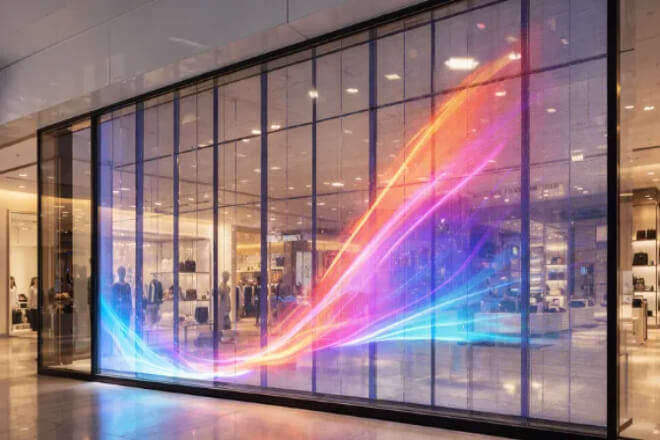
An ordinary billboard might only tell passersby, “There’s a brand here,” but a grid LED screen installed on a building facade offers much more.
It’s not just a display device; it can place architecture, the city, and brand content on the same visual stage.
Grid LED screens have good transparency and large-area coverage, allowing them to cover large building facades while preserving the original architectural structure and visual effect as much as possible.
During the day, the building won’t become a completely “black screen,” and at night, dynamic visuals create a stronger visual presence.
For cities, it can display urban culture, public information, festival themes, and content from large-scale events.
For example, during city celebrations, the entire building can be given a unified visual theme, transforming public information from mere cold text into an integral part of the city’s nighttime cityscape.
For brands, grid LED screens offer greater display space. Brand advertising, product launches.
And collaborative events can all leverage the scale of the building’s facade to amplify the visual impact.
For instance, during new product launches, commercial complexes can unleash brand visuals along the entire building, creating a more memorable impression than a typical outdoor billboard.
Simultaneously, the building’s commercial value may also be enhanced.
A building with a continuously operating digital facade is more than just a “building”; it becomes a media space that can continuously generate content and exposure.
Simply put, grid LED screens transform buildings from being “seen” to “actively speaking”:
Cities can tell their culture, brands can tell their stories, and buildings, in turn, elevate their commercial value.
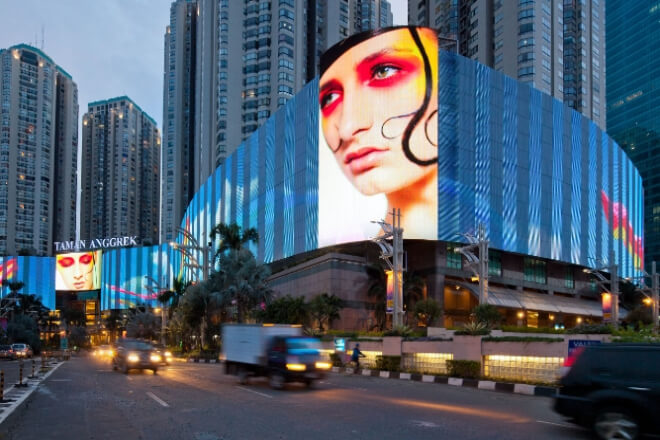
Installing LED grid screens on urban buildings shouldn’t be a one-size-fits-all decision, focusing solely on brightness and visual appeal.
These screens face wind, sun, rain, and long-term operation, while also needing to coexist harmoniously with surrounding residents, roads, and the urban landscape.
First, it’s crucial to choose a grid LED solution truly suited to the outdoor environment.
This is especially important for large building facades, where waterproofing, wind resistance, weather resistance, and structural safety are paramount.
While grid screens are lightweight and transparent, their large size means they still experience significant stress in strong winds.
Therefore, it’s essential to consider not only the screen’s specifications but also the building’s height, installation location, and steel structure during planning.
Second, luminosité shouldn’t be arbitrarily increased.
While daytime clarity is crucial, nighttime brightness should automatically or appropriately adjust based on the surrounding environment to avoid disturbing nearby roads, buildings, or even residents’ rest.
Otherwise, the landmark might become a source of neighbourhood complaints before it even becomes a city landmark.
Furthermore, long-term operation needs to be considered in advance. Grid LED screens must not only be easy to maintain but also have well-planned content updates.
For example, different content can be scheduled for city festivals, brand advertising, public information, and event visuals, keeping the screen vibrant instead of just displaying a logo on a loop after six months.
Simply put, when installing grid LED screens on city buildings, the goal is to ensure they “don’t clutter the daytime, are eye-catching at night, and remain stable in wind and rain.”
The screen is responsible for creating a captivating effect, while the structure and operation ensure that this effect continues.


 English
  Español
  简体中文
简体中文  Français
  日本語
日本語  한국어
한국어  العربية