

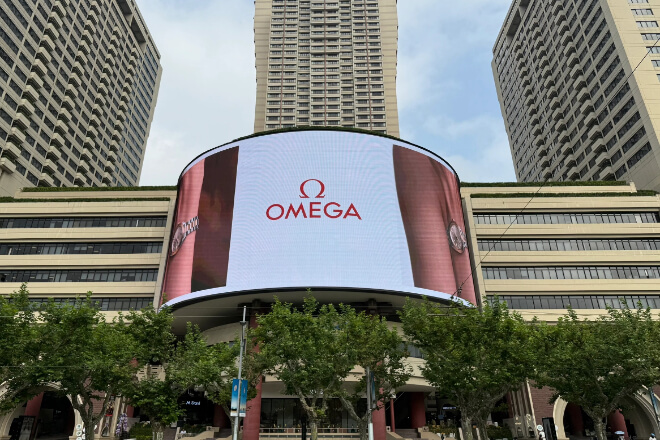
Many commercial buildings now favor curves, arcs, and flowing architectural lines.
However, if a rigid rectangular LED screen is installed at the end, it’s somewhat like—the building is wearing a haute couture suit, and suddenly a television is hanging on its shoulder.
Especially in spaces like curved facades and curved lobbies, the straight edges of the screen easily “cut off” the originally continuous lines.
If it’s added later without prior consideration of the structure and location, the LED screen is more likely to appear as an external device, separate from the architecture.
Modern commercial buildings increasingly prioritize overall visual appeal, so LED screens shouldn’t be limited to just “can they be installed?” or “can they play content?” They should be planned from the design stage.
Curved, arc-shaped, or even irregularly shaped LED screens should be selected based on the building’s curves and structure, allowing the screen to extend naturally along the building’s contours.
For example, if a commercial center features a large curved facade, installing a rectangular LED screen would easily make the edges appear jarring.
Replacing it with curved LED screens that match the facade’s curves allows the image to unfold along the building, making it seem from a distance that “this screen is part of the building.”
Ultimately, the ideal state for an LED screen isn’t just adding a screen next to a building, but rather presenting the complete building at first glance, with the realization upon second glance that it actually plays content.
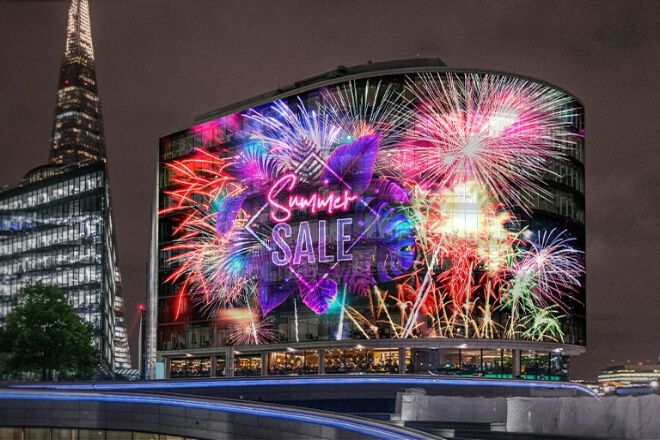
The real interest in curved LED screens isn’t just about “bending a square screen”, but about making the screen’s lines and the building’s original curves appear as “a unified design.”
If the curvature is simply for the sake of curvature, it easily feels like an aftermarket addition.
Different architectural structures allow for different integration methods. For example, curved walls allow the image to extend along the building’s contours.
While cylindrical structures can be directly transformed into 360° surround display surfaces, turning ordinary columns into digital devices that play content.
At building corners, LED screens can naturally span two directions, allowing viewers to see a continuous image from different angles.
In large atrium spaces, curved LED screens can further create an immersive experience.
The image is no longer confined to a single plane but can extend forward, upward, or to the sides along with the architectural space.
Of course, once the shape is determined, a suitable product solution needs to be selected based on the actual curvature and radius. For projects with complex curvature, flexible LED modules can be considered;
For relatively fixed curved surfaces, custom-made curved enclosures can be used. This ensures both aesthetic appeal and ease of installation and maintenance.
Par exemple, un hôtel lobby might have a naturally curved wall. If a rectangular screen were simply hung there, the image and the wall would appear to clash.
However, by using curved LED screens that match the wall’s radius, content such as waves and lights can flow along the wall, truly integrating the screen and the architecture.
Therefore, true “integration” isn’t simply about bending the screen, but about making the lines of the architecture and the screen appear as if they were meant to be together.
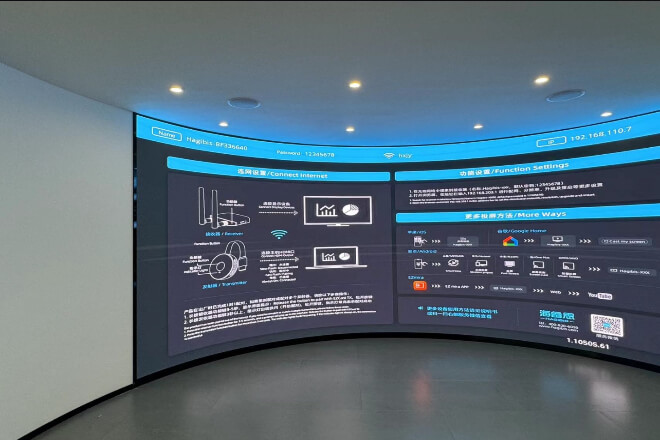
Not all places need curved LED screens, but if the space itself has curves, curved surfaces, or wraparound structures, they often appear more natural than traditional rectangular screens.
Especially in commercial buildings that emphasize design and visual experience, curved LED screens allow the original architectural lines to continue “speaking.”
Par exemple, dans centres commerciaux, they can be used in atriums, curved facades, and brand spaces, allowing the image to extend along the building’s contours.
Dans hôtel lobbies, columns or distinctive walls can create a wraparound visual effect, allowing guests to immediately feel the space’s design upon entering.
The curved windows and brand display areas of flagship stores are also well-suited for showcasing products and brand content using curved LED screens.
Exhibition halls can utilize large-area curved screens to create immersive displays, allowing viewers to not just “see a screen,” but be surrounded by visuals.
In clubs, entrances, stages, and circular visual areas can all become spaces for curved LED screens.
For example, a hotel lobby might have a large cylindrical column in the center; using it merely as a regular architectural pillar would be somewhat wasteful.
However, if designed as a 360° surround LED screen, it can display brand visuals, event information.
And even artistic content from different directions, ensuring guests see it wherever they go.
Therefore, the most suitable place for curved LED screens is often not “where you want to install a screen.”
But “where there is already a curve.” The architecture provides the stage, and the LED screens enhance that curve.
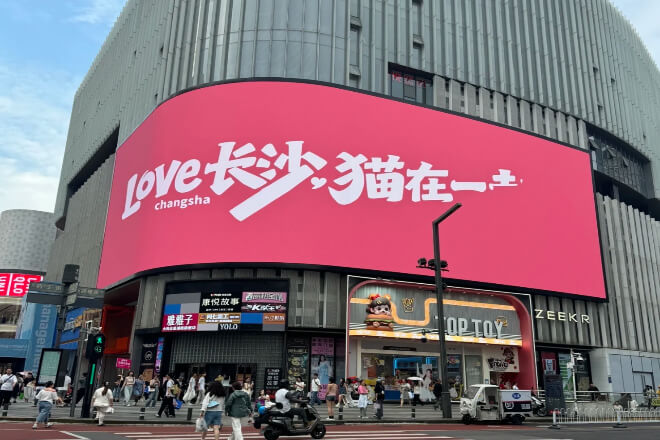
The biggest pitfall in curved LED screen projects is that everyone focuses on one question: “Can this screen be bent?”
The ability to bend is only the first hurdle; the real challenge is ensuring that after installation, the screen and the building don’t look like two temporary pieces pieced together.
Before a project begins, the building’s curvature, dimensions, installation location, and distance de visualisation should be confirmed to determine the appropriate LED screen products and pixel pitch.
The installation structure should also be planned in advance, concealing it as much as possible to avoid making complex brackets, cables, and fasteners immediately visible.
Furthermore, power supply, heat dissipation, and space for future maintenance shouldn’t be considered only after the screen is installed.
Especially in large commercial buildings, if maintenance personnel don’t even have a place near the screen, later maintenance can become a “puzzle game.”
In addition, content creation should consider the curved surface effect in advance, ensuring the image truly maps to the screen’s curvature, rather than simply cramming in ordinary flat materials.
Par exemple, un centre commercial with a curved atrium wall can first plan the LED screen structure based on the wall’s radius, then select the pas de pixel based on the viewing distance.
And finally use content mapping to allow water flow, lighting, or brand animations to move naturally along the wall.
This way, it doesn’t look like “a curved screen installed on the wall,” but rather the wall itself possessing a digital life.
Therefore, for architecture and LED screens to truly “grow together,” it’s not simply about bending the screen.
But about ensuring that the structure, display, source de courant, heat dissipation, and maintenance are all based on the same design from the very beginning.
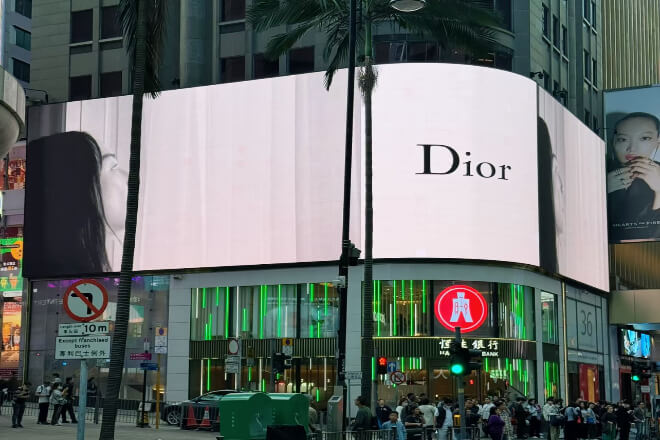
A building with only a beautiful exterior might be considered “well-designed”; but if it can change its visual appearance with time, season, and events, it’s a completely different story.
The value of curved LED screens lies in adding a constantly changing “digital skin” to the building.
It can display brand visuals and city-themed content during normal times, switch to festive visuals for holidays, change the theme for large events, and even adjust the visual style according to different time periods.
The building’s exterior remains unchanged, but it can have different “expressions” every day.
Par exemple, un hôtel can use curved LED screens to display soft natural light and shadow during the day, and switch to a more atmospheric brand visual at night;
at Christmas, the entire curved LED screen surface can transform into flowing lights and snow scenes.
When guests take photos, the building itself becomes the backdrop, and when the photos are posted on social media, the hotel’s visual image is also conveyed.
For commercial complexes and flagship stores, this dynamic expression can also strengthen brand recognition.
Consumers may not remember the specifics of an advertisement, but they will remember “what that building will look like at night.”
Therefore, when LED screens are no longer just “advertising screens on walls,” but become a digital skin for buildings, the building is no longer just a static space.
It can display, change, interact, and even tell its own story—today it’s a building; at night it might be a giant urban media.


 English
  Español
  简体中文
简体中文  Français
  日本語
日本語  한국어
한국어  العربية