
Introduction
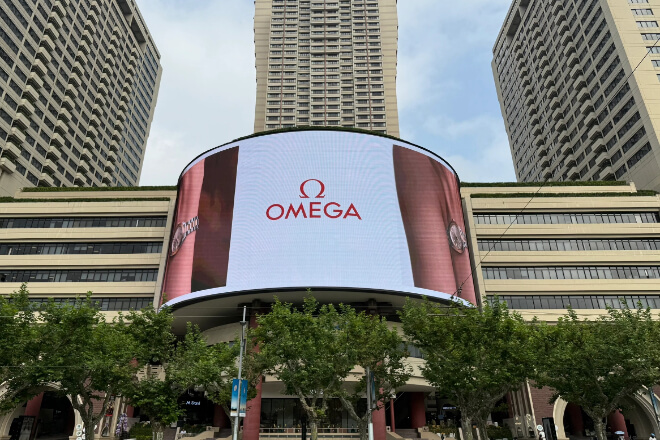
Walk into a centre commercial or commercial complex today, and you’ll notice a change: people are more willing to stop rather than rush past.
Often, what truly makes people stop isn’t the merchandise itself, but a “moving” screen.
Afficheurs LED are quietly changing the atmosphere of commercial spaces—from “display spaces” to “content spaces.”
Table des matières
1. How LED Displays Can Enhance First Impressions at the Entrance of a Commercial Space?

The entrance area is essentially the “first face” of a commercial space.
Whether a customer is willing to stop and become interested is often decided within three seconds. The role of an Affichage LED here is to turn “passing by” into “being attracted.”
First, it attracts the attention of passersby, making the space visible immediately.
Compared to static signs, LED screens have the advantages of dynamic images and high luminosité, making them particularly “eye-catching” in densely populated streets or mall entrances.
Flowing images and rhythmically changing content naturally capture the visual focus of passersby.
Par exemple, un centre commercial entrance that was originally just a regular lightbox signage can be transformed into a dynamic LED display showcasing the brand’s main visual animation and daily event information.
Even before approaching, people are immediately drawn to the screen.
Secondly, it enhances the visual impact of the space, turning the entrance into a “memorable point.”
An entrance that is merely a functional passageway is easily overlooked; however, with dynamic LED visuals, it becomes a “visual event point.”
For example, during holidays, themed animations (such as fireworks, flowing lights, or city silhouettes) or unified brand visual effects can make the entire entrance resemble a “glowing door.”
Simply put: it’s not about making people “walk in,” but about making them “want to take a second look before entering.”
Simultaneously, it enhances first-glance brand recall, making the impression more profound. Human memory often relies not on information, but on visuals and emotions.
LED screens, through dynamic visuals, brand colors, and rhythmic changes, can reinforce brand memory at the first point of contact.
For example, if a shopping mall entrance uses “waves + blue light and shadow” as its main visual element, customers will immediately associate the space with it even if they only pass by.
Finally, increasing foot traffic and willingness to linger transforms “passing by” into “entering.”
The more attractive the entrance visuals, the more willing customers are to slow down and even enter the space.
The role of LED screens here is essentially to “increase hesitation time,” turning passersby into explorers.
2. How Atrium and Core Area LED Screens Become Traffic Hubs?

The atrium is a very interesting location; it’s a place where people naturally pause.
Add a large enough LED screen, and it essentially transforms from “part of the space” into the visual center of the entire mall floor.
First, it draws people’s attention, making everyone look in the same direction. Atrium screens are generally large and high-mounted, and when combined with dynamic visuals, they easily create a unified line of sight within the crowd.
For example, a common scene: someone has just come down from the escalator, initially looking at the shops.
But a glance upwards draws them to the atrium screen—perhaps a holiday animation or a brand video. The result is that everyone spontaneously “looks up for a while.”
Secondly, once an event is displayed on the screen, the atrium becomes the “main stage.”
Many centres commerciaux use LED screens in their atriums to host new product launches, raffles, and holiday events.
In these cases, the screen becomes more than just a background; it’s an integral part of the event itself.
For example, during a raffle, the screen displays the winning list in real-time; or during a brand pop-up event, the screen plays a themed video and countdown simultaneously.
This easily attracts a crowd, and the more people watch, the more they gather.
Simply put: it’s not that “there are people only because there’s an event,” but rather that “the moment the screen is on, the event creates a sense of presence.”
Furthermore, when people stop, those around them tend to stop as well.
The atrium has a very distinct characteristic: as long as people gather, more and more will follow. The Ecran LED provides a reason for people to stop.
For example, someone is watching an interactive poll on the screen, and someone passing by stops to take a look; soon it becomes a small circle, then gradually a large crowd.
Ultimately, the atrium transforms from a “passing-through area” into a “staying area.” What was originally just a space connecting different floors has become a place where people intentionally spend a few more minutes.
Sometimes, it’s not even about buying anything; it’s simply about “taking a peek at what’s on the big screen.”
3. How Brand Stores Can Boost Sales Conversion with LED Displays?

If an LED screen in a store is only used to display brand videos, it’s a bit of a “waste of space.” Used well, it’s more like a “talking sales assistant” standing at the entrance.
First, dynamically displaying new products and promotional information grabs people’s attention from the start.
Often, passersby aren’t uninterested; they just don’t stop. The Ecran LED‘s role is to get them to look for even a second longer.
For example, a common scenario: a clothing store’s LED screen continuously displays “New hoodies available + 20% off today,” with images of mannequins walking around.
Someone who was just passing by might stop and think, “Oh, this store has a promotion today?”
Second, it makes the window and entrance less “cold,” giving the feeling of being open even when there’s no one around.
Some stores are most afraid of looking “lifeless” when there are few customers in the evening.
But if the window has an LED screen continuously playing styling videos or showcasing new products, the overall atmosphere is completely different.
For example, if a shoe store is showing live footage of new shoes being worn on foot before closing time, passersby are more likely to think, “This store seems quite professional; I might want to check it out.”
Simply put: Previously, store windows were simply “displayed for you to see”; now, they are “actively attracting your attention.”
Furthermore, brand identity is easier to remember, rather than being forgotten after a glance.
For example, in the clothing market, one store might haphazardly display posters, while another uses a consistent video slideshow—the difference is obvious.
For instance, trendy brands use fast-paced editing and visually engaging music, while accessible luxury brands use slower-paced displays with clean backgrounds.
Even before entering, customers already have a general idea of ”whether this is my style.”
Finally, many decisions are made in those few seconds at the door. LED screens constantly highlighting “new products,” “limited-time offers,” and “styling recommendations” significantly shorten hesitation time.
4. How LED Screens Can Amplify Commercial Value in Events and Marketing Scenarios?

The biggest fear in organizing events isn’t a lack of content, but rather a failure to generate buzz or spread effectively.
The role of Écrans LED here is to transform an event from “what happens on-site” into “something that can be seen by more people.”
First, they support new product launches and pop-up events, instantly maximizing the organiser atmosphere.
Previously, a new product launch might have involved simply explaining the product and setting up a booth; now, with LED screens, the overall atmosphere is completely different.
For example, when launching a new mobile phone, the screen can simultaneously display product close-ups, dynamic teardowns, and usage scenarios, creating a “launch event” feel from the moment it appears.
Or, at a pop-up store, the LED screen can continuously switch thematic visuals, making the entire space feel more “motivational.”
Second, they can update event content and rhythm in real time, making the event more “lively.”
Events aren’t static; there might be raffles, guest appearances, or limited-time offers. LED screens can switch content at any time, making the event’s rhythm clearer.
For example, during a raffle, the list of winners scrolls across the large screen; a countdown to a limited-time discount immediately creates tension; a custom opening animation when a guest takes the stage instantly elevates the sense of ceremony.
Simply put: it’s not about “the event following a set procedure,” but rather “the screen creating a sense of rhythm for the event.”
Simultaneously, it enhances on-site participation, making the audience not just watch, but “engaged.”
Features like QR code interaction, voting, and on-screen comments make the audience feel like they are part of the event.
For example, at a brand event, a “favorite new product poll” is held, with results changing in real-time on the large screen. The audience will unconsciously start discussing and inviting others to participate.
Finally, it enhances dissemination and exposure, turning an event into a multi-faceted campaign.
Many people come to take photos and videos because “the screen is visually appealing and has rich content.”
The more visually impactful the LED screen, the easier it is to be photographed and shared on social media.
5. How LED Displays Reconstruct the Operational Logic of Commercial Spaces?
If commercial spaces used to be “basically unchanged after being decorated,” now it’s more like the same space, but a different way of life every day.
The role of LED screens here is no longer just “equipment,” but a transformation of the entire operational approach.
First, it shifts from static spaces to dynamic content spaces. In the past, the visual identity of centres commerciaux, parks, and venues was fixed:
Once the decoration was finalized, the atmosphere was essentially set. However, with LED screens, the “atmosphere” of a space can be changed at any time.
For example, during the day, it displays brand promotion and wayfinding information; at night, it transforms into a festive light show.
And during holidays, it changes to themed visuals (Christmas, Chinese New Year, grand opening celebrations). The same place presents completely different “scenes” at different times.
Simply put: previously, “decoration determined the atmosphere” of a space; now, “content determines the atmosphere.”
Secondly, it improves space utilization efficiency, ensuring that every area is “used.” Previously, some areas were merely background or passageways.
Now, with LED screens, they can become information dissemination points, advertising points, and even event venues.
For example, elevator lobbies are no longer just places to wait for elevators; they can also play brand advertisements.
Atriums are not just empty spaces; they can host press conferences and interactive activities; corridors can also become dynamic wayfinding and promotional information channels.
Simply put: previously, “spaces were only valuable where they were useful”; now, “as long as there is a screen, a space can become a content carrier.”
Simultaneously, it enhances advertising and brand monetization capabilities, allowing the space itself to “earn money.”
LED screens can be rented out for advertising space in different time slots and areas, and can also host brand event exposure. The same screen serves different merchants at different times, achieving continuous revenue.
For example: promoting restaurant breakfast discounts in the morning, mall events at noon, and brand advertising in the evening. The LED screen becomes an “operable advertising resource.”
Finally, it forms a sustainable content operation system, rather than a one-off display.
Truly mature LED operation is not about randomly placing content, but about a planned, rhythmic, and updated content system.
There is content for holidays, content for events, and content for daily life.
6. Conclusion
The changes brought about by an LED display screen are often not immediate.
But it gradually changes pedestrian flow, dwell time, and how brands are seen. When the space begins to “express itself,” the logic of business changes accordingly.
Finally, if you would like to learn more about LED displays, veuillez nous contacter.


 English
  Español
  简体中文
简体中文  Français
  日本語
日本語  한국어
한국어  العربية