

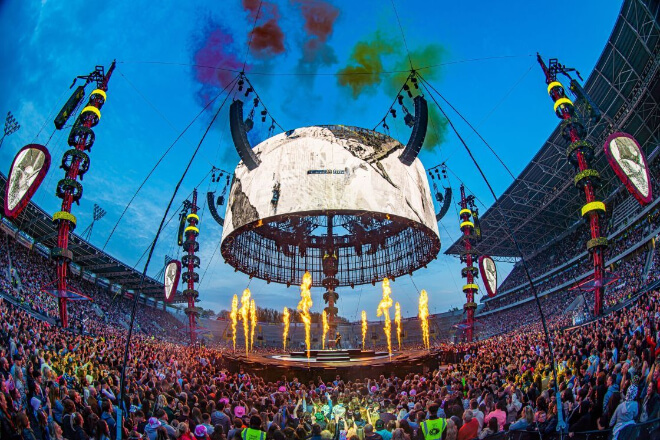
In large-scale performances, the main stage screen is the LED display that cannot be “understated.”
First, it is the visual core of the entire Affichage LED system. The main screen is responsible for “standing up” the organiser; whether it’s the opening or the climax, the first thing the audience sees is often the story it tells.
For example, at the opening, the LED main screen directly displays a starry sky or a city skyline; the atmosphere is already in place before the stage even moves.
Secondly, the biggest advantage of the LED main screen is its dynamic background switching. Previously, changing stage scenes required changing scenery and moving equipment;
Now, simply changing the content on the LED display instantly transforms the stage into a different world.
One second, it’s a rainy night street scene; the next, the LED screen transforms into a neon-lit futuristic city.
Even more interesting is that this transition “follows the program.” Slow songs use soft, flowing visuals, while fast songs deliver a high-frequency, visually impactful rhythm.
Allowing the LED screen to breathe in sync with the music, rather than simply playing background videos.
For example, in one live moment: as the chorus hits, the main LED screen instantly amplifies the visual impact, with the lights following suit, immediately energizing the entire audience.
Simultaneously, it reinforces the theme of the entire performance. The main LED screen can use a unified visual language to directly visualize “what this performance is about.”
Such as a youth theme, a future technology theme, or an urban narrative, allowing the audience to understand without explanation.
Finally, it determines the upper limit of the overall stage’s visual impact. Because the main screen has the largest area and is located in the center, it is the most “eye-catching” part of the LED system.
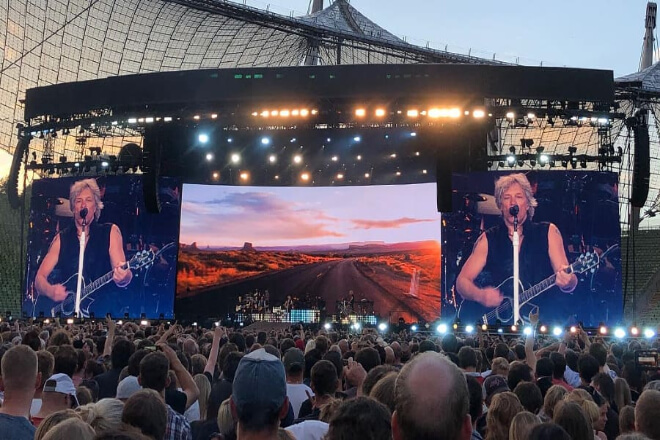
In a stage Affichage LED system, the main screen is responsible for “telling the story,” while the side screens and extended screens are more like—responsible for “filling the entire space” with that story.
First, their most direct function is to extend the visual boundaries of the organiser. Many live performances appear to have a “large stage.”
But a significant portion of this spatial sense comes from the side screens “pulling” the image outwards.
For example, if the main screen represents the city center, the side screens can extend to show streets, sky, and distant buildings, making the stage appear as a complete space rather than just a single screen.
Second, multi-angle simultaneous content display ensures that audiences, regardless of their seating position, receive consistent yet varied visual information.
The main screen provides the core image, while the side screens supplement and extend it, creating a visual effect that “envelops” the entire venue.
More interestingly, this design creates an illusion for the audience: they are not looking at a screen, but rather “surrounded” by the image.
For another example, consider a live moment: the main LED screen displays a close-up of a person, while the side screens simultaneously extend to show emotional lighting or scene changes, making the entire stage seem enveloped by a single emotion.
Simultaneously, it enhances the sense of depth in the image. The main screen is the subject, and the side screens are the extensions;
The content on the LED displays forms visual layers in space—front-to-back and left-to-right—no longer a single plane, but a visual structure with “depth.”
Finally, it can create an “enclosed” visual experience. The audience is surrounded by the main screen, side screens, and extended screens;
The visual focus is no longer a single point, but an entire space, resulting in a significantly stronger sense of immersion.
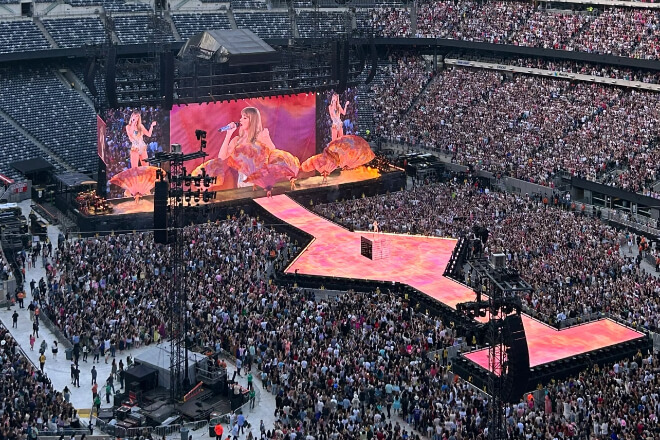
With the introduction of LED floor displays, the stage is no longer just about “looking in front,” but even the ground beneath your feet becomes dynamic.
First, its most obvious change is that the ground “moves.” What was once just a organiser for movement and positioning can now transform into flowing water, flames, a starry sky, or even cracked ground effects.
The audience’s first reaction is often not to look at the performers, but to observe “how the ground is changing.”
For example, at the beginning of a dance, flowing water suddenly appears beneath the performers’ feet, making each step seem like walking on water.
Second, it can “interact” with the performers’ movements. As an actor walks, the light and shadow extend; when they jump, the ground may instantly expand with a halo;
A turn can create a trajectory effect. It looks more like the action “triggers the scene,” rather than simply a performance.
Sometimes, it even creates the illusion that the actors are “controlling the stage.”
For example, a typical scene: as soon as a dancer lands, Écrans LED burst into life beneath their feet, perfectly aligning with the drumbeats, easily drawing the audience in.
Simultaneously, the LED floor screens can “lift” the entire space. Because the visual focus expands from the vertical plane to the horizontal floor, the stage is no longer a flat surface, but a complete “spatial field.”
Finally, the experience is direct: the audience doesn’t just watch the performance, but feels “standing in the same world.”
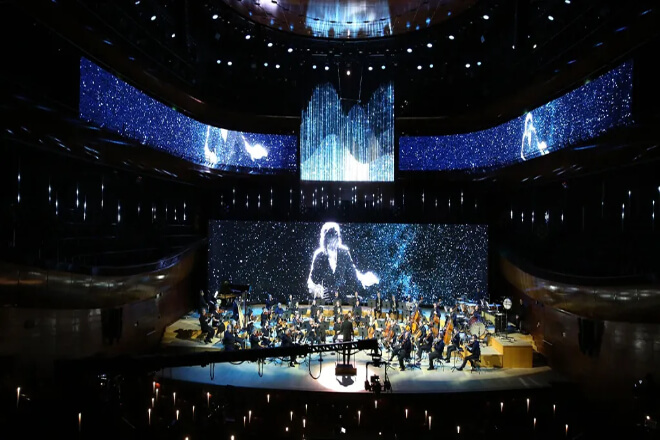
The audience area Écrans LED have a very interesting function: they’re not just for the audience to see, but also “watch the audience.”
First, they display audience reactions and interactions in real time. For example, moments of cheering, waving, or group singing will appear on the screen immediately.
Amplifying the live emotions. If you shout something in the audience, it might appear on the screen the next second.
For example, a common scene: a front-row audience member raises their support sign, and the next second, the big screen cuts to a close-up, causing the entire audience to burst into laughter.
Secondly, by playing close-ups and live footage, the audience transforms from “background” into “part of the scene.” This feeling is unique—you’re not just watching the performance; you might actually be part of it.
Sometimes, it’s even possible to see a close-up of the LED screen as soon as you wave to a friend.
Simultaneously, it guides the audience to participate in the atmosphere. For example, prompts like “Countdown together,” “Clap together,” and “Sing along together” guide the audience visually, showing them “how to participate,” rather than just sitting and watching.
For instance, with the last 10 seconds of the countdown, the big screen sets the rhythm, and the entire audience naturally joins in.
Finally, it bridges the gap between the organiser and the audience. The performance on stage and the emotions in the audience are connected by the same LED screens system, no longer a case of “performance on stage, audience watching,” but a mutually responsive dynamic.
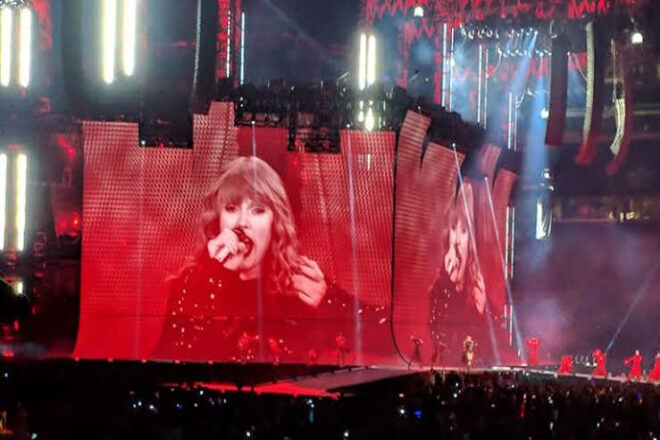
In large-scale performances, the truly breathtaking moment often isn’t a single screen, but rather the instant when the lighting, audio, and LED displays all move together.
First, the organiser design system provides unified control, treating the LED screens, lighting, and sound as a unified whole, rather than operating them independently.
This allows visual changes, lighting variations, and musical rhythms to be aligned within the same system.
For example, at the opening moment, the main Ecran LED illuminates a starry sky, simultaneously flooding the entire venue with lights, and the sound effects accelerate, illuminating the entire space as if simultaneously.
Second, synchronized visual content transitions are crucial. It’s not a matter of “lights moving first, screens following,” but rather all elements changing in unison with the musical beat.
Fast-paced scenes transition rapidly, while slower tempos involve elongated visuals and contracted lighting, creating a unified emotional flow.
Even more interestingly, this synchronization makes the audience feel that “the rhythm isn’t something you hear, but rather the entire space moving together.”
For example, consider this moment: as the drumbeat intensifies, the LED screen suddenly shifts at a faster pace, the lights flashing in sync, instantly elevating the entire audience’s emotions.
Simultaneously, it significantly enhances the overall rhythm of the performance. Audiences don’t need to consciously understand the structure, because the visual and auditory senses have already differentiated the “climax, transition, and release.”
Ultimately, it creates a complete immersive experience. LED screens handle the visual space, lighting handles the emotional layers, and audio drives the rhythm;
Together, the stage is no longer just about “watching a performance,” but about “entering a pre-designed world.”


 English
  Español
  简体中文
简体中文  Français
  日本語
日本語  한국어
한국어  العربية