

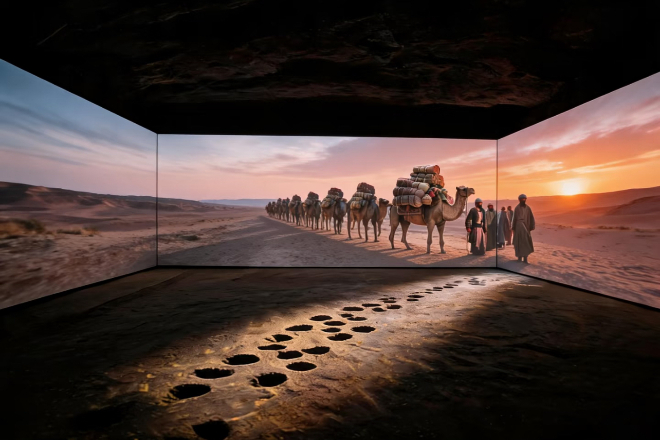
Digital art spaces often aim for more than just an ordinary display screen; they seek to integrate the visuals with the architecture, installations, and the audience experience.
The advantage of pantallas LED flexibles lies in their ability to adapt to some non-planar structures, providing more possibilities for creative design.
- Curved LED displays: Allowing the image to extend naturally
Si el exhibición space aims to present a wraparound landscape, flowing digital art, or a visual effect with spatial depth, a curved flexible LED display can be considered.
For example, a digital ocean on a wall can extend from one side to the other, making the image appear more coherent.
- Cylindrical LED displays: Transforming building columns into display containers
Traditional columns are typically just part of a building’s structure, but by wrapping suitable columns with flexible LED displays, they can be transformed into digital art installations.
The images can display rotating light and shadow, flowing colors, or constantly changing abstract patterns, turning an otherwise inconspicuous column into a focal point of the space.
- Wave-shaped and irregular LED displays: Adding artistic flair to installations
For digital art exhibitions, brand experience centers, and commercial spaces seeking unique shapes, wave-shaped, undulating surfaces, or other custom-designed irregular structures can be considered.
The screen is no longer just a flat surface displaying images, but can participate in the design of the entire space.
However, flexible LED displays do not mean they can be bent arbitrarily.
Different products support different bending directions, minimum bending radii, and structural methods, which must be confirmed based on the specific model.
Therefore, the final shape of the screen should be clearly defined in the early design stages before determining whether flexible modules are suitable.
Drawing the desired shape first and then selecting a screen that can realize it is much more reliable than buying the screen and then figuring out how to bend it.
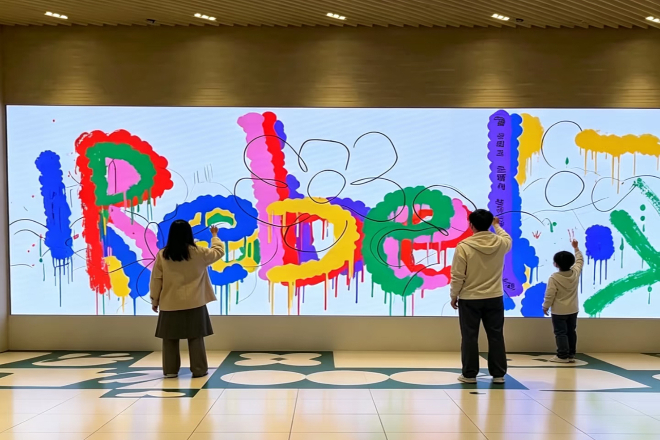
When choosing a flexible LED display, many project teams focus on resolución, brillo, and price, but easily overlook a crucial parameter: the bending radius.
Simply put, the bending radius determines the size of the curved surface the screen can conform to.
A smaller radius usually means a more compact bend is required, but whether the product supports this type of bend must be determined based on the actual specifications.
For example, if the project requires mounting the LED display on a thick cylinder, the required curvature may be relatively gentle;
If a compact wave or complex curve is desired, the product’s structural limitations need to be checked more carefully.
When purchasing, it is recommended to focus on confirming the following:
Minimum bending radius: Can the product achieve the curvature required by the design drawings?
Bending direction: Does it support the inward, outward, or other bending methods required by the project?
Module connection method: After bending, are the connection points easily subjected to compression or stretching?
Mounting structure: Can the screen conform evenly to the supporting surface, rather than having localized bulges or depressions?
Requisitos de mantenimiento: Can the modules be easily disassembled and replaced after damage?
It’s also crucial to note that pantallas LED flexibles are not like soft fabric that can be repeatedly folded.
The flexible modules still contain LED displays, circuitry, and connecting components; exceeding the product’s permissible bending range may cause damage.
If the project requires complex three-dimensional shapes, it’s recommended to create a structural prototype before production to verify the fit between the screen and the supporting surface.
For digital art spaces, the smoothness of the curved surface often directly determines the final effect.
Even with captivating content, noticeable creases, misalignments, or unevenness on the screen surface can draw the viewer’s attention away from the artwork and towards installation issues.
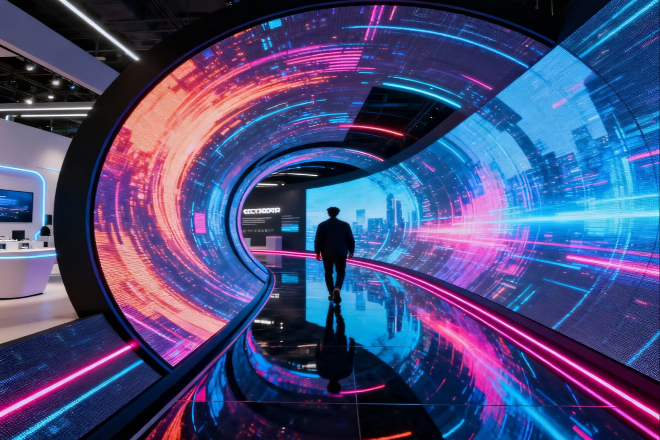
Digital artworks often feature subtle gradations, slowly changing light and shadow, complex lines, and abstract patterns.
Therefore, flexible LED displays must not only adapt to the shape but also accurately present the content.
First, the tamaño de píxel should be selected based on the distancia de visualización.
A smaller pixel pitch generally results in a more detailed image, all other things being equal, but the cost may also be higher.
If viewers will be appreciating the textures and details on the screen up close, products with smaller pixel pitch should be prioritized.
If the screen is primarily used to create a spatial atmosphere from a distance, a more suitable specification can be chosen based on the viewing distance.
Secondly, pay attention to the consistency of color and brillo.
Digital artworks often use large areas of gradient colors. If there are significant color differences between different areas of the screen, what was originally a smooth color transition may become a patchwork of dark and light areas.
When purchasing, use real artwork for testing, such as slowly changing gradients, fine lines, dark areas, and highly saturated colors, rather than just watching brightly colored demo videos.
Third, check the aspect ratio on curved surfaces.
When flat videos are used directly on curved or irregular screens, problems such as image stretching and subject misalignment may occur.
For cylindrical or wavy screens, content production needs to be adapted to the actual pixel layout.
For example, a light ray flowing from left to right may abruptly change if it is not properly handled when crossing different curved surfaces.
Viewers who were appreciating the artwork may have their attention interrupted by the image abruptly changing.
Furthermore, the screen’s form factor should match the content’s style. Soft, slow-motion visuals are suitable for creating an immersive experience;
Complex, fast-paced animations require more careful testing of playback effects to avoid an overly cluttered image.
When choosing a screen, don’t just ask “Can it be bent?” Also ask, “Will the image still look good after bending?”
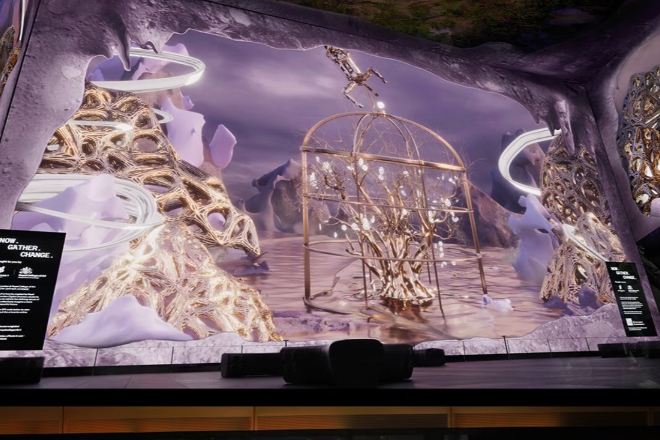
In digital art spaces, LED displays don’t necessarily have to be mounted independently on a wall.
They can become part of a sculpture, extend along the curved surfaces of a building, or even be combined with physical materials to form a complete digital art installation.
For example, in a brand experience center, a flexible LED display can be installed on a wave-shaped structure, allowing colors and light to flow with the curves;
In an art gallery, a cylindrical screen can be used to display rotating digital patterns, allowing viewers to see changing images from different directions.
To create a more immersive space, pantallas LED flexibles can also be combined with lighting, sound, and interactive systems.
The image can change as viewers approach the installation; the screen can also switch visual themes when the ambient lighting adjusts.
However, these creative ideas need to be considered from the design stage to ensure content adaptation, rather than starting video production after the screen is installed.
First, the content canvas must be planned according to the actual screen size and pixel distribution.
Second, it’s crucial to identify the primary viewing angles to avoid important images being obscured or distorted by curved surfaces.
Finally, the content’s playback on the actual screen must be tested to ensure smooth transitions.
Structural design is equally important.
Flexible modules need to be installed on suitable support surfaces; the curvature, flatness, and fixing method of the support structure will all affect the final display effect.
Insufficient space behind the screen can also increase heat dissipation and maintenance difficulties.
For large or complex digital art installations, it’s recommended that the architectural design team, display supplier, and content production team collaborate in advance.
This allows for simultaneous resolution of issues related to form, installation, and visual presentation.
Otherwise, the art installation on the design drawings may look beautiful, but during actual construction.
It may be discovered that modules cannot fit properly, cables are misplaced, or the content cannot be displayed as expected.
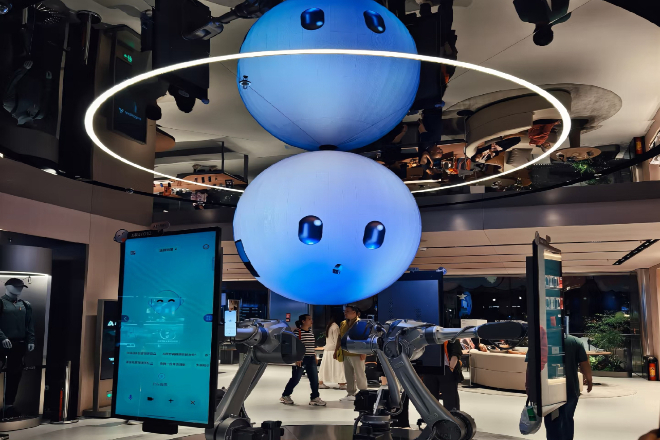
Flexible LED displays can achieve unique shapes, but the higher the degree of customization, the more attention needs to be paid to the overall cost.
First, a comprehensive project budget is essential.
Besides the pantalla LED flexible itself, costs for supporting structures, control systems.
Installation and commissioning, content production, spare parts, and maintenance services should also be considered.
Complex curved surfaces may require specially designed module layouts and installation structures.
Therefore, project costs cannot be judged solely based on the price per square meter of screen.
Second, maintenance methods must be confirmed.
Some flexible LED displays support front maintenance, reducing the reliance on space behind the screen in certain projects, but the specific capabilities depend on the product design.
Module replacement methods, power supply maintenance routes, and spare parts availability should be confirmed before procurement.
Third, heat dissipation and the operating environment must be considered.
Digital art spaces may require long-term playback of dynamic content. If the screen is installed inside an enclosed installation.
Heat dissipation space should be planned in advance, and operating temperature and environmental conditions should be confirmed according to product requirements.
If the installation is near water features, humid areas, or other special environments, corresponding protection requirements also need to be assessed.
The flexibility of the screen does not automatically make it suitable for all installation scenarios.
Fourth, future content updates must be planned.
One of the advantages of digital art spaces is that the same hardware can present new themes with different content.
For example, artworks can be played during exhibiciones, themed animations can be switched during holidays, and exclusive visual content can be displayed during brand events.
However, content updates require a certain production budget and technical support.
Therefore, projects should clearly define the content production process, file formats, playback system compatibility, and update frequency in the early stages.
Finally, it’s crucial to choose a supplier capable of providing technical support.
Besides product parameters, it’s essential to understand whether the supplier has experience with projects involving irregular structures and can assist with curved surface adaptation, display calibration, and installation and debugging.
For project decision-makers, an ideal flexible LED display solution should not only attract attention at the opening but also be easy to maintain, operate stably, and continue to provide value as the art content evolves.


 English
 Español
 简体中文
 Français
 日本語
 한국어
 العربية