
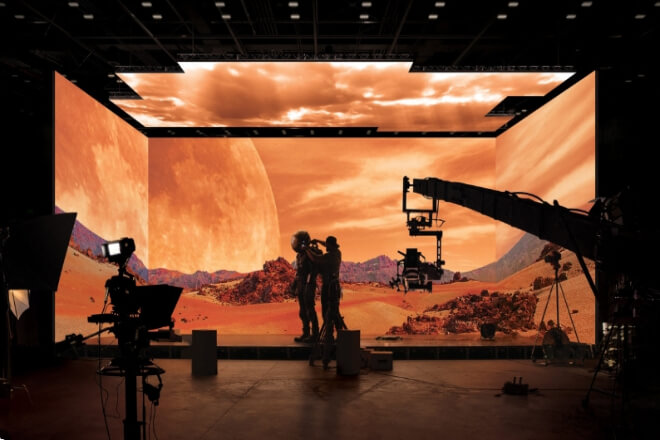
In a virtual production studio, the LED display has become a “core character” on the set, not just a background hanging there.
It brings the images that would originally require extensive post-production work to the shooting location, making the entire creative process more intuitive and controllable.
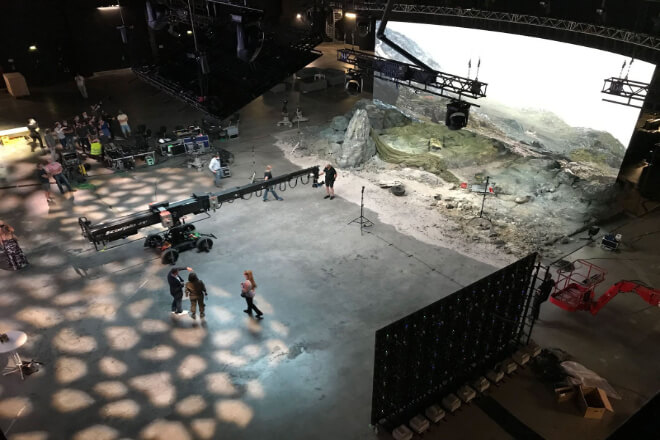
1) Real-time Scene Rendering: What You See Is What You Get
Alto-resolución LED displays can directly “project” virtual scenes onto the set. Actors and cinematographers see the background that will appear in the final image.
With a real-time rendering system, background lighting, colors, weather changes, and dynamic elements can be adjusted on the spot, such as changing from sunrise to sunset, or switching from a city to a sci-fi space, with almost no downtime.
Because the LED screen itself emits light, it provides very realistic ambient light and reflection effects for characters and props, resulting in a more natural image and making it easier to achieve the desired lighting and atmosphere.
This significantly reduces the pressure of post-production keying, compositing, and repeated color correction compared to traditional green screens.
2) Flexible Scene Switching: Shoot in Many “Locations” in One Day
By stitching together multiple LED screens, a large shooting area can be covered, creating wide skylines, city streetscapes, or even large-scale virtual spaces.
It also supports curved screens and irregularly shaped screens, giving the image a more immersive feel and allowing for greater freedom of camera movement.
The biggest advantage is – no need to change sets.
In the same studio, you can be in a desert one moment, then a snow-capped mountain, and then a futuristic city, greatly improving the shooting pace and creative efficiency.
3) Faster and More Cost-Effective Shooting
LED virtual production studios significantly reduce the need for on-location shooting, eliminating the need to repeatedly build physical sets, travel to multiple locations, or worry about weather, time, or venue limitations.
Many problems that previously required “waiting” can now be solved in the studio.
For the production team, this not only saves on transportation, set design, and venue costs, but more importantly, it saves time.
Shorter shooting cycles and a more controllable overall production process are very beneficial for both the budget and the project schedule.
4) Stronger interactivity and more realistic immersion
Combined with a camera tracking system, the virtual images on the LED screen change in real-time as the camera moves, ensuring that the perspective is always correct, making the virtual scene “look like it’s really there.”
Actors can directly see the environment and perform against the realistic visuals, resulting in more natural performances, and making it easier for directors and cinematographers to judge the effects on set.
This method is not only suitable for film and television production but also ideal for real-time demonstrations, virtual press conferences, brand events.
And mixed reality (MR) projects, offering a strong overall experience and a high level of technological sophistication.
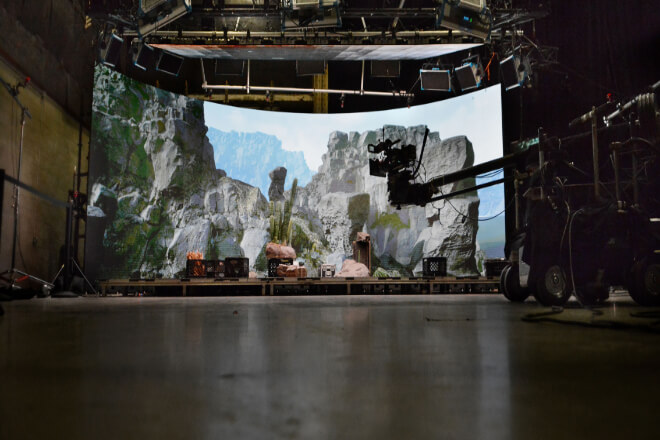
1). LED screen parameters must “match” the camera
In a virtual production studio, the LED display does not work independently, but rather in close cooperation with the camera.
Brillo range, color space, white balance, and grayscale performance all need to match the camera used for shooting; otherwise, color cast, uneven brightness, or even inconsistent image styles between different camera positions may occur.
In practical applications, specialized color calibration is usually required for the shooting equipment to ensure that the LED screen display looks realistic and natural through the lens, rather than “looking good to the naked eye but not through the camera.”
2) Alto frecuencia de actualización and low latency are basic requirements
Virtual shooting places very high demands on the refresh rate and system latency of the LED screen.
If the refresh rate is insufficient or the driver is not synchronized with the camera, motion blur, scan lines, or flickering problems can easily occur in the shooting footage, especially during high-speed motion shots or slow-motion filming.
Low latency is equally crucial. The LED screen display content must be as close to the real-time rendering results as possible to avoid desynchronization between the image and camera movement, thus affecting the realism of the image and on-set judgment.
3). Collaboration between the content management system and the rendering system
A stable and efficient content management system (CMS) is one of the core components for the normal operation of a virtual production studio.
The CMS needs to seamlessly integrate with the real-time rendering engine, supporting rapid loading, switching.
And real-time updating of scene content, such as temporarily adjusting background elements, lighting parameters, or animation timing.
At the same time, the operation process should be intuitive enough to facilitate quick collaboration among technical personnel, directors, or art teams, avoiding delays in shooting efficiency due to system complexity.
4). Maintenance and Stability: Determine the Success of Filming
Virtual production often involves long, continuous shooting sessions, requiring extremely high stability from the LED display system.
This includes screen consistency, power and signal redundancy, heat dissipation design, and the ability to quickly locate and replace faulty components – all issues that must be considered in advance at the management level.
A well-maintained and stable LED system minimizes the risk of filming interruptions and ensures a smooth production process.
 English
  Español
  简体中文
简体中文  Français
  日本語
日本語  한국어
한국어  العربية