

For manufacturing companies, the production workshop is often the most visible demonstration of their capabilities.
However, for customers without relevant technical backgrounds, seeing equipment in operation doesn’t necessarily mean they understand the entire production process.
For example, a precision parts factory might have automated processing equipment, quality inspection instruments, and multiple production lines.
During a visit, customers can see the machines running, but they may not understand the function of each process or how the company ensures product quality.
In this case, LED displays in the factory visit corridor can serve as supplementary explanations.
Companies can install LED displays at key locations along the tour route to showcase introductions to corresponding processes, production flow animations, equipment operating principles, and quality inspection procedures.
As customers pass through an area, the screen content corresponds to the actual production scene before them, helping them understand the production process more quickly.
For example, before entering the processing area, the screen can explain how raw materials are processed into finished products;
In the quality inspection area, key inspection items and quality control processes can be displayed; and in the product display area, application scenarios and technical features of components can be presented.
However, factory tour corridors do not need to be equipped with a screen every few meters. Too many screens may distract visitors from the actual production environment.
A more reasonable approach is to set up a few important visual nodes along the tour route, allowing the LED displays to function where information needs to be explained.
At the same time, the screen installation locations should not obstruct personnel passage, equipment operation, or safe evacuation.
For areas with dust, vibration, or special environmental requirements, appropriate equipment should be selected based on the site conditions.
A good factory tour demonstration is not about turning the production process into a video playback.
But about allowing customers to see the actual process and understand the technology behind it.
While factory tour corridors primarily showcase production capabilities, a company’s brand display area is better suited to answering another question: Why is this company worth partnering with?
Many companies display certificates of honor, development histories, product samples, and company introductions in their brand display areas.
This content is certainly important, but if presented entirely through static panels, the information may be scattered, and customers may not be willing to read every single item.
pantallas LED offer a more flexible way to express a brand.
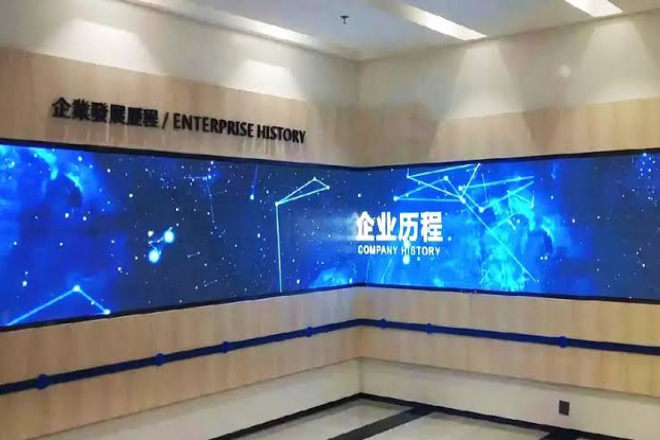
For example, companies can use large LED displays to showcase their development history, core technologies, production capabilities, product applications, and key project case studies.
Dynamic visuals allow content that would otherwise require lengthy explanations to be presented more intuitively.
For manufacturing companies targeting international clients, brand introductions, product applications, and factory information can be switched to different languages depending on the visitor, increasing the flexibility of reception.
If the brand display area has ample space, companies can consider using a large LED display as the visual center;
If space is limited, appropriately sized screens can be combined with product samples, graphic panels, and physical installations.
It’s important to note that brand displays should not only feature company promotional videos.
Customers may be more concerned with what problems a company can solve, where its products are applied, how production quality is controlled, and what value project collaborations can bring.
Therefore, brand content should revolve around information that customers care about, rather than simply repeatedly displaying the company name and slogan.
Furthermore, screen content should be consistent with reality. Information such as production capacity, quality certifications, project cases, and technical parameters should all be verified before being released.
For business decision-makers, the value of LED displays lies in helping customers understand the brand more quickly, not simply making the display area look more modern.
The usage environments of factory visitor corridors and brand display areas are different, and the choice of LED displays should also differ.
First is the viewing distance.
If the screen is installed at the far end of the visitor corridor, requiring customers to walk around and view it, then screen size, information readability.
And content simplicity are crucial. Text on the screen should not be too small, and key content should not be arranged too sparsely.
If the screen is installed in the brand display area, where customers can stop for a closer look, the company needs to further consider image sharpness and detail.
Second is pixel pitch.
Pixel pitch is the distance between the centers of adjacent pixels, usually expressed in millimeters.
All other things being equal, a smaller pixel pitch generally results in a more detailed image, but may also increase equipment costs.
For brand display areas that need to showcase precision parts, product details, or technical animations, the appropriate pixel pitch can be evaluated based on viewing distance.
For aisle screens viewed from a distance, resolución, screen area, and budget should be considered comprehensively; blindly pursuing the smallest possible size is unnecessary.
Thirdly, screen form factor is important.
Standard LED displays are suitable for displaying corporate promotional videos, production processes, and brand introductions.
If a company wants to create a more spacious brand display area, curved screens, corner screens, or other creative display solutions can be considered.
For example, corner LED displays can utilize the building structure to extend the brand image;
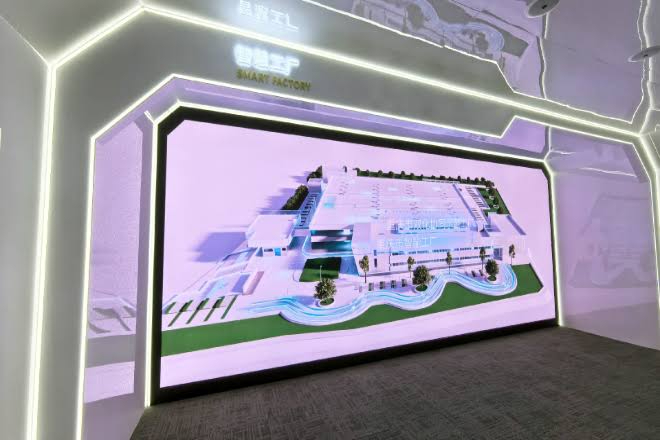
Large LED display walls are suitable for showcasing panoramic views of production bases, product applications, and company strengths.
However, special shapes increase the complexity of structural design, content production, and maintenance.
Companies should decide whether to adopt a particular design based on the space design and the display task, rather than increasing unnecessary investment in pursuit of novelty.
Finally, environmental conditions must also be considered.
The requirements for equipment protection and installation methods may differ between general exhibition areas and industrial areas with significantly high temperatures, dust, or vibration.
Companies should confirm the suitability of equipment based on the site environment.
The most valuable aspect of a factory visitor corridor is that customers can see the production site firsthand.
Por lo tanto, pantallas LED should not replace the actual factory display but rather help customers understand aspects that are not visible or easily understood on-site.
For example, customers standing beside the production line can see the equipment processing parts but cannot directly observe the internal operating principles.
In this case, the screen can explain key processing steps through animation or authorized internal equipment footage.
In the quality inspection area, the screen can display the inspection process, measurement methods, and verified quality control information, helping customers understand how the company manages product quality.
For companies involving automated production, the screen can also display the production process, equipment operating principles.
Or audited production data, allowing visitors to understand how the production system works collaboratively.
If a company plans to use real-time production data, it should confirm the data source, update frequency.
And display permissions in advance. Information involving customer orders, process parameters, equipment safety.
Or trade secrets should not be directly disclosed to the public. Furthermore, the tour route and screen content must be consistent.
If the screen continues to display completely irrelevant promotional content as customers move through an area, it will be difficult to establish an effective information connection.
Companies can arrange the content sequence according to the tour route: first introduce raw materials and production processes.
Then demonstrate processing and testing, and finally explain product applications and delivery capabilities.
For international customers or visitors from different business sectors, the content can be adjusted according to the purpose of the visit, making the display more relevant to their interests.
In this way, LED displays are no longer just wall decorations, but tools that help customers understand the real production site.
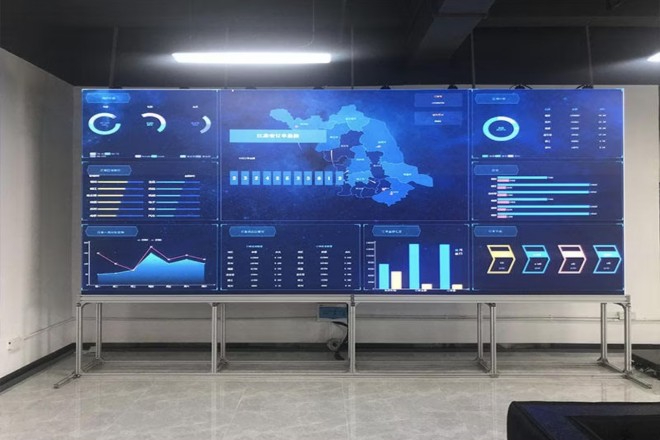
Once the LED displays in factory tour corridors and corporate brand display areas are put into use, they require continuous content management and equipment maintenance.
First, companies should develop clear content plans for different areas.
Tour corridors are suitable for displaying explanations corresponding to the production process, process animations, and quality management information;
Brand display areas are more suitable for presenting company introductions, technological advantages, product applications, and cooperation cases.
Different areas can use different content rhythms, but the overall visual style should remain consistent, allowing customers to feel the continuity of the company’s presentation.
Secondly, content updates must be considered.
Companies may add production equipment, launch new products, or expand into new markets.
If the screen content is not updated for a long time, discrepancies between the displayed content and the actual situation may occur.
Therefore, companies should clearly define the content manager, review process, and update frequency.
For multiple screens, a unified management system can be used to schedule playback, improving content update efficiency.
Thirdly, equipment maintenance is crucial.
Companies should confirm the screen’s installation structure, power supply, heat dissipation, signal connections, and maintenance space in advance.
And understand the supplier’s warranty, spare parts supply, and after-sales service.
If the screen is located at a high position or in a location difficult to access from visitor walkways, maintenance may require additional construction arrangements, which should be considered in advance during the planning stage.
Finally, the overall budget is important.
In addition to the LED display screen itself, the control system, installation, content production, system integration, energy consumption, and maintenance costs should also be considered.
Companies do not need to use the highest-configuration products in every area. A more reasonable approach is to allocate the budget based on the display objectives.
Focusing investment on areas where customers need to understand most and where the company wants to highlight its products.
For companies building their first exhibition space, priority can be given to planning key visitor nodes and main brand display areas, and then gradually expanding based on actual usage results.
A successful factory tour solution isn’t about the number of screens installed, but rather how each screen helps clients understand a specific capability of the company.


 English
 Español
 简体中文
 Français
 日本語
 한국어
 العربية