

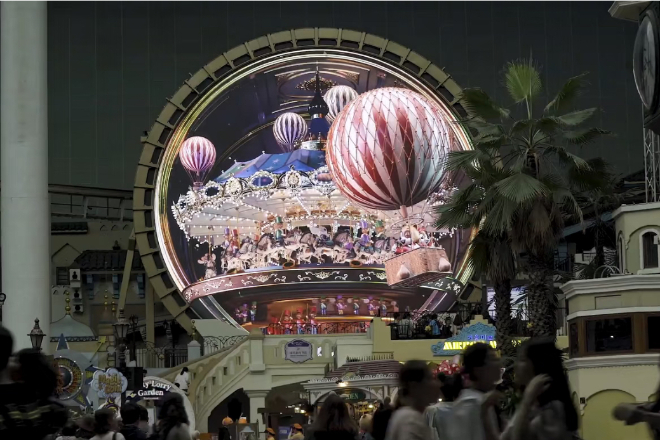
In large indoor theme parks, both circular and curved LED displays can break the limitations of traditional flat screens, but they offer different experiences.
- Circular LED displays: Making visitors feel like they’ve entered another world
Circular screens can create a continuous image around the viewer, suitable for creating an immersive visual experience.
For example, in a space-themed area, visitors standing in the center of the screen watch planets slowly move around them, and shooting stars streak across their faces, as if they’re about to embark on a cosmic adventure.
In an ocean-themed space, schools of fish can swim from one side to the other, and large marine creatures can gradually approach from a distance.
Compared to standard background screens, circular LED displays are more likely to create an immersive experience.
- Curved LED displays: Integrating architecture into the performance
Curved screens don’t necessarily need to completely surround the audience; they can extend along walls, corners, or building structures.
For example, a theme park entrance can use a curved عرض الصمام to show a welcome message, allowing visitors to experience the themed atmosphere even before entering the rides.
Waiting areas can use curved screens to display backstory information, while dining areas can showcase flowing forests, oceans, or starry skies.
Curved screens are generally easier to integrate with parts of the building’s layout, but the actual installation difficulty still depends on the curvature, size, and structural conditions.
When choosing a screen shape, project teams can ask three questions: Do visitors need to be surrounded by the image? I
s the screen the main focus of the space, or part of the architecture? Will visitors stop to watch, or will they look at it as they walk by?
If the goal is simply to achieve a novel shape without considering the actual visitor experience, even a large budget may only result in a uniquely shaped screen.
Determine what visitors want to experience first, then decide how the screen should be curved; otherwise, creativity will become just expensive decoration.
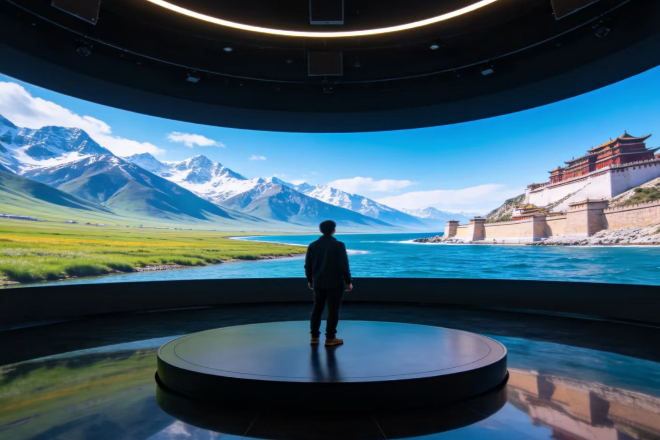
The design of circular and curved LED displays cannot solely rely on the impact of renderings; it’s crucial to consider what visitors will actually see on-site.
First, the screen size must be determined based on the space.
If the screen is installed in a large themed plaza, visitors will view it from different directions, and a larger display area helps create a visual center.
However, if the screen is located in a narrow passageway, an excessively large size may make the space feel cramped and obstruct passage.
So, is a larger screen always better? Not necessarily. The key is whether the screen’s proportions are harmonious with the space and whether visitors can see the complete image from a suitable position.
Second, the curvature must be determined appropriately.
The curvature of a curved LED display affects how the image extends and the visual experience for viewers from different angles.
A curvature that is too gentle may result in a weak sense of immersion; a curvature that is too large may increase the difficulty of structural design, installation, and content production.
Circular LED displays also require consideration of the overall diameter, screen height, and the viewing position of the audience.
If the screen is too close to the audience, they may only see a portion of the image; if the distance is too far, the visual impact may be weakened.
Third, the مساحة وحدة الصورة should be selected based on the عرض المسافة.
Pixel pitch is the distance between the centers of adjacent pixels, usually expressed in millimeters.
All other things being equal, a smaller pixel pitch generally results in a more detailed image, but the procurement cost may also be higher.
If visitors will be observing people, buildings, or interactive content up close, attention should be paid to image detail;
If the screen is mainly used to display large-scale themed scenes from a distance, the appropriate specifications can be selected based on the actual viewing distance.
Furthermore, it’s not enough to only test the viewing effect from the center of the screen.
Visitors may stand at the edges, sides, or walk around while viewing, so the continuity of the image at different angles must also be checked.
It is recommended to create a spatial model or build a partial prototype during the design phase to test the screen size, curvature, and viewing distance through actual content playback.
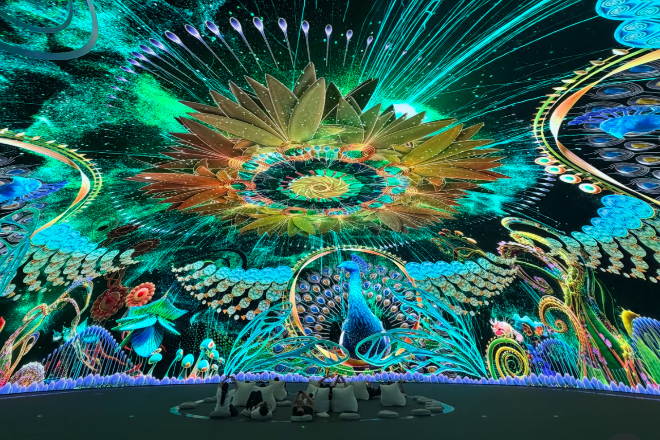
Circular and curved يعرض الصمام cannot be achieved simply by bending an ordinary screen arbitrarily.
Curved structures can affect module splicing, installation accuracy, image continuity, and subsequent maintenance.
Therefore, special attention must be paid to whether the product is suitable for the target design when selecting a model.
First, confirm the curvature range supported by the product.
Different LED displays use different module and cabinet structures; not all products can achieve arbitrary curvature.
The project team should confirm whether the supplier provides suitable curved modules, cabinets, or specialized installation solutions based on design requirements.
If the curvature variation is significant, the connection method between adjacent modules should also be checked to avoid obvious folds in the screen.
After all, visitors come to theme parks to see fantastical worlds, not to study screen splicing seams.
Second, color consistency is crucial.
Large theme parks often display large-area dynamic images such as skies, oceans, and forests.
If there are significant brightness differences or color casts in different areas of the screen, continuous scenes may appear fragmented.
When purchasing, focus on color correction capabilities, brightness consistency, and grayscale performance。
And test with real content, rather than just looking at the most vibrant images in the supplier’s demonstration videos.
Third, check the performance of dynamic images.
Theme park content often includes fast-moving characters, flying scenes, and special visual effects.
The screen needs to work stably with the playback equipment and control system to maintain a natural visual experience.
Fourth, the installation structure must be planned in advance.
Large circular screens may require specialized steel structure supports, and curved screens need to be fixed according to the building’s structural conditions.
The design should consider load-bearing capacity, installation accuracy, heat dissipation, and maintenance space, and a structural assessment should be conducted by a professional team.
For project decision-makers, a worthwhile product should not only achieve the curves shown on the design drawings but also remain stable in actual operation, display natural visuals, and be easy to maintain.
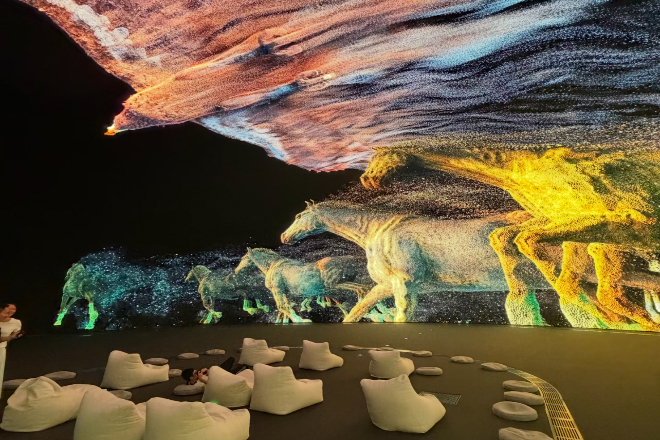
The screen’s shape can attract visitors’ first glance, but whether it leaves a lasting impression ultimately depends on the content played.
If a circular عرض الصمام simply loops ordinary scenic videos, even a large screen may not provide a truly immersive experience.
Conversely, if the content is closely integrated with the space’s theme, the screen can become part of the entire story.
For example, in a space-themed area, the visuals could gradually transition from planetary surfaces to space travel, then into nebulae and unknown galaxies.
Standing in the center of the circular screen, visitors feel as if they are participating in a space exploration.
In the ocean-themed area, a visual journey can be designed to gradually transition from shallow to deep waters, allowing corals, schools of fish, and large marine life to appear as the story unfolds.
Curved screens can showcase environmental changes along pathways, allowing visitors to discover new scenes as they move.
Furthermore, LED displays can be linked with lighting, sound, and interactive devices.
For example, when a spaceship on the screen starts, the lights change in sync, and the sound system plays engine sounds;
When visitors complete interactive tasks, the characters on the screen respond. The interplay of visuals, sound, and motion makes the entire space feel more like a real adventure.
However, content design must begin with the screen’s form.
Circular screens need to consider the seamless transition between the beginning and end of the video to avoid abrupt changes at the end;
Curved screens require attention to the placement of main subjects and perspective to prevent figures or buildings from appearing compressed.
Simply stretching a regular rectangular video onto a circular or curved screen can distort figures, crop important scenes, and diminish the effectiveness of the content.
Theme parks can also update content based on festivals, seasons, and events, allowing the same LED display screen to continuously deliver new experiences.
The screen creates the space, while the content imbues it with a story. When both work well together, visitors truly feel they’ve entered a fantastical world.
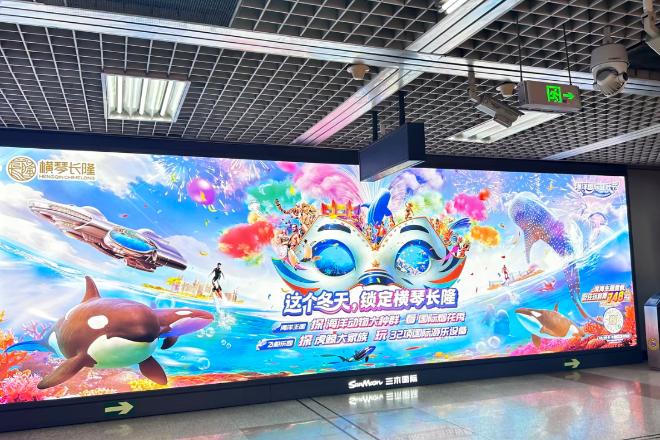
For large indoor theme parks, circular or curved LED displays are typically long-term installations.
Investors must consider not only the visual impact at opening but also the equipment’s stability, ease of maintenance, and the reasonableness of subsequent operating costs.
First, structural and installation safety must be prioritized.
Large circular screens may be suspended or fixed to specific building structures, while curved screens may be installed on high walls, at corners, or in high-traffic areas.
Therefore, a professional team should assess the structural load-bearing capacity, fixing methods, and necessary safety measures, ensuring the installation plan meets applicable requirements.
Second, proper planning of heat dissipation and maintenance space is crucial.
يعرض الصمام generate heat during operation. If the screen is enclosed in a confined structure with insufficient heat dissipation, it can affect equipment stability.
During the design phase, sufficient space for heat dissipation should be reserved according to product requirements.
And the maintenance methods for modules, power supplies, and control equipment should be confirmed in advance.
For locations where the back is difficult to access, a front maintenance solution can be evaluated, but the actual maintenance capability still needs to be confirmed in conjunction with the specific product structure.
Third, the protection level should be selected based on the installation environment.
Theme parks may include water features, interactive installations, and special themed areas.
If the LED display screen is near water or in a high-humidity environment, moisture-proof, splash-proof.
And electrical safety requirements need to be evaluated; products cannot be simply selected based on ordinary indoor environments.
Fourth, the complete project cost must be calculated.
In addition to the LED display screen purchase cost, expenses such as steel structure, installation and commissioning.
Control system, content production, energy consumption, spare parts, and maintenance services should also be considered.
Content production for circular or curved screens usually requires specialized adaptation; therefore, subsequent content updates should also be included in the budget.
Otherwise, although the screen is installed, if the cost of updating is too high and the same content is played for a long time, the original creative advantages may gradually diminish.
Finally, the supplier’s technical support capabilities should be considered.
Before purchasing, it’s essential to understand the warranty coverage, spare parts supply, repair response time.
And whether the supplier can cooperate with curved structure design, image calibration, and subsequent content adjustments.
For project decision-makers, the ideal solution isn’t simply pursuing the lowest price, but rather striking a balance between visual appeal, structural safety, ease of maintenance, and long-term operating costs.


 English
 Español
 简体中文
 Français
 日本語
 한국어
 العربية