

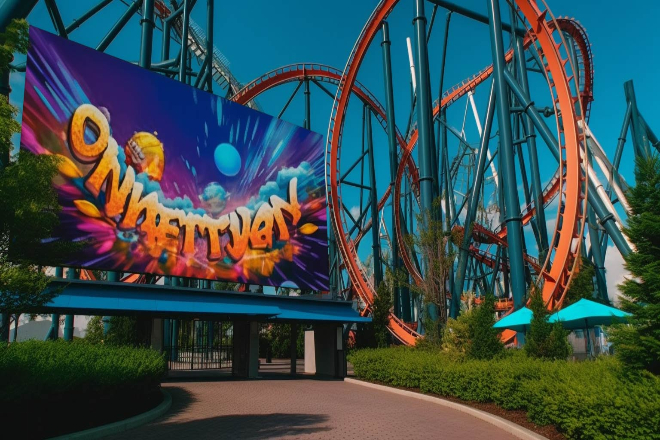
Theme park queue areas shouldn’t just be passageways to rides; they can be part of the overall story.
The value of LED displays lies in gradually drawing visitors into the scenario set for the ride while they wait.
For example, in a space-themed ride, the يعرض الصمام in the queue area could showcase space travel missions, planetary exploration.
And countdowns to spaceship launches, making visitors feel as if they are waiting to board a real spaceship.
For a jungle adventure ride, the screens could display animals deep in the forest, mysterious ruins, and adventure clues, turning the queuing process into a prelude to the story.
For ocean-themed attractions, dynamic underwater scenes, schools of fish, and shipwrecks can create an atmosphere of exploration;
In the fantasy castle area, magical scenes, character stories, and upcoming adventures can be displayed.
However, LED displays shouldn’t just continuously play videos related to the attraction’s theme. Truly effective design requires considering what visitors will see at different stages of the queue.
The queue entrance can build anticipation, the middle area gradually unfolds the story, and the plot of the upcoming attraction is revealed as visitors approach the boarding entrance.
This way, visitors don’t repeatedly see the same images in the same place, but gradually approach the climax of the story as they move.
At the same time, the content should be consistent with the real environment. If an intense space battle is unfolding on the screen.
But the surrounding area is just ordinary queue railings and cluttered equipment, the immersive experience will be greatly diminished.
Therefore, when planning LED displays, theme parks should consider the screen content, architectural decorations, lighting, and the story setting of the rides together.
The best LED displays in queue areas don’t make visitors feel that the wait is getting longer, but rather that the adventure has already begun ahead of time.
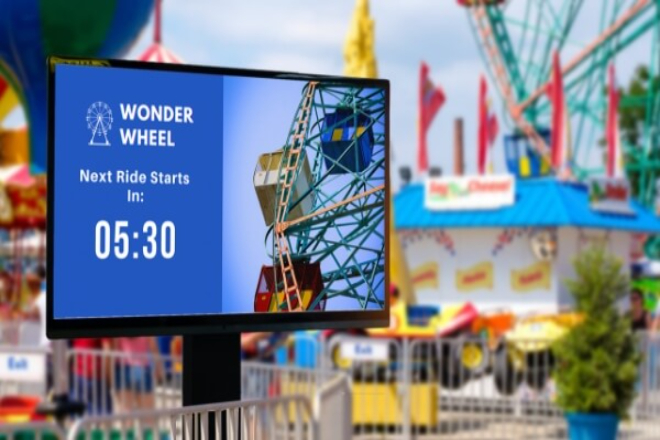
Choosing the right location for LED displays is sometimes more important than simply increasing screen size.
Theme park queuing areas typically include different spaces such as entrances, long corridors, corners, indoor waiting areas, and attraction entrances, each suitable for different display tasks.
First, there are the queue entrances.
Entrances are often where visitors first encounter the attraction’s theme, making them ideal for visually appealing يعرض الصمام.
Large dynamic visuals, themed characters, and scene displays can help visitors quickly understand the attraction’s features and generate anticipation before they even enter the queue.
Second, there are longer queues.
If the queue involves multiple turns or a long wait, appropriate LED displays can be placed along the route to play continuous story content, fun facts, or interactive information related to the attraction.
This enriches the waiting experience and reduces the boredom caused by repeatedly seeing the same images.
Third, there are corners and locations where sightlines change.
Corners often create visual blank spaces and are where visitors naturally change their gaze as they move.
Depending on the space, vertical screens, narrow screens, or creative screens integrated with architectural decorations can be used to allow visitors to discover new scenes as they turn the corner.
For example, castle-themed attractions can present visitors with a seemingly opening magical door around a corner, while adventure attractions can use screens to display clues about unknown areas.
Finally, there are waiting areas near rides.
Here, prompts indicating the ride is about to start, character dialogue, or countdown timers can be displayed, giving visitors a clear psychological expectation before entering the riding area.
However, the placement of LED displays cannot be considered solely in terms of visual appeal.
The design should also avoid obstructing evacuation signs, operational information, and staff visibility, and should not impede visitor movement.
A reasonable amount of space needs to be left between the screens and queuing barriers, lighting fixtures, and other equipment.
For park operators, the screen layout should facilitate smoother visitor movement, rather than causing people to stop to see the screen, thus hindering queue flow.
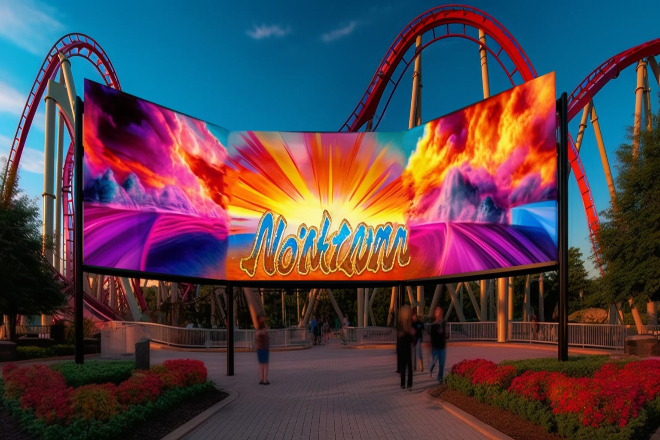
Theme park queuing areas are not always spacious indoor halls.
Some are located outdoors, some pass through narrow passageways, and some are integrated with castles, caves, or futuristic architecture. Therefore, LED displays cannot be purchased in uniform sizes.
First, the مساحة وحدة الصورة must be selected based on the viewing distance.
Pixel pitch is the distance between the centers of adjacent pixels, usually expressed in millimeters.
All other things being equal, a smaller pixel pitch generally makes it easier to display details at close range, but it may also be more expensive.
If visitors will linger at close range in front of the screen, a small-pitch LED display can be evaluated;
If the screen is installed at a higher location and primarily used to display large themed images, a more suitable specification can be chosen based on the actual viewing distance.
For example, a large themed screen at the entrance needs to be visible to visitors from a distance, while a screen in a narrow passageway needs to consider clarity at close range.
Secondly, the screen shape should be chosen based on the space.
Flat LED displays are suitable for displaying story videos, project introductions, and operational information;
Curved LED displays allow the image to extend along the wall, enhancing the sense of immersion; vertical or narrow screens are suitable for corners, near pillars, and areas with limited space.
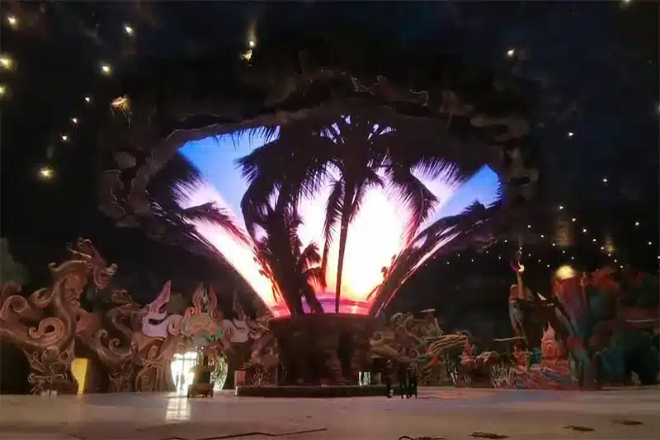
For theme parks that want to highlight creativity, irregularly shaped LED displays can also be considered.
Allowing the screen to integrate with architectural elements such as castle windows, spaceship hatches, or cave entrances.
However, irregularly shaped structures usually require more careful planning of installation methods, content proportions, and subsequent maintenance.
Thirdly, the product should be selected based on the installation environment.
Outdoor queuing areas may face challenges from sunlight, rain, dust, and temperature fluctuations, requiring assessments of brightness, protection levels, and heat dissipation design.
Indoor areas should focus on viewing comfort, color reproduction, and installation space.
Finally, don’t overlook the matching of content to screen ratio.
Placing ordinary videos directly on a specially shaped LED display may result in important figures being cropped or the image being stretched.
Ideally, content production should be planned concurrently with the screen size and shape.
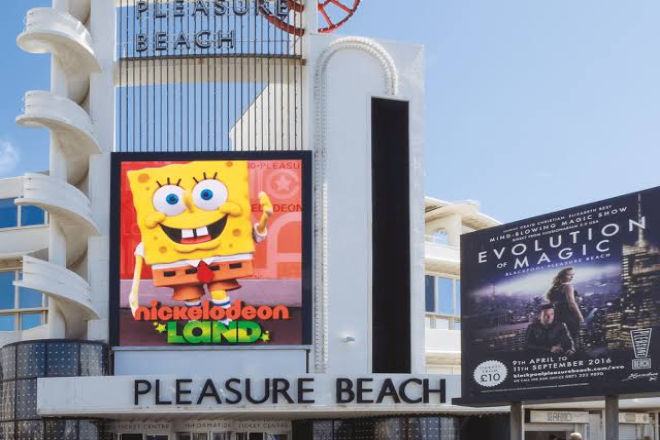
لو يعرض الصمام in a theme park simply play videos, they can improve the visual experience; if they can also interact with visitors, they can make the wait more engaging.
For example, in interactive waiting areas, simple games can be introduced through motion recognition, sensors, or touchscreens.
Space-themed areas can feature virtual planet exploration, ocean-themed areas can allow visitors to help fish find their way, and adventure-themed areas can offer interactive tasks like finding hidden clues.
Interaction doesn’t necessarily require complex equipment. Sometimes, a simple action from a visitor, eliciting a response from the on-screen character, is enough to engage children and families.
Another approach is to design experiences that involve multiple participants. For example, visitors could help launch a spaceship on screen with simple actions or complete a marine conservation mission together.
This not only increases fun but also creates a more social atmosphere in queue areas.
However, interactive content must consider real-world queue conditions. Visitors typically need to move forward, and if interactive tasks take too long, it can cause congestion.
Therefore, theme parks should prioritize short, easy-to-understand interactive experiences that can be ended at any time, ensuring visitors can pass through smoothly even without participating.
For visitors of different ages, easily understandable visual cues should be provided to avoid complex operations turning the experience into another burden.
Meanwhile, interactive screens should not obstruct operational instructions and safety information.
If cameras or other sensing devices are used, privacy and data management issues should be addressed according to the project requirements.
The goal of interaction is not to make visitors forget queue rules, but to provide them with more enjoyment without hindering passage.
For theme park investors and operators, LED displays in queuing areas need to not only attract visitors but also withstand long-term use.
First, the appropriate product should be selected based on the installation location.
Outdoor queuing areas require consideration of waterproofing, dustproofing, ambient temperature, and visibility under sunlight;
Indoor areas should prioritize heat dissipation, brightness adjustment, and viewing comfort.
Second, equipment maintenance is crucial.
Theme parks typically have fixed operating hours. If a screen malfunctions, the repair process may require closing sections of the passageway, potentially impacting the visitor experience.
Therefore, when purchasing, it’s essential to understand module replacement methods, maintenance space, spare parts availability, and after-sales response time.
For areas with limited installation space, front-maintenance يعرض الصمام can be evaluated to allow for front-side module inspection.
However, the specific maintenance capability still depends on the product structure and installation plan.
Third, content updates also need to be planned in advance.
If the queuing area displays the same content year-round, even if initially attractive, repeat visitors may gradually lose interest.
The park can update content based on holiday activities, seasonal themes, new attraction launches, and special events to keep familiar areas fresh.
For example, a mystery adventure theme can be switched during Halloween, while winter activities can incorporate snowscapes, holiday characters, and special stories.
Hardware doesn’t need frequent replacements; new experiences can be brought through content updates.
Fourth, calculate the overall operating cost.
In addition to the purchase price of the LED display screen, the costs of structural installation, control systems, content production, energy consumption, maintenance, and spare parts should also be considered.
For interactive projects, the maintenance costs of sensing equipment and software also need to be assessed.
Finally, safety cannot be sacrificed for visual appeal.
The screen should not obstruct evacuation signs, affect staff observation of queues, or cause visitors to linger in the middle of passageways for extended periods to watch or participate in interactive activities.
For ground-level and low-level screens, additional assessments of slip resistance, load-bearing capacity, and pedestrian safety are necessary.
A truly mature solution should allow LED displays to attract visitors while also complementing the park’s daily management.


 English
 Español
 简体中文
 Français
 日本語
 한국어
 العربية