
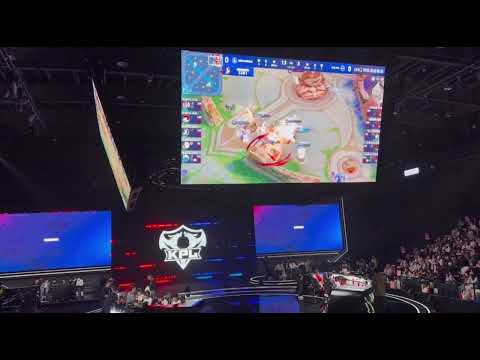
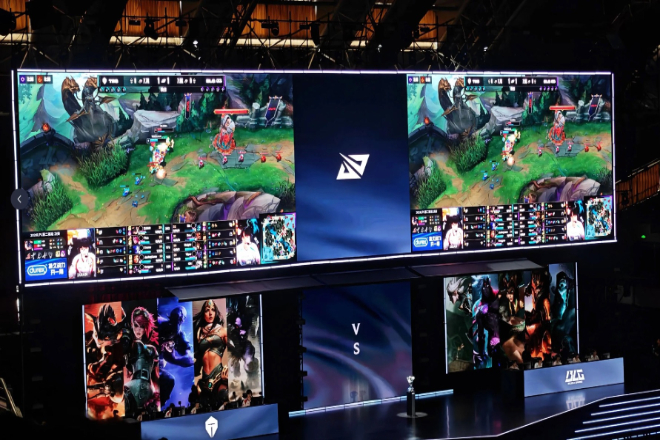
When choosing an LED display for an e-sports hall, the pixel pitch is an important parameter to consider.
It refers to the distance between the centers of adjacent pixels, usually expressed in millimeters. For example, P1.5 means that the pixel spacing is approximately 1.5 mm.
When other conditions are similar, the smaller the مساحة وحدة الصورة, the greater the number of pixels per unit area, making it easier to present a detailed picture when viewed at a close distance.
But this does not mean that e-sports venues must choose the smallest pixel pitch.
The reason is simple: the further away the viewer is from the screen, the harder it is to detect subtle pixel differences.
If the main screen is far away from the auditorium, even if a very small pixel pitch is used, the actual improvement in look and feel may not be directly proportional to the increased purchase cost.
On the contrary, if the screen is installed near the player area, interactive area, or smaller e-sports space, the audience may watch the game screen at a close distance.
At this time, more attention needs to be paid to pixel spacing and screen details.
For example, the auditorium of a small e-sports stadium may be only a few meters away from the screen, and the character outlines, text.
And skill effects on the screen are relatively easy to observe. The main screen of a large event venue may need to cover farther stands, and the screen size and overall line of sight should also be considered when choosing.
Therefore, before purchasing, enterprises should measure the nearest and farthest viewing positions and determine what scenarios the screen is mainly used for.
The selection logic of pixel pitch is not that the smaller the better, but to allow the audience to get a clear and comfortable picture at the actual viewing distance.
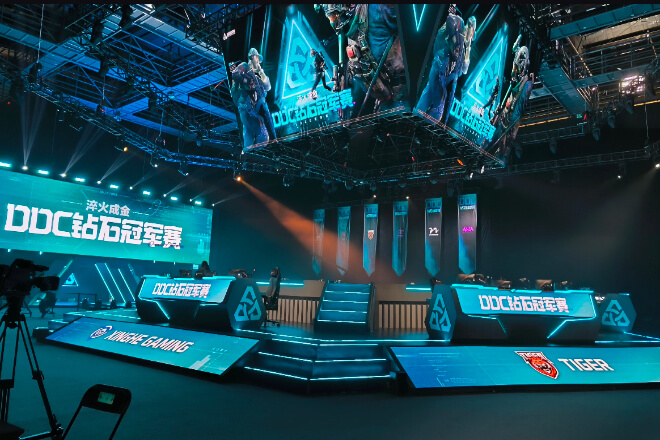
There’s not just one way to use an eSports arena. Some venues are mainly used for daily entertainment of players, some are specialized in hosting offline competitions.
And some need to take into account live broadcasts, brand activities, and comprehensive entertainment performances. Different scenarios have different requirements for شاشات LED.
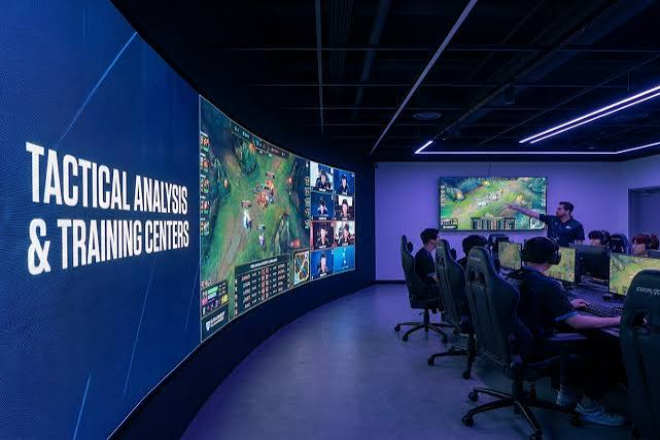
إذا كان عرض الصمام has a small مساحة وحدة الصورة but cannot stably present rapidly changing game images, the audience may still feel that the experience is not ideal.
E-sports competitions have higher requirements for dynamic images. Character movement, camera switching, skill release, and fast transitions all require stable processing by the display system.
Therefore, companies cannot just compare pixel pitch, but also pay attention to refresh rate, grayscale performance, brightness uniformity, and video processing capabilities.
The first is the refresh rate.
Refresh rate, usually expressed in Hertz, reflects the number of times the screen updates its image per second.
Higher refresh rates can help reduce some dynamic display issues, but actual performance is also affected by signal source, driving method, and camera shooting conditions.
If the eSports arena frequently hosts live events, the screen should also be tested using actual camera equipment to confirm whether obvious scanning stripes or flickers appear.
Followed by grayscale and color performance.
E-sports games often have dark maps, shadow areas, and highlighted skill effects. If details in dark areas are lost, it may be difficult for the audience to see the character clearly;
If highlight areas are poorly performed, complex skill effects may appear dazzling or lack layering.
Therefore, when purchasing, it is recommended to play real game scenes and observe dark parts, fast-moving pictures, text, and high-contrast scenes, rather than just watching carefully produced promotional videos.
Lastly is the overall consistency of the screen.
If there are obvious سطوع differences, uneven colors, or local abnormalities on the screen, even if the pixel spacing is small, it will affect the look and feel of the entire screen.
For e-sports venues, pixel spacing determines the basis for the performance of picture details, while refresh rate, color, and stability jointly affect the final effect seen by the audience.
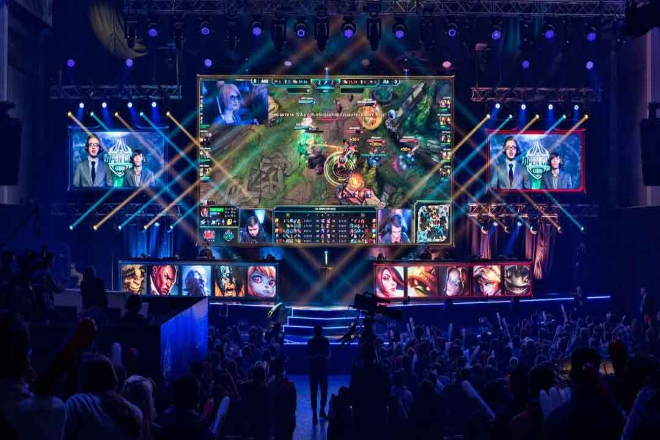
E-sports stadiums are usually equipped with display devices for different purposes, such as main منصة screens, score screens, player information screens, and interactive area screens.
These devices don’t necessarily need to have the same مساحة وحدة الصورة.
The main stage عرض الصمام screen is usually responsible for displaying the main game images, and the specifications need to be selected based on the audience distance, screen size, and event production requirements.
Side screens may be used to display player close-ups, scores, team information, and sponsor content.
If the audience is far away, you can choose a more cost-effective solution based on actual viewing needs; if the side screen is located in a close interaction area, you need to pay more attention to detail clarity.
Interactive screens may be installed in player experience areas or audience participation areas.
Since viewers may be in close contact with the screen, businesses need to consider pixel spacing, سطوع, content layout, and device security.
However, when screens of different specifications are used in combination, screen connection must also be considered.
If the main screen and side screen need to present the same scene, the pixel spacing, color, and brightness performance will be too different, which may affect the overall visual effect.
Therefore, enterprises can select models separately according to the functions of each screen, but they should plan the control system, color management, and content layout in a unified manner.
For e-sports halls with limited budgets, it is usually more reasonable to configure appropriate display specifications for the main game screen first.
And then select equipment that matches the actual use for the auxiliary area, rather than using the highest configuration for all screens.
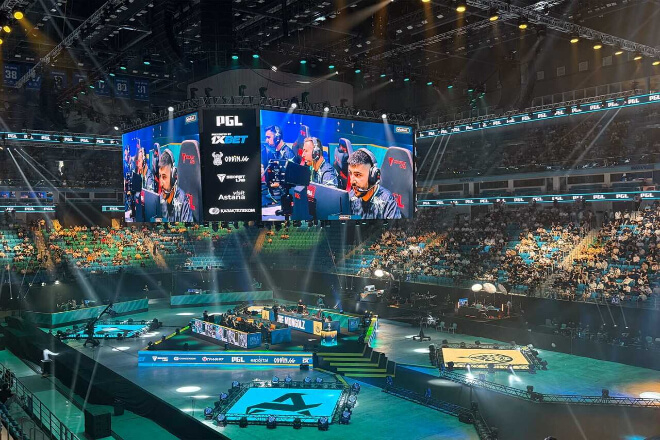
Determining the مساحة وحدة الصورة التابع عرض الصمام in the e-sports hall ultimately comes back to the project itself.
Enterprises should conduct verification based on actual عرض المسافة, event needs, and budget, rather than relying solely on parameter tables to make decisions.
First, draw a layout diagram of the auditorium and screen, identifying the nearest, farthest, and primary viewing positions.
If the venue has multiple grandstand areas, you should also confirm whether side screens are needed to supplement information.
Secondly, suppliers are required to provide actual game screen testing.
Test content should include fast movement, dark details, score text, and high-contrast scenes, and should be conducted as close to the actual viewing distance and ambient light as possible.
Third, compare the overall cost of different pixel pitch solutions.
Products with smaller pixel pitch usually require a higher number of pixels per unit area, but the actual quotation will also be affected by factors such as product structure, معدل التحديث, سطوع, control system, and brand.
Therefore, comparisons should be made under similar configuration and service conditions.
Fourth, consider long-term maintenance.
There are frequent activities in e-sports venues, and screen failures may affect game arrangements.
Enterprises should confirm module replacement methods, spare parts supply, warranty coverage, and after-sales response capabilities, and plan maintenance space in advance.
Finally, consider future changes in usage.
If the venue plans to add live broadcasts, host larger events, or expand interactive areas, it should reserve reasonable room for upgrades during the system design stage.
For project decision-makers, the most worthy comparison is not which pixel pitch number is the smallest.
But the comprehensive performance of different solutions in terms of viewing experience, investment cost, and long-term operation.
When purchasing LED displays for e-sports halls, it is often more effective to first determine the viewing needs, then filter the pixel pitch, and finally verify through actual screen testing than simply pursuing high specifications.


 English
 Español
 简体中文
 Français
 日本語
 한국어
 العربية