
Creative LED displays can certainly “look different,” but it’s not about being as strange as possible.
If the shape doesn’t match the space at all, the screen might not be a plus, but rather a distraction.
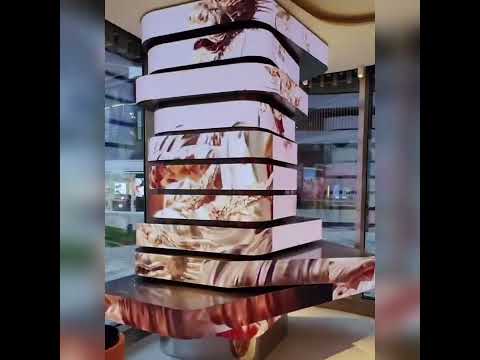
For example, if there’s a huge column in a 购物中心 atrium, why not simply “fit” it with an LED display?
What was originally an ordinary column can be transformed into a 360° digital display space.
If a 酒店 lobby is a curved space, a curved LED display can be installed along the wall, allowing dynamic images to flow along the building’s contours.
Customers won’t see a “screen that was installed later,” but rather it will feel like the building was designed that way from the start.
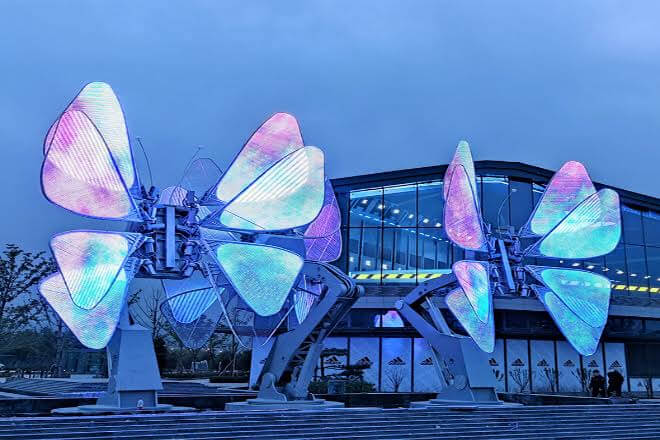
Brand stores can also be bolder. If the wall is wavy, let the LED display follow the wave; if the space has a special structure, make the screen into a corresponding curve or geometric shape.
In this way, the LED display isn’t forcibly crammed into the space, but rather “grows” out of it.
This is also what makes creative LED displays so interesting: they are no longer just standard-sized “boxes,” but become part of the space based on the wall, columns, and architectural structure.
Therefore, the real focus of irregularly shaped LED displays isn’t: “How strange a shape can I make?” but rather: “What kind of screen is best suited to grow in this space?”
With a rationale for the shape, the screen won’t just be eye-catching for its own sake; instead, it will make the entire space look more complete and more design-oriented.
The most interesting thing about irregularly shaped LED显示屏 is that the screen can be unconventional in shape, but the image quality should still ideally be normal.
Rectangular LED displays are relatively simple; just place the video on it, and it will generally display normally.
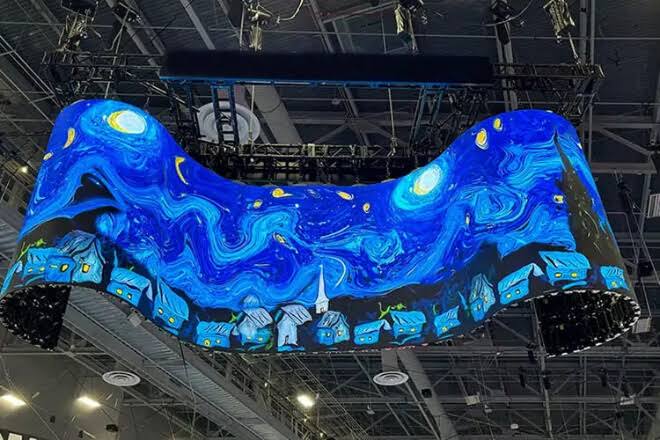
But if you switch to spherical, cylindrical, or wavy LED displays, things are not so simple.
Each LED module on the screen has a different position. Playing ordinary videos directly can easily result in stretched logos, distorted figures, or even misaligned images.
This is where mapping becomes crucial. Based on the pixel positions and screen structure, mapping is needed to ensure each area of the video corresponds correctly to its position on the LED screen.
For example, on a giant cylindrical LED display, the logo needs to naturally wrap around the can, and the beverage, ice cubes, and bubbles should move along the curved surface.
If the mapping isn’t done correctly, the bubbles might suddenly “drift off course,” and the logo might be stretched out like it just finished a stretching exercise.
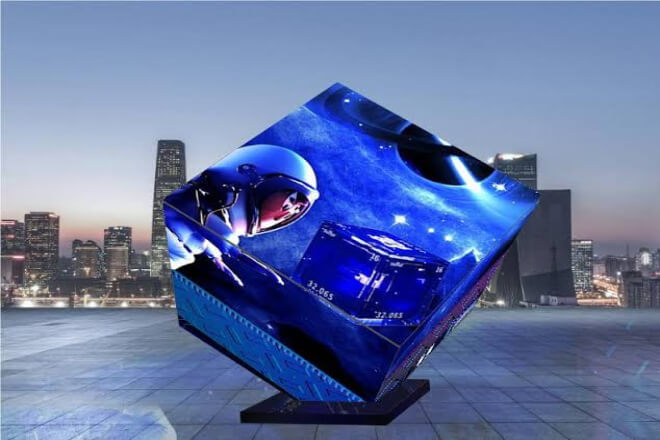
The effects are even more pronounced on spherical LED displays. A beautifully animated Earth can become distorted at the screen edges if the mapping is inaccurate—the Earth might inadvertently become an ellipse.
Therefore, when designing 创意LED显示屏s, one cannot only consider “what shape the screen should be.”
But also how the pixels are arranged, how the content corresponds, and how the image is displayed correctly across the entire screen.
Ultimately, irregularly shaped LED displays can be bold, but pixel mapping must keep up. The screen is responsible for “looking special,” and mapping is responsible for making it look special.
The larger the LED display area and the more modules it has, the less you can afford to simply “piece it together.”
如果 亮度 and color are inconsistent between modules, an awkward effect can result: what appears to be one screen looks like several screens pieced together.
For example, consider a giant cylindrical LED display screen where a brand wants to showcase its classic red packaging.
If the red hues of different LED模组 vary, the logo might appear bright red in the first half and dark red in the second half as it circles the screen.
This is undesirable for the brand—the product packaging hasn’t changed, but the color has.
Therefore, after the LED display screen is installed, the brightness and color of different modules need to be calibrated to ensure the overall display effect is as consistent as possible.
For irregularly shaped LED displays such as spherical or cylindrical ones, the visual differences caused by different curvatures and viewing angles must also be considered.
Especially when viewed up close, even slight differences in brightness can be magnified.
If the project has high image quality requirements, further pixel-by-pixel calibration can be performed to ensure that every pixel on the LED display screen maintains a consistent appearance.
The goal is simple: to present viewers with a cohesive, aesthetically pleasing LED display, rather than a collection of individual LED modules with their own ideas.
While bold designs and dazzling visuals are acceptable, brightness and color should ideally maintain a “team spirit.” This allows creative LED displays to truly maximize their visual impact.
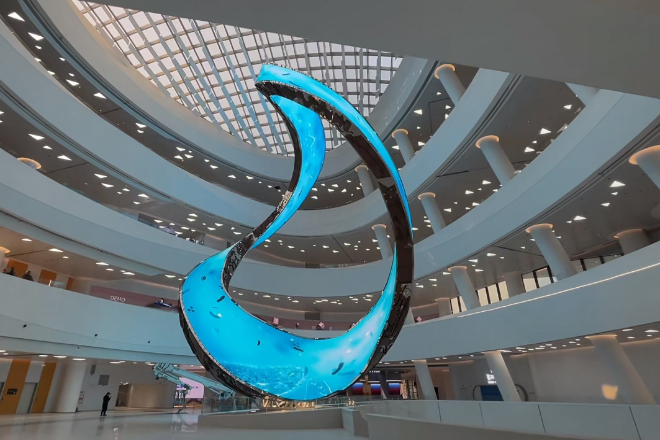
LED显示屏 are already spherical, cylindrical, and curved.
Simply using standard rectangular screen materials directly on top of them results in a situation where “the screen’s shape has changed, but the content hasn’t caught up.”
The true beauty of 创意LED显示屏 lies in making the screen shape and the image work together.
For example, a cylindrical LED display can allow beverages, light, or particles to move in a circular motion around the entire screen, making viewers feel as if the image is truly “attached” to the can.
A spherical LED display can utilize the spherical surface to display circling visuals of the Earth, planets, flames, etc., allowing the content to unfold naturally along the LED screen’s structure.
However, not all content is suitable for “randomly rotating.” Important information such as text, logos, and product names should ideally be placed away from areas of the LED display prone to visual distortion.
Especially for cylindrical and spherical screens, if the logo is placed in an inappropriate position, it might be stretched when rotated, making the brand name almost unrecognizable.
Conversely, dynamic and flowing visuals are very suitable for irregularly shaped LED displays. Elements such as bubbles, smoke, liquids, light.
And particles don’t have strong fixed boundaries and can move along the curves of the LED display, actually amplifying the advantages of the irregular structure.
Therefore, when designing creative LED displays, the question shouldn’t just be, “What can this screen play?” but also, “What kind of image is best suited to ‘move’ on this screen?”
When the shape and content of the LED display truly complement each other, the screen is no longer just “changed shape,” but truly begins to tell a story through its shape.
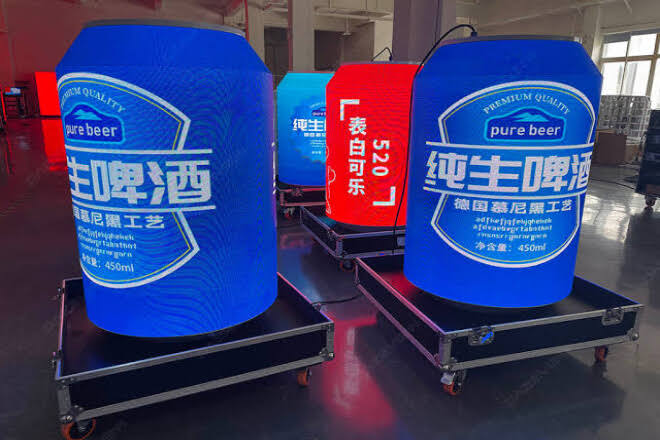
The first time an LED display lights up is usually the most exciting moment—the lights are on, the image appears, and the effect looks cool.
But don’t rush to celebrate. This is especially true for irregularly shaped LED displays such as spherical, cylindrical, and curved ones.
After installation, grid, color, and image testing are required to confirm that the position, brightness, and display effect of each LED模组 are normal. Simultaneously, the signal, control system, and module operating status must be checked.
The biggest problem with LED displays isn’t simply installation issues, but rather unexpected misalignment after installation.
For example, consider a giant cylindrical LED display where an LED module is replaced after a period of operation.
If the new module isn’t recalibrated, a small area might appear with different brightness or color than its surroundings. From a distance, it looks like the LED display has been secretly patched up.
Therefore, timely calibration after module replacement is crucial to ensure consistent display effects between the old and new LED modules.
Furthermore, mapping files, pixel configurations, and control system parameters must be carefully saved. For complex, irregularly shaped LED displays, these files act like a “screen map.”
During future maintenance, module replacement, or readjustment, these files allow for quick location of the corresponding areas, eliminating the need to re-analyze the entire LED display’s pixel layout.
Thus, the truly stable operation of a 创意LED显示屏 relies not only on good hardware but also on proper installation, debugging, calibration, and long-term maintenance.
The design can always be cool, and ideally, the LED display should always be operational.


 English
  Español
  简体中文
简体中文  Français
  日本語
日本語  한국어
한국어  العربية