
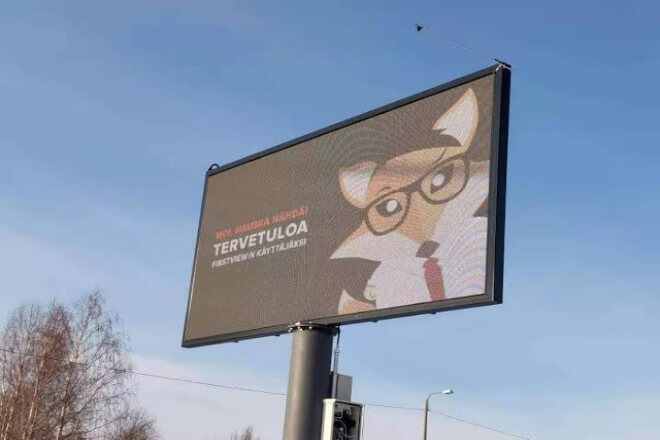
On the edge of deserts, in hot cities, or in areas with persistent strong sunlight, an 户外LED屏 faces more than just sunlight every day.
High temperatures, dust, and sandstorms all test the equipment’s ability to operate stably.
Therefore, choosing an outdoor LED screen cannot only focus on “亮度,” but also on its adaptability to the local environment.
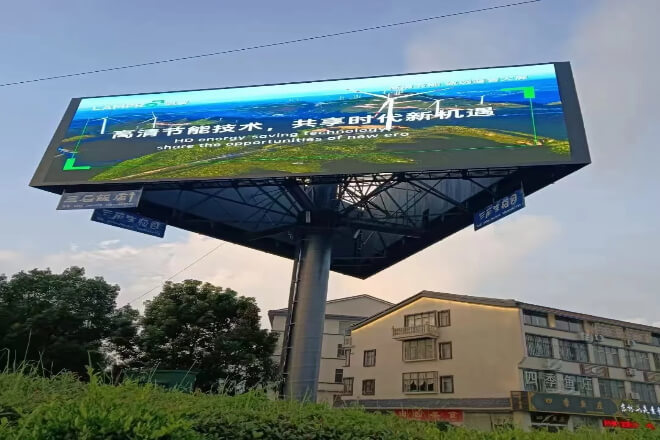
户外LED显示屏 in high-temperature areas are truly the “hardcore soldiers” of the screen industry, working under immense pressure every day!
Compared to screens in normal temperature environments, they must withstand multiple challenges simultaneously, including high temperatures, strong light.
Temperature differences, and sandstorms, directly doubling the difficulty of construction and daily use.
First, constant high temperatures mean the equipment is constantly working overtime.
LED beads, chips, and power supplies are all heat-sensitive and simply cannot withstand continuous high temperatures.
Prolonged operation in high-temperature environments, coupled with insufficient heat dissipation, leads to rapid aging of components.
A gradual decrease in screen brightness, frequent malfunctions, and a significantly shortened lifespan.
Second, exposure to scorching sunlight can completely destroy the screen.
In high-temperature regions, direct sunlight at midday is extremely powerful, and ordinary LED screens simply cannot withstand it.
Just like looking at a phone directly in the sun, the image becomes washed out, grayish, and the colors become blurred, making the content unreadable.
This places extremely high demands on screen 亮度 and sun resistance
Third, large temperature differences between day and night can cause hidden damage.
These regions experience extreme weather variations, with scorching heat during the day and rapid cooling at night.
The metal casing, circuit boards, and sealant materials of LED screens vary, and their different expansion.
And contraction rates can lead to problems such as cracked seals and loose solder joints due to repeated stress. This can create hidden risks of water ingress and short circuits.
Fourth, dust storms further exacerbate the maintenance burden.
In hot, arid regions, constant sandstorms can clog screen ventilation vents, causing the equipment to overheat and eventually malfunction.
Sand also accumulates on the screen surface and inside the device, negatively impacting its appearance and requiring frequent cleaning and maintenance – a time-consuming and expensive process.
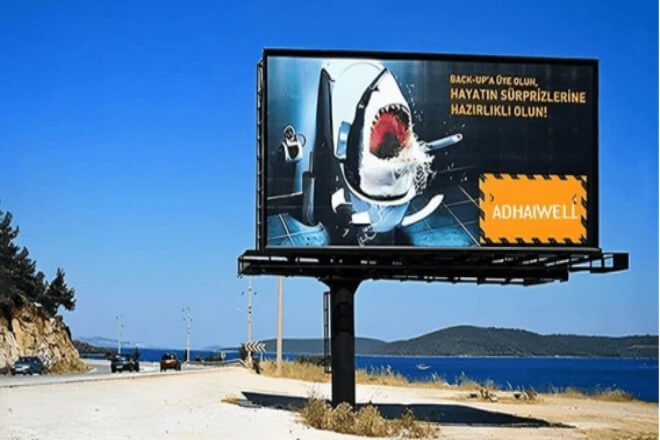
Strong outdoor light is the biggest enemy of LED screens. Under intense sunlight, images easily become washed out and blurry.
To ensure your screen performs well in strong light, don’t blindly stack parameters or rely on brute-force brightness.
A scientifically sound configuration allows the screen to adapt easily to varying outdoor lighting conditions, maintaining optimal performance around the clock.
屏幕 亮度 configuration should be “tailor-made,” avoiding a rigid, one-size-fits-all approach.
We precisely adjust parameters based on the local sunlight intensity and duration to ensure a clear and bright image even under direct midday sun, preventing a blurred or smudged picture.
Furthermore, don’t just focus on brightness; contrast ratio is key to image quality! High-quality configurations prevent colors from appearing grayish.
And lacking detail under strong light, ensuring that color details remain consistently high even when the screen is directly facing the sun.
The choice of pixel pitch is also crucial; there’s no need to blindly pursue the smallest possible size.
Matching parameters to the actual 观看距离 ensures a delicate and pleasing image while avoiding excessive performance and wasted costs.
Many people have fallen into the trap of thinking “the higher the brightness, the better.” While ultra-high brightness can overcome strong daytime light.
It becomes excessively glaring and causes severe light pollution at night, significantly diminishing the viewing experience.
A reasonable balance between day and night 亮度 is the correct answer for comfortable display all day long.
For a smarter and more energy-efficient screen, automatic brightness adjustment is absolutely essential.
Displays equipped with this feature are like having built-in “light-sensing eyes,” automatically brightening on sunny days and softening the brightness on cloudy days and at night, based on ambient light changes.
This solves the problem of visibility in strong light, avoids glare at night, reduces unnecessary power consumption, lowers device wear and tear, and maximizes screen durability.
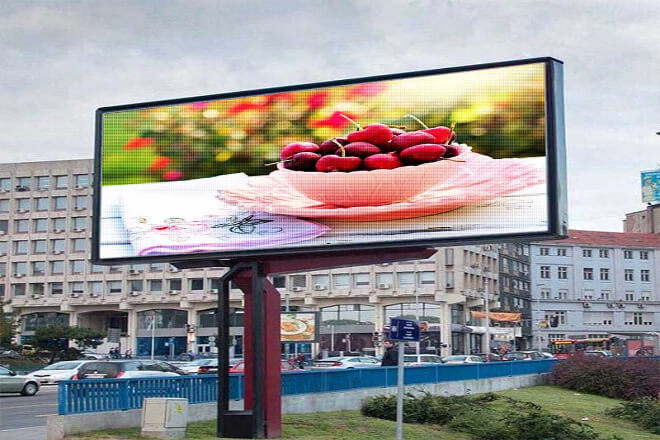
LED displays are somewhat like people; they also “heat up” after prolonged operation.
The difference is that while a person can take a break to drink water when they get hot, a large outdoor screen may need to run continuously for over ten hours, or even all day.
If the heat cannot be dissipated in time, the LED screen may experience decreased brightness, unstable display, and even affect the lifespan of internal components.
Therefore, heat dissipation capability is a crucial factor in evaluating the long-term performance of an LED display.
First, an efficient heat dissipation structure needs to be designed.
By optimizing the cabinet structure and increasing heat dissipation space, the heat generated by the LED模组, 电源, and control system can be quickly dissipated.
For example, in summer, outdoor advertising screens operate under the scorching sun.
If the heat dissipation design is inadequate, the screen is like constantly working in a “high-temperature overtime state,” easily affecting the display effect.
Second, reasonable ventilation and heat dissipation paths are also very important.
The LED screen needs to maintain good air circulation, allowing cool air to enter and hot air to leave, like creating a smooth “breathing system” for the equipment.
At the same time, core components such as the power supply and control system also need to have good temperature resistance.
After all, these components are like the “brain and heart” of the LED screen; once exposed to high temperatures, the entire display system can be affected.
Furthermore, the heat dissipation solution needs to be adjusted according to the local environment.
For example, hot regions need to focus on the ability to operate continuously at high temperatures.
While coastal areas need to consider environmental factors such as humidity and salt spray, choosing a more suitable temperature control design.
Simply put, heat dissipation for an LED display is like installing an “air conditioning system” for the equipment.
A good heat dissipation solution not only cools the screen but also helps it operate stably under high temperature and high load conditions.
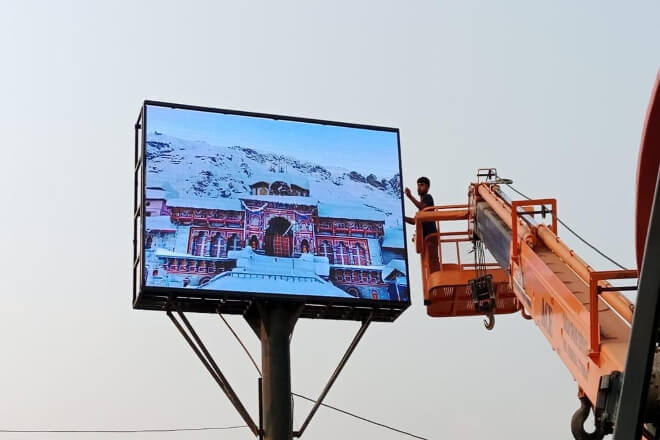
户外LED显示屏 face many “opponents” every day. Besides scorching sun and rain, there is another often overlooked challenge—dust and sand.
If the screen is installed in a desert area, coastal city, or industrial park, it’s like having the equipment “work” outdoors for extended periods.
Airborne sand and dust can constantly approach, and once they enter the screen, they can not only affect heat dissipation.
But also potentially affect the stable operation of core components such as the power supply and control system.
Therefore, an excellent outdoor LED screen not only needs to be bright enough, but also needs strong “defense capabilities.”
First, it’s essential to choose a dustproof and waterproof design suitable for the outdoor environment.
For example, in areas with frequent sandstorms, outdoor advertising screens require better sealing performance to prevent sand particles from entering the screen and ensure normal operation even in harsh environments.
Second, the cabinet structure is also a crucial aspect of protection.
A well-designed structure reduces dust ingress and helps maintain the optimal working condition of internal components.
Simply put, a good cabinet is like an “outdoor protective suit” for the LED screen, protecting it from wind and sand while also safeguarding internal components.
Simultaneously, the IP protection rating needs to be selected based on the actual environment.
Different regions present different challenges. For instance, city streets primarily face dust and rain, while areas prone to sandstorms require stronger protection.
Choosing the appropriate protection rating avoids situations where “too low a rating is insufficient, while too high a rating is wasteful.”
Besides the screen itself, the installation structure is equally important.
Facing strong winds and sandstorms, a robust support structure and reliable fixing methods can help LED screens reduce environmental impact and avoid safety issues.
Of course, even the strongest protection requires daily maintenance.
Regularly cleaning the screen surface and checking the heat dissipation channels and internal condition can prevent dust accumulation from affecting equipment performance.
For outdoor LED displays, dust and sand protection is like equipping the equipment with “outdoor survival skills.”
It must not only display vibrant images but also withstand wind, sun, and sandstorms to achieve truly long-term stable operation.
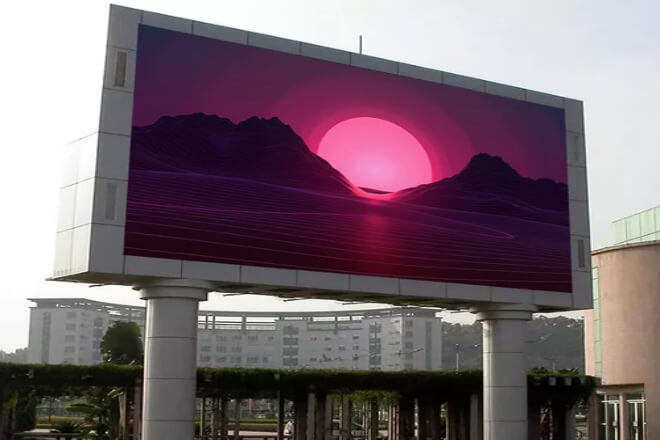
For LED displays to operate stably in the long term, installation and lighting up are not enough.
An outdoor LED screen may need to withstand years or even longer of wind, sun, and rain.
Without proper post-installation management, it may perform well initially, but over time, it is prone to problems such as decreased 亮度 and increased malfunctions.
Therefore, a truly reliable LED display solution should not only focus on the purchase price but also consider its “operating condition” over the next few years.
First, a suitable maintenance schedule needs to be established based on the local climate.
Different environments have different “tempers”: high-temperature areas require a focus on heat dissipation, humid areas need attention to moisture and corrosion prevention.
And areas with a lot of dust require enhanced cleaning and maintenance. Proactive, targeted maintenance can reduce many unexpected problems.
Second, the screen status can be monitored in real time through an intelligent monitoring system.
For example, monitoring temperature, brightness, and power supply operation is like assigning a “health manager” to the LED display.
When abnormal signals occur, they can be detected and addressed in advance, rather than discovering a problem only when an event starts or an advertisement is playing.
At the same time, the selection of core components determines the longevity of the equipment.
Components such as power modules and control systems are like the “engine” of the LED screen; stable quality ensures the screen maintains good performance for a long time.
Furthermore, preparing spare parts and repair plans in advance is also crucial.
For example, if a module on a shopping mall’s exterior wall advertising screen plays continuously every day, quick replacement of the spare part can reduce downtime and not affect normal operation.
Finally, it is also necessary to comprehensively calculate procurement costs, energy consumption, and maintenance costs.
Some LED screens are inexpensive to buy initially, but their high power consumption and frequent repairs can actually increase long-term costs.
The long-term stability of an LED display screen is like owning a car. It’s not enough to just buy one and have it start; you also need to see if it can still operate reliably on the road after several years.
Choosing the right equipment and proper maintenance are essential to making an LED screen a tool for long-term value creation.


 English
  Español
  简体中文
简体中文  Français
  日本語
日本語  한국어
한국어  العربية