

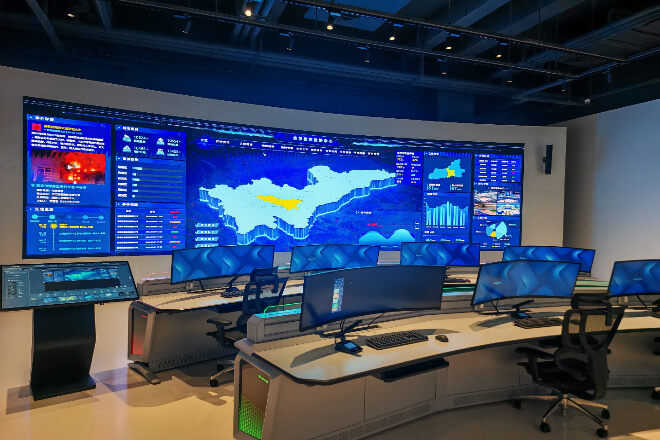
In an emergency command center, LED displays aren’t just for “decorating the walls”—they are tools truly involved in command work.
Normally, they might only display data, but in the event of an emergency, they need to immediately enter “combat mode.”
Because in emergency scenarios, information transmission is often more urgent than imagined.
On-site conditions, personnel locations, rescue progress, weather changes, etc., all need to be presented quickly and clearly to command personnel.
For example, during a natural disaster or a major emergency, the command center may need to simultaneously view on-site video, road conditions, resource allocation information, and task assignments.
A stable, 大型 LED 屏幕 helps staff quickly grasp the overall situation, instead of switching back and forth between multiple small screens.
In addition, emergency response halls typically require long-term operation, and their display systems must withstand continuous workloads.
Abnormal visuals or information delays during critical moments can impact judgment and response efficiency.
After all, emergency command doesn’t allow for “wait a minute.” A highly reliable LED display system acts as the “information hub” of the hall.
Maintaining stable operation normally and helping the team clearly see the situation and act quickly during critical moments.
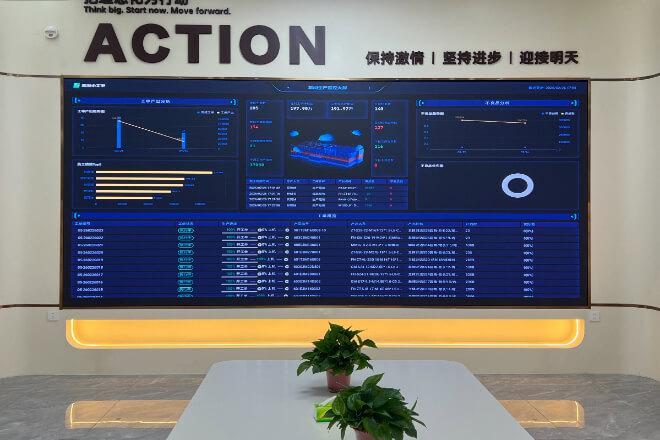
In a command center, the large screen faces numerous tasks daily.
It must display monitoring footage, data analysis, and provide real-time updates on the situation, functioning like a “giant information desktop.”
If the screen display is unclear, situations may arise where monitoring footage of key areas is obscured.
Important data is hidden in corners, and staff have to constantly switch windows to find information.
This is clearly inefficient for scenarios requiring rapid response.
因此,在选择 LED显示屏 solution, the first consideration should be information carrying capacity.
A suitable LED screen needs to clearly display monitoring videos, maps, data charts, and on-site dynamics, presenting various information in a centralized manner.
For example, in a city emergency command center, staff may need to simultaneously view road conditions, weather changes, on-site video, and rescue progress.
Through LED screens, multiple pieces of information can be displayed on the same screen, helping the team quickly understand “what’s happening now.”
Meanwhile, multi-signal source display capability is also crucial. Data from different departments can be simultaneously accessed on the large screen.
Eliminating the need to constantly switch pages like on an office computer, making information viewing more intuitive.
Furthermore, image clarity and detail are paramount. Whether viewing vehicle locations in surveillance footage or analyzing data changes, a stable and detailed display helps staff quickly identify key information.
After all, the biggest fear for command centers isn’t an overabundance of information, but rather the inability to find crucial information.
A good LED display solution is like giving commanders a pair of “digital eyes,” making complex situations clearer and easier to manage.
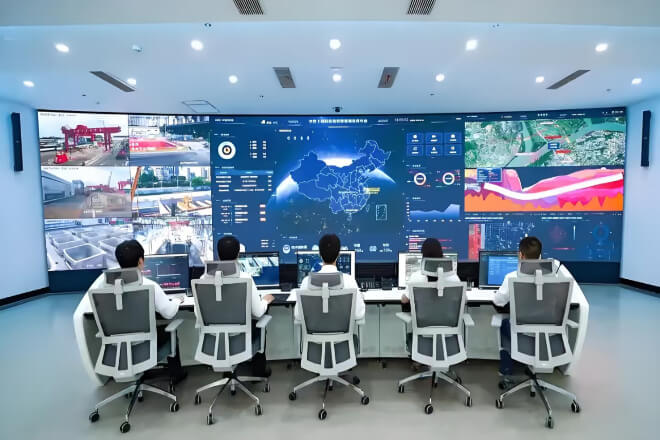
In an emergency command center, LED显示屏 are somewhat like “always-on information windows.”
Normally, they may only display data, but in the event of an emergency, they must function immediately and not “fail” at critical moments.
Because emergency scenarios typically require 24/7 operation, the display system needs to remain stable for extended periods.
Whether for routine monitoring or emergency response, staff rely on large screens to continuously access the latest information.
For example, in emergencies like heavy rain or earthquakes, the command center may need to continuously view on-site videos, rescue routes, and real-time data.
If the screen displays abnormalities or information is interrupted, it can affect on-site judgment and dispatch efficiency.
Besides operating time, display quality is equally important. A high 刷新率 reduces screen flicker and abnormalities.
Making the display of monitoring videos and dynamic data smoother and preventing interference with staff’s ability to observe details.
Meanwhile, a good heat dissipation design also determines whether the LED system can operate stably for a long time.
Especially in large command centers, equipment generates heat during prolonged operation; a reasonable heat dissipation solution can reduce the risk of failure and extend its lifespan.
After all, emergency command doesn’t allow for “reloads.” A stable and reliable LED display system is like a staff member on standby, operating quietly normally and ensuring accurate information delivery in critical moments.
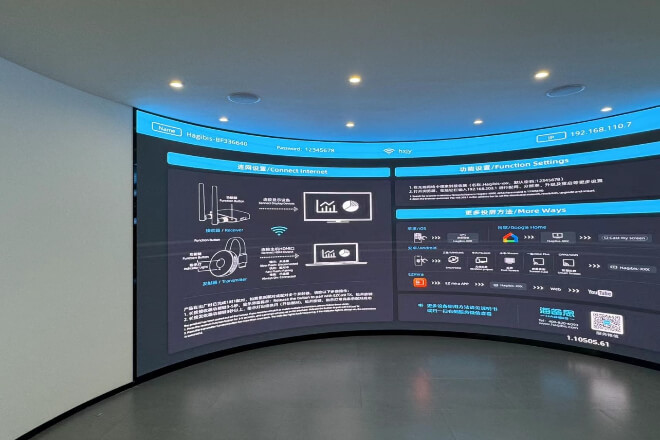
The LED display screen in the emergency hall is not necessarily “the bigger the better.”
Different areas are responsible for different tasks, much like a team where some members observe the overall picture, some analyze problems, and some relay messages.
Each screen also needs to play a different role.
In the main command area, the LED screen acts like a “digital map” for the commanders.
It requires a large, high-解决 display to centrally show maps, monitoring footage, and event progress.
For example, in the event of a large disaster, staff can simultaneously view the affected area, rescue routes, and the situation on-site through a single large screen, enabling faster judgment.
In the meeting and analysis area, the focus is on “clear visibility.” When the team needs to analyze on-site images, view data changes, or discuss solutions.
The screen needs to present more details so that everyone can see the same information, rather than crowding around a computer screen.
In the information dissemination area, the LED屏幕 functions more like a real-time bulletin board.
Whether it’s daily notifications, task assignments, or emergency alerts, updates can be rapid.
For example, if a meeting location is temporarily changed or an important notice is issued, staff and visitors can obtain the information immediately.
And in the monitoring area, multi-screen display capabilities are crucial.
Facing multiple cameras and data sources, LED systems can simultaneously display information from different areas.
Helping staff quickly identify anomalies—like giving the command center “eyes that never blink.”
After all, every second in the emergency response hall is crucial. A suitable LED display solution not only displays information but also helps different positions see, analyze, and act faster.
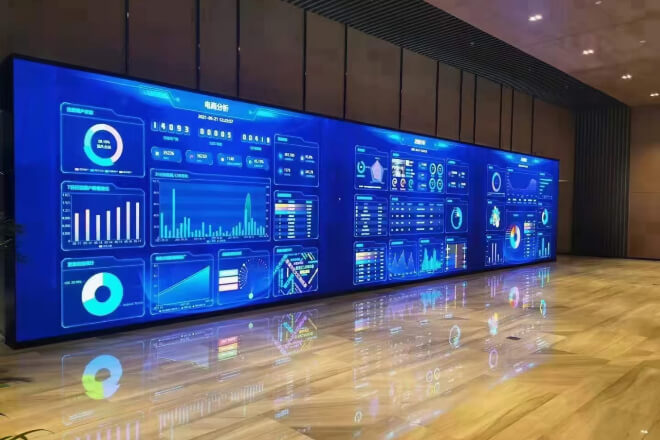
选择一个 LED显示屏 system for an emergency response hall is somewhat like choosing a long-term “work vehicle.”
It’s not just about how fast it runs initially, but also whether it can operate stably for several years.
First, the screen specifications need to match the actual usage environment. Smaller pixel pitch isn’t always better; it depends on the size of the space and the viewing distance.
For example, in a small analysis room, where staff need to view maps, data, and on-site images up close, 小间距LED显示屏 can display more detail;
While in a large command hall, a more suitable display solution needs to be chosen based on the viewing range.
Second, the system’s compatibility and scalability cannot be ignored. Emergency management systems are constantly evolving.
Today they connect to monitoring platforms, but in the future, they may need to integrate with more data centers, AI analysis systems, or other information platforms.
If the LED system has good scalability, major overhauls won’t be necessary for new demands.
Maintenance efficiency also impacts long-term user experience. After all, equipment in an emergency response center isn’t like a regular office monitor where problems can be addressed gradually.
For example, if the large screen malfunctions during an emergency, it affects not only the image but the entire information acquisition process.
Therefore, stable after-sales support and rapid maintenance capabilities are crucial.
Of course, budget planning is also essential. Choosing an LED system shouldn’t be based solely on purchase price, just like buying a car requires considering fuel consumption, maintenance, and lifespan.
A stable and reliable system often saves more costs in the long run.
After all, an emergency response center needs a screen that’s always online, not one that performs well only occasionally.
A good LED solution should accompany the command center in its long-term operation, remaining reliable whenever needed.


 English
  Español
  简体中文
简体中文  Français
  日本語
日本語  한국어
한국어  العربية