
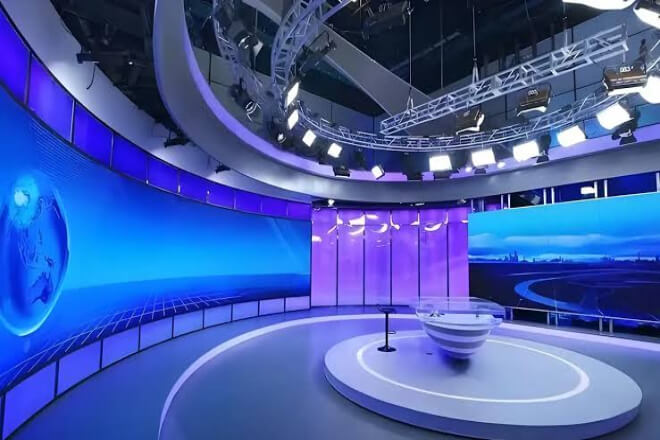
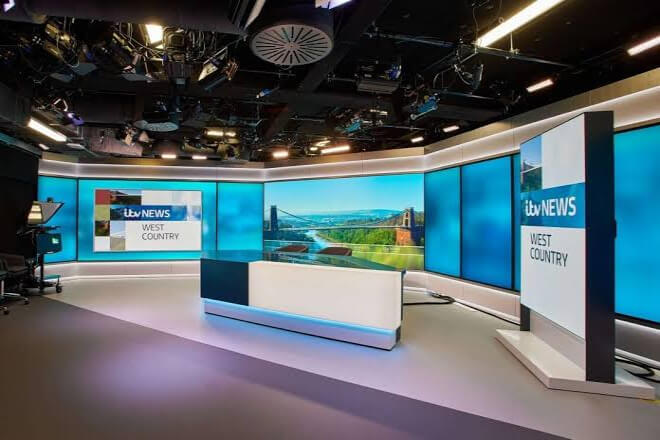
If the primary task of a shopping mall advertising screen is to attract passersby’s attention, then the LED screen in a radio studio needs to withstand repeated scrutiny from the camera.
First, cameras have extremely high requirements for the displayed image.
Viewers may not notice subtle color differences in the background, but cameras can capture uneven brightness, color deviations, and localized display anomalies.
These problems, once they appear in live news broadcasts or interview programs, can affect the overall image quality.
Second, studios typically require close-up shooting.
The distance between the presenter, guests, and the LED screen may be relatively close.
If the pixel pitch is too large, the image can easily appear grainy, even affecting the detail of the background.
In addition, broadcast studios need to consider the following factors:
Refresh rate and shooting compatibility: Reduce the risk of flickering, horizontal lines, and other problems during camera shooting.
Color consistency: Ensure that the background image looks harmonious and unified in different areas.
灰阶表现: Make the transitions in shadows, gradients, and details more natural.
Operational stability: Meet the needs of live news broadcasts, program recordings, and long-term operation.
维护方便: Reduce the impact of equipment failures on program production schedules.
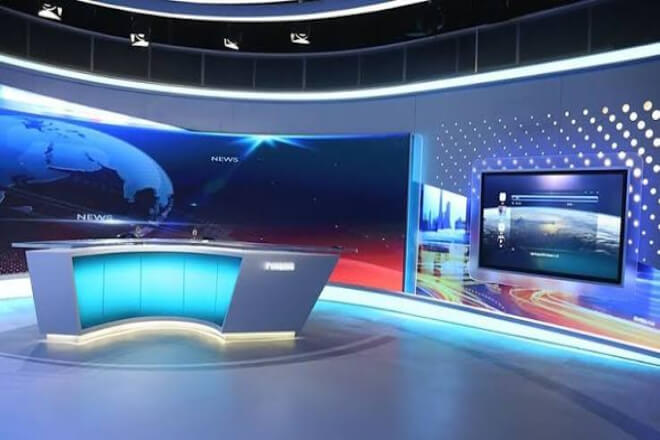
For example, in a news program, the presenter might be shown a city night view, dynamic charts, or footage of the news scene behind them.
If the background screen has obvious color differences or inconsistent brightness in certain areas, the audience’s attention may shift from the program content to the display device itself.
Therefore, when choosing an LED display for a broadcast studio, one should not only consider the screen size and brightness, but also its actual performance under camera lenses.
MIP, or Micro-LED Packaging, is a technology that pre-packages micro-LED chips into individual devices and then mounts them onto display modules using surface-mount technology.
Compared to traditional surface-mount technology, MIP’s key feature is that it separates the packaging process for the micro-LED chips.
Allowing for testing and sorting of the devices during the packaging stage before they enter the subsequent module production process.
So, why is this technology worth the attention of broadcast studios?
First, it facilitates more refined display effects.
MIP technology can be applied to small-pitch and micro-pitch LED display products, suitable for scenarios with high requirements for close-range viewing quality.
For studios with limited space and close proximity between cameras and background screens, appropriately selecting pixel pitch can result in a more detailed image.
Second, the packaging process helps strengthen quality control.
Individually packaged devices can be tested and sorted for parameters such as brightness and wavelength during production, helping to control device consistency.
However, the final display effect still depends on the packaging process, module manufacturing, calibration, and overall screen quality management.
Third, it provides different options for repair.
Because MIPs use individually packaged components, partial replacement of faulty parts is possible, provided the product structure and repair processes allow.
Compared to repair methods that require replacing larger components, this can help control maintenance costs.
However, the actual repair difficulty still depends on component size, product design, repair equipment, and the experience of the technicians.
For broadcast studios that require maintaining high-quality images for extended periods, MIPs offer a display technology solution worth evaluating.
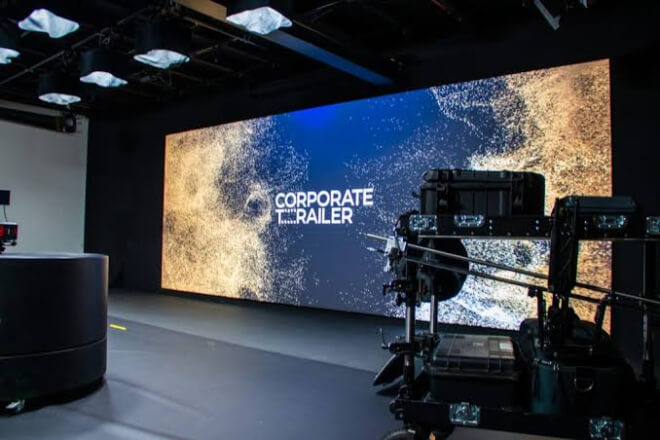
Broadcast studio screens not only need to provide clear visibility for on-site staff but also ensure natural camera shots.
The value of MIP LED screens needs to be judged by considering several key display indicators.
- More detailed images, suitable for close-up shooting
In news studios, interview areas, and virtual shooting spaces, cameras may capture half-body or even close-up shots of the presenter.
If the background screen pixel pitch is too large, image details can easily appear coarse.
Choosing a MIP LED screen with an appropriate pixel pitch helps improve the detail of close-up displays.
- Good grayscale performance makes the background more natural
Studios frequently use dark backgrounds, gradients, and complex images.
Insufficient grayscale representation can lead to lost detail in dark areas and unnatural tonal variations in gradients.
MIP products, with good component consistency and appropriate drive and calibration solutions, can provide a foundation for detailed image presentation.
- Matching refresh rate with shooting parameters reduces image interference
When cameras capture LED screens, flickering, horizontal lines, or scanning stripes may occur.
This is related to factors such as refresh rate, scanning method, drive timing, and camera shutter settings.
Therefore, when purchasing, one should not only look at the product’s nominal refresh rate but also conduct actual camera tests to confirm performance under different shooting parameters.
- Brightness and color correction improve overall image consistency
Studio backgrounds typically require brightness adjustments based on lighting and shooting environment. Excessive screen brightness may interfere with the exposure of subjects;
Insufficient brightness may affect the background image. MIP screens also require professional calibration and appropriate brightness settings to achieve a harmonious effect with studio lighting.
It is important to emphasize that MIP does not automatically eliminate all shooting problems.
Truly excellent camera performance requires the coordinated efforts of packaging technology, drive systems, control systems, calibration processes, and camera parameters.
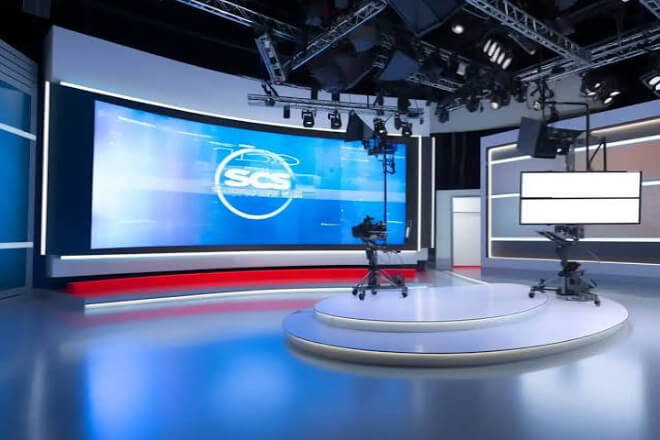
Different types of broadcast programs have different background display requirements.
MIP LED screens can be applied to various studio scenarios depending on the spatial structure and manufacturing method.
- News studios: Creating a clear and professional information background
News programs often need to display maps, data charts, news photos, and dynamic backgrounds.
Small-pitch MIP LED screens provide a delicate display foundation for close-up shots, making the information content clearer.
- Interview studios: Creating a more layered spatial atmosphere
Interview programs need to balance the visual impact of the subject and the background.
Displaying cityscapes, brand visuals, or dynamic scenes using MIP LED screens can add more variety to an otherwise simple space.
- Virtual studios: Supporting diverse digital scenes
For program production requiring dynamic backgrounds and digital scenes, LED screens can become an important component of the virtual shooting environment.
MIP products with suitable pixel pitch, refresh rate, and color reproduction capabilities are worth considering in virtual studio solution evaluations.
Large-scale variety shows and live broadcasts: Enhancing stage visual presentation.
In variety shows and live broadcasts, LED screens often need to display dynamic visual content and coordinate with lighting, stage, and cameras.
Choosing a suitable MIP LED solution helps improve the overall visual presentation.
Of course, different projects have different requirements for screen size, brightness, pixel pitch, and budget.
Purchasers should determine product configuration based on actual shooting distance, program type, and stage structure, rather than simply pursuing smaller pixel pitches.
MIP technology has its own characteristics, but for business decision-makers, what truly matters is whether the product can meet the actual production needs of the studio.
When purchasing, it is recommended to focus on the following aspects:


 English
 Español
 简体中文
 Français
 日本語
 한국어
 العربية