
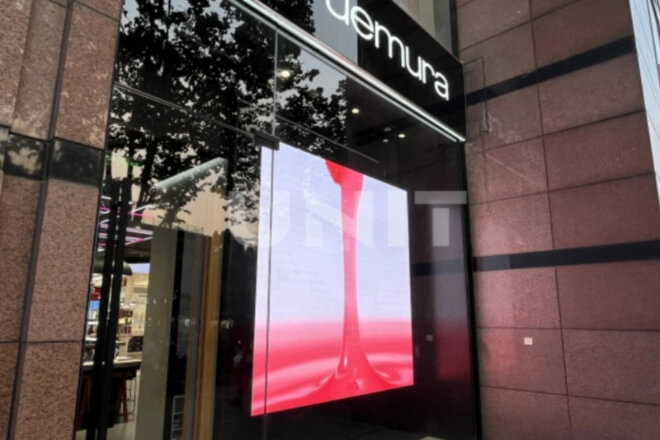
In modern commerce, advertising is much more than just a poster hanging on a wall. One of the biggest advantages of LED displays is their high flexibility.
Changing the content takes only minutes, without needing to print a bunch of posters or replace billboards.
For example, if a mall wants to promote a coffee shop’s limited-time discount in the afternoon and then switch to showing new movie trailers in the evening, a simple backend operation transforms the screen into a “multi-functional billboard.”
Even more interestingly, the content can be customized at any time, such as on holidays or specific events.
At Christmas, the LED screen can flash snowflake animations and holiday discount information; on Valentine’s Day, the screen can be changed to a romantic promotional poster.
Even during major new product launches, the screens can update in real time, immediately grabbing customers’ attention with fresh content upon arrival.
Moreover, LED screens can be used in a variety of creative ways. Full-screen playback of cool videos attracts passersby’s attention.
Split-screen display of multiple messages allows advertisements, event notifications, and interactive content to be presented simultaneously.
Some screens also include touch or QR code scanning functions, allowing customers to directly participate in prize draws or view offers.
Compared to traditional billboards, LED screens not only tell you “buy this” or “see this,” but also allow you to interact and engage, providing a highly immersive experience.
Therefore, the high flexibility and customizable content of LED displays are like a “magic card” in the world of commercial advertising.
They can update content at any time, respond quickly to the market, and attract customer attention through interaction, making marketing both vivid and efficient.
They are much more interesting and practical than simple posters or paper advertisements.
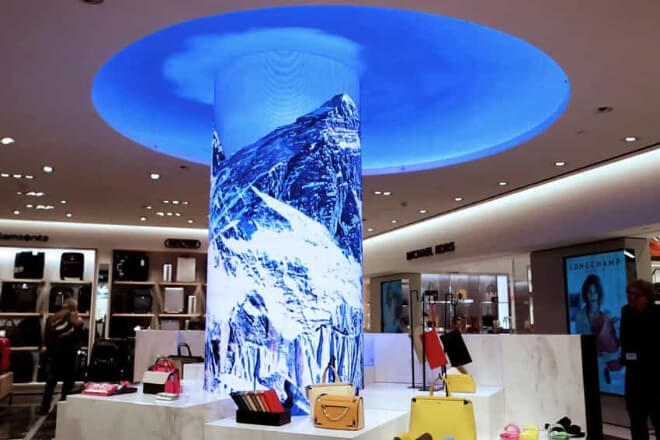
One of the strengths of LED displays is their versatility; they can be installed almost anywhere, easily handling both indoor and outdoor environments.
Indoor LED screens are like little stars in centres commerciaux, exhibition halls, and conference rooms, offering high-definition, vibrant colors, and crystal-clear details.
Walking into a shopping mall, seeing new product promotional videos playing on screens, where even the texture and color of the goods are clearly visible, far surpasses the sophistication of posters or traditional advertisements.
In conferences or des expositions, screens displaying presentations are brighter and clearer than projectors, delivering information more directly.
Outdoor LED screens are even more like “tough guys,” unaffected by wind, rain, scorching sun, or bright nighttime light.
Street advertisements, city squares, shopping mall facades, and even large event venues can stably display information around the clock, ensuring advertisements and announcements are always visible without being disrupted by bad weather.
Even more interestingly, the size, pixel density, and even shape of LED screens can be adjusted to meet specific needs.
From small shop windows to large shopping mall atriums and urban outdoor walls, screens can be custom-made.
Some creative shopping malls even arrange screens into curved, circular, or even irregular shapes, transforming advertisements not only into information-conveying visual installations that draw the eye.
In general, LED displays excel at both sophisticated indoor displays and all-day outdoor advertising.
Their versatility and flexible design allow businesses to present advertisements vividly and eye-catching anytime, anywhere, making them far more engaging and effective than traditional advertising.
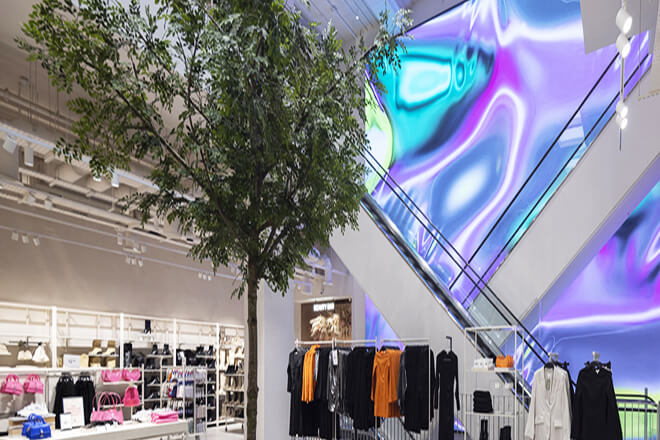
LED displays go beyond static displays; they interact with customers, encouraging them to stop and engage rather than simply glance at the screen.
Many screens support touch operation, sensor-based interaction, and even smartphone integration, making marketing more fun and engaging.
For example, on centre commercial LED screens, customers can scan QR codes to participate in prize draws, vote for their favorite products, or answer quizzes to receive coupons.
This approach is far more attractive than traditional posters or static advertisements, not only making customers stop and look more closely but also encouraging active participation, increasing brand affinity, and memorability.
Interactive features can also make the atmosphere more vibrant. For example, LED screens in shop windows can change displayed content via touch.
Allow friends to compete in quizzes, or even display real-time leaderboards, allowing customers to experience brand appeal while being entertained.
Compared to one-way information delivery, this “play and watch” approach makes advertising more engaging and enhances brand communication.
In short, the interactive features of LED displays make advertising less monotonous, turning customers into participants rather than mere spectators.
It makes displays more vivid and information more attractive, while also increasing brand loyalty.
Making it easier for customers to remember the brand, develop goodwill and trust, making it an invaluable tool for modern commercial displays.
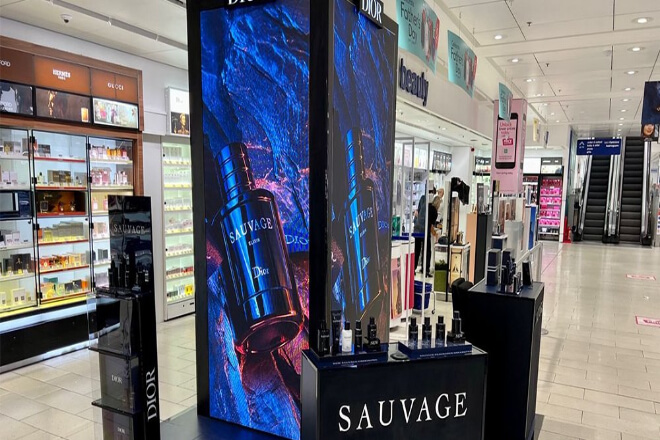
Another major advantage of LED displays is their versatility—they can be used almost anywhere, and their applications are incredibly diverse.
In retail stores, they can play promotional activities, showcase new products, and even provide interactive shopping guidance, allowing customers to participate in the shopping experience while watching.
At trade shows or large events, they can play dynamic advertisements, brand promotions, or on-site information, allowing attendees to immediately grasp the key content.
Public spaces also serve as a grand stage for LED screens. Whether in transportation hubs, city street advertisements.
Or cultural event displays, they attract passersby’s attention and facilitate rapid information dissemination.
For example, LED screens at train stations not only display train schedules but also scroll through mall promotions and city events, allowing waiting passengers to “incidentally” see business advertisements.
Large screens in city squares can display live event broadcasts, cultural promotions, or public service announcements, adding vibrancy to the space.
The catering, entertainment, and hôtel industries also rely heavily on them. Restaurant LED menu boards clearly display dishes and prices, and can even feature dynamic demonstrations to whet the appetite.
Screens in cinemas or entertainment centers can play real-time event previews, ticket information, or interactive games, enriching the customer experience.
Hotel lobby LED screens can display welcome messages, event schedules, or nearby recommendations, allowing guests to experience the combination of technology and attentive service.
In short, LED displays are adaptable to various business environments, from retail and exhibitions to public spaces, catering, and entertainment, offering flexible and diverse functions.
It not only conveys information but also enhances the on-site experience, making each scene more vivid and attractive, truly becoming an “all-rounder” in modern commercial displays.
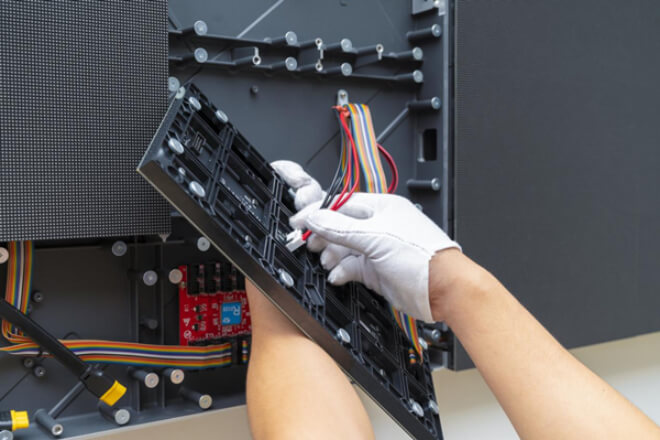
Another advantage of LED displays for businesses is their ease of maintenance and upgrades.
Many screens employ a modular design, meaning that if a part malfunctions, only the faulty module needs to be replaced, without disassembling or scrapping the entire screen.
For large centres commerciaux or public spaces, this saves significant repair time and costs.
Furthermore, software upgrades are very simple. Adding new features, optimizing display effects.
Or improving interactive methods can be achieved through backend operations without replacing hardware.
This allows businesses to keep up with the latest marketing trends without incurring large sums for new equipment.
Even better, as technology advances, the luminosité, résolution, and display functions of LED screens can be gradually improved.
For example, a screen that originally could only play high-definition video may, after upgrading, support touch interaction, mobile phone linkage.
And even real-time data display, making business displays increasingly diverse and better suited to the preferences of modern consumers.
In summary, LED displays are not only easy to maintain and upgrade, but also continuously improve their performance with technological advancements.
For businesses, this means a higher return on investment, stable long-term operation, and a constant stream of new display possibilities, keeping advertising and marketing fresh and engaging.
 English
  Español
  简体中文
简体中文  Français
  日本語
日本語  한국어
한국어  العربية