
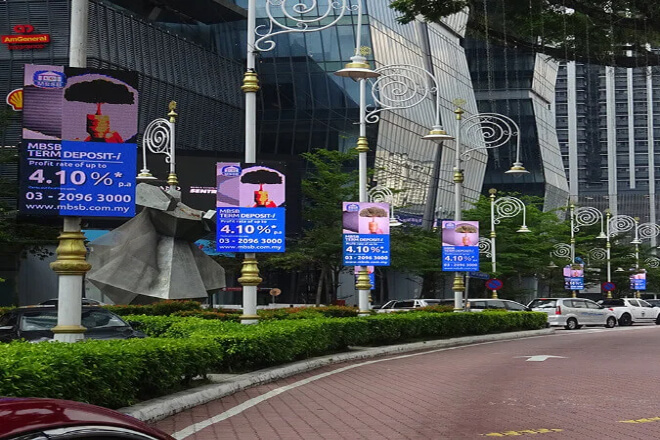
Pour affichages à LED sur poteau to function effectively, the prerequisite is actually quite simple—”passersby can see it naturally,” rather than needing to deliberately search for it.
First, ensure the screen is within the primary line of sight for drivers and pedestrians. Ideally, the location should allow it to naturally enter the field of vision as pedestrians.
And vehicles pass by, rather than having reduced visibility due to excessively high or low angles or obstructions.
At the same time, it’s necessary to avoid interfering with traffic information, such as obstructing traffic signs, traffic lights, or other key directional information.
The screen can play a role in information dissemination, but it cannot “steal” the more important traffic information.
Furthermore, traffic safety is also a bottom line. Neither the installation location nor the external structure can obstruct pedestrian or vehicular traffic, nor can it create additional safety hazards in the space.
Finally, the viewing angle directly affects the actual effect. Even if the screen itself has a good display quality, if the angle is unreasonable, visibility may decrease at a distance or in a specific direction.
Simply put, a good installation location is not just about “being able to install it,” but about ensuring that it is “visible, comfortable to see, and safe to see.”
Only when the location is chosen correctly can the value of the pole LED displays be truly maximized.
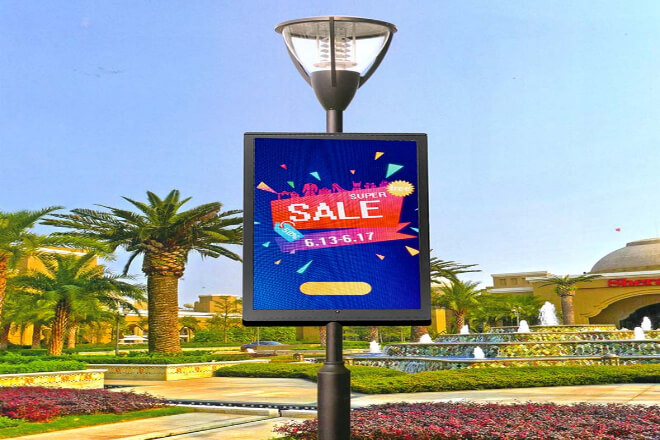
While pole LED displays are “designed for light poles,” before actual installation, the question must be asked: Can this light pole “hold up”?
Different light poles vary in height, material, thickness, and service life. Some are relatively new, while others may have already endured years of outdoor exposure.
If the screen is installed directly without prior assessment, it can easily lead to safety and stability issues during long-term operation.
In actual projects, it’s usually necessary to first assess the structural strength and stability of the light pole to confirm its ability to support the weight of the display screen and the additional impacts of daily operation.
In some cases, testing or professional evaluation is also required to determine whether it can be used directly or whether structural reinforcement is necessary.
Furthermore, the outdoor environment can also play a significant role. For example, in areas with strong winds or open intersections.
Wind loads will have a continuous impact on the light pole and the screen. These factors combined will affect the overall long-term stability.
Simply put, the key to a pole LED display screen is not just “whether it can be installed,” but also “whether it can be used reliably after installation.”
Conducting thorough structural checks upfront can minimize unnecessary “unexpected situations” later.
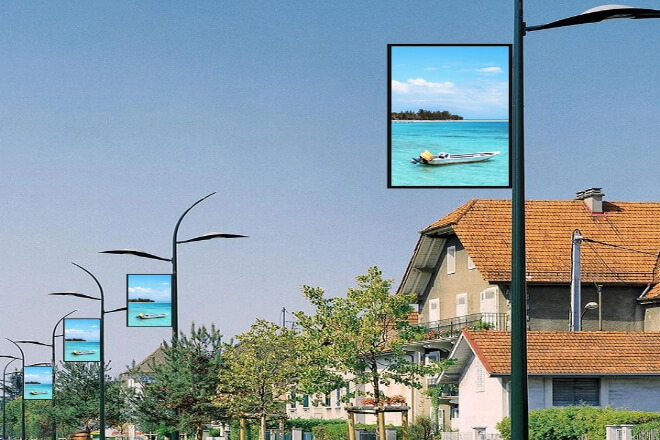
Pole LED displays are not just about “playing content on the roadside,” but more importantly, is the content truly suitable for “being seen on the road”?
First, the information should be presented as clearly and intuitively as possible. In roadside scenarios, the audience’s attention span is usually very short.
So the content needs to be understood within seconds, rather than relying on complex reading or excessive detail.
Secondly, the content type also needs to be prioritized. Content more suitable for road environments typically includes traffic alerts, public information.
Or content with immediate reference value, rather than information displays requiring prolonged focused viewing.
This maximizes information value and better suits the context.
Furthermore, the pace of content switching is crucial. Too fast a playback frequency can cause visual interference, while too slow a pace can reduce information utilization efficiency.
A reasonable arrangement based on the rhythm of traffic and pedestrian flow will make the overall presentation more natural.
Finally, it’s necessary to avoid interfering with driving behavior. Whether it’s visual design, motion effects intensity, or information presentation methods.
Everything should be kept within a range that is “perceptible but not overly attractive,” ensuring safety is always the highest priority.
Simply put, content in road scenarios should not only be “aesthetically pleasing,” but also “easy to read, appropriate, and not overly disruptive.”
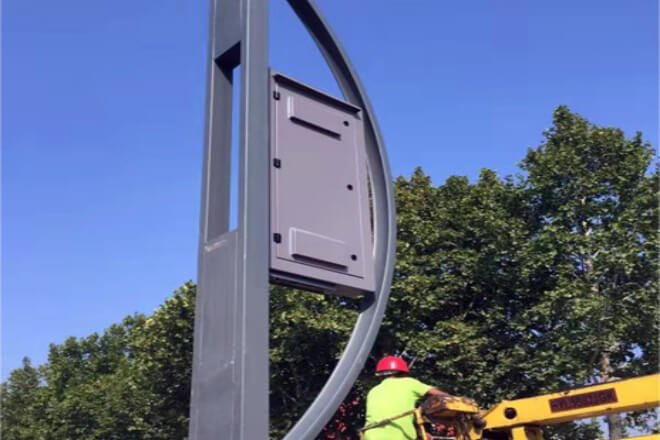
Installing an pole LED displays on an outdoor essentially places it within a “year-round, non-stop working environment,” where exposure to wind, sunlight, and rain becomes a severe daily challenge.
First, basic protective capabilities must be considered, such as waterproofing and dustproofing.
After all, the outdoor environment is far from gentle. A sudden rain shower or long-accumulated dust can both affect the stable operation of the equipment.
Secondly, there’s the ability to adapt to temperature changes. Summer’s high temperatures and winter’s low temperatures.
Coupled with significant day-night temperature differences, all pose continuous challenges to equipment operation.
Stable temperature control and adaptability often determine whether the equipment can remain “online” for extended periods.
In bright daylight, display quality is magnified and put to the test. If the content remains clearly visible in sunlight.
The information transmission efficiency is truly established; otherwise, it may easily “exist without being noticed” outdoors.
Furthermore, these devices typically operate continuously for long periods, making overall stability particularly critical.
Rather than pursuing short-term performance, it’s more important to focus on stable output over long periods, avoiding frequent fluctuations or interruptions that could negatively impact the user experience.
In short, the outdoor environment is more like a “long-term real-world test”; the equipment not only needs to function.
But also needs to operate continuously and stably under various environmental conditions.
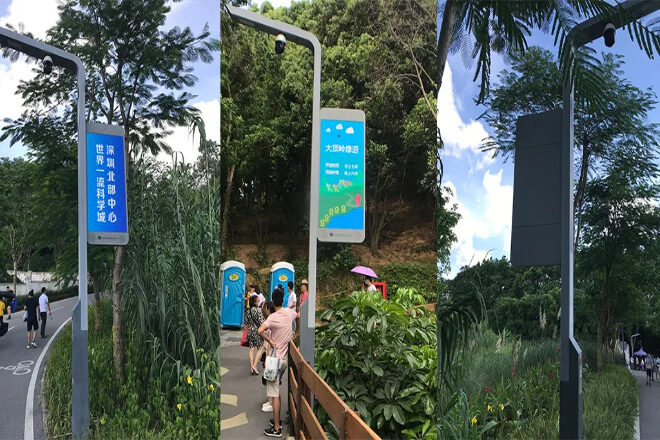
LED pole displays are not devices that can be installed “at will”; they are more like nodes embedded in the city’s operational system. Therefore, compliance is usually the first hurdle before implementation.
First, confirm whether the relevant approval processes have been completed.
Different cities have specific management requirements for municipal facilities, outdoor information displays, and traffic-related equipment.
Getting these prerequisites in place is often more time-efficient and controllable than completing the necessary procedures later.
Second, ensure compliance with municipal and traffic management regulations. For example, the installation location, brightness control.
And content display method must be designed without affecting public order and traffic safety—ensuring visibility without being overly disruptive.
At the daily operation level, remote management capabilities directly impact efficiency.
If content updates, regional control, or batch management can be completed through a unified platform.
Then both activity switching and routine maintenance will be more flexible, eliminating the need for frequent on-site operations.
Simultaneously, a smooth operation and maintenance mechanism is also crucial.
The presence of clear inspection procedures, monitoring methods, and fault response mechanisms, and the ability to quickly locate.
And resolve problems, often determines whether the equipment is “stable online” or “occasional offline.”
Simply put, this type of equipment is not just a hardware investment, but also an integral part of long-term operation.
Clearly defining the standards and management system upfront makes later use much easier.
 English
  Español
  简体中文
简体中文  Français
  日本語
日本語  한국어
한국어  العربية