
Introduction
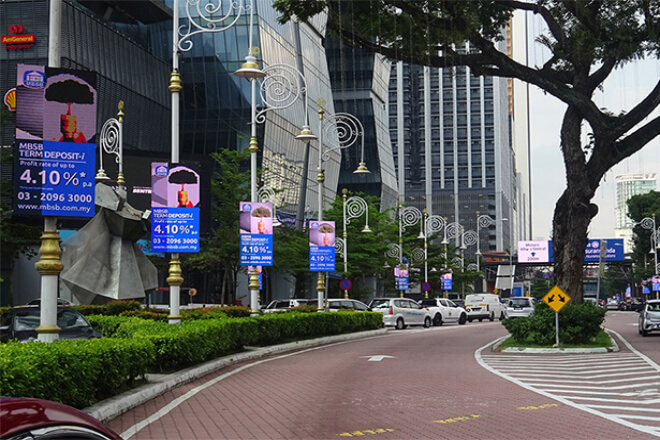
Walking through a city, you can see LED displays almost everywhere: traffic information screens at intersections, information screens in subway stations, and large electronic screens in squares.
But have you ever considered that these LED screens, besides displaying advertisements, are actually participating in the “smart operation” of the city?
Table des matières
Application Scenario 1: Traffic Management on Highways and Urban Roads
If you drive frequently, you’ve probably seen the large LED displays above highways or main urban roads.
Many people may only glance at them, but these screens are actually very useful for traffic management.
They display various road condition information in real time, such as whether there has been an accident ahead.
Which section of road is under construction, the current speed limit, and sometimes even a warning such as “Congestion ahead, detour recommended.”
For drivers, this information is often crucial; a simple reminder can help you change your route in advance and avoid traffic jams.
Compared to traditional traffic signs, the biggest advantage of LED displays is that the information can be updated in real time.
For example, during rush hour, the screen will indicate that certain road sections have heavy traffic.
In foggy or rainy weather, these LED screens also remind drivers to slow down. The information is more timely and easier for drivers to notice.
In fact, these LED screens are usually connected to a complete intelligent transportation system.
Road cameras, vehicle sensors, and signal systems constantly collect traffic data, and once congestion or accidents are detected on a certain section of road, the information can be quickly displayed on the LED screens.
These screens can be described as “real-time information boards” on city roads, helping drivers better judge road conditions and making urban traffic run more smoothly.
Application Scenario 2: Public Safety and Emergency Information Dissemination
In many smart cities, LED displays are not only used to play advertisements or city promotions; sometimes they also “guest-star” as public safety alerts at critical moments.
For example, large LED screens can often be seen in city squares, subway stations, train stations, or near schools.
Normally, they may be displaying event information or city promotions, but in the event of an emergency, the screen content will immediately switch to issue emergency notices or safety alerts.
For a simple example, in the event of sudden heavy rain, typhoon warnings, or road closures, LED screens can quickly display alerts, such as evacuation advisories, temporary traffic control measures, or evacuation directions.
For people nearby, a quick glance at the screen is all it takes to know what’s happening, far more convenient than searching for information elsewhere.
Furthermore, LED screens offer clear brightness and color contrast, such as red warnings and yellow alerts, along with simple icons, ensuring they are quickly noticed even in crowded or poorly lit environments.
Many cities now connect LED screens to monitoring systems and environmental sensors. Once the system detects an anomaly, such as a sudden accident or safety risk, the screen can immediately display warning information.
In a sense, these screens act like “public warning boards” in the city—inconspicuous most of the time, but crucial in critical moments, helping people understand the situation and react more quickly.
Application Scenario 3: Urban Environmental Monitoring and Data Visualization
In some smart cities, LED displays are not only used to broadcast advertisements or event information but also serve as “city data dashboards.”
For example, on screens in squares, parks, or city center districts, people often see the Air Quality Index (AQI), temperature, humidity, noise levels, and even the water quality of nearby rivers or lakes.
Previously, this data was mostly stored in mobile apps, but now, a quick glance at an LED screen while passing by provides a general understanding of today’s environmental conditions.
This display method is quite intuitive. For instance, when the air quality is good, the screen might display “Excellent Air Quality” in green; if the pollution index rises, it will turn yellow or red as a warning.
Some cities also add simple suggestions, such as “Suitable for outdoor activities” or “Recommended to reduce outdoor activities.”
Many people glance at these screens as they pass by, finding it convenient and easy to understand.
For example, in public squares of some European cities, large LED screens regularly update the day’s air quality and weather data, allowing citizens and tourists to quickly understand the environmental situation.
Some LED screens at park entrances display real-time temperature and humidity, reminding runners or cyclists to be aware of weather changes.
This data actually comes from various environmental monitoring devices throughout the city, such as air quality sensors, noise monitors, or water quality testing systems.
These screens continuously collect data and synchronize it to the LED screens via the city’s data platform.
Simply put, these screens act as “environmental information windows” for the city, making previously invisible data more intuitive and providing a better understanding of the urban environment.
Application Scenario 4: Real-time Public Transportation Information Display
LED displays have become almost standard equipment at bus stops, subway stations, and airports in many cities.
When waiting for a bus, many people’s first action is to look up at the screen—how many minutes until the next bus? Is there a delay?
Do I need to transfer to another line? This seemingly simple information can actually save people a lot of time.
For example, at a bus stop, if the screen displays “Next bus arrives in 2 minutes,” people can basically wait with peace of mind, without constantly staring into the distance to see if the bus is coming.
If there is traffic congestion or temporary route adjustments, the LED screen will also update the notification quickly, letting passengers know the situation in advance and avoiding wasting time waiting for a bus.
Many cities also use simple icons and multilingual prompts on LED screens to display information.
Such as small icons for subways, buses, and airplanes, along with arrows indicating transfer directions.
This makes it easier for even first-time visitors to the city to find their way. These information screens are especially convenient for tourists at large airports and subway hubs.
This information comes from the GPS systems on buses and subways, combined with real-time updates from the city’s transportation data platform.
Therefore, the arrival times displayed on the screens are usually quite accurate.
Simply put, these LED screens act like “little helpers” in public transportation, reducing guesswork and increasing certainty for travelers, thus making the overall travel experience smoother.
Application Scenario 5: Urban Culture and Information Services
In many cities, LED displays are frequently used to publish various city information in squares, museum entrances, or near popular tourist attractions.
For example, they display recent cultural events, exhibition dates, and weekend music festivals or markets.
For passersby or tourists, a glance at the screen quickly reveals nearby activities worth seeing.
For example, at the entrances of tourist attractions in some cities, large LED screens display attraction introductions, performance schedules, or the day’s activities.
Some even recommend nearby popular photo spots or walking routes, making it easier for tourists to plan their trips.
This not only benefits tourists but also allows more people to see the city’s cultural activities.
Many places are now combining LED screens with mobile phone interaction.
A QR code is displayed on the screen; tourists can scan it to view more detailed information on their phones, such as event times, map navigation, or ticket purchase links.
Some interactive screens even support touch-screen queries, acting like a “city information service desk,” allowing users to look up any information they need.
In this way, LED displays not only broadcast information but also help promote cultural activities and encourage wider participation.
Simply put, it’s like a “public information window” in the city, making it convenient for citizens to access information and making the city’s cultural atmosphere more vibrant.
6. Conclusion
From traffic management to public safety, from environmental data display to public transportation information, and to urban cultural services, LED displays are making city information more intuitive and timely.
Often, people only glance at the screen casually but have already obtained important information.
These screens, distributed throughout the city, are like “information nodes,” making the city operate more efficiently and making life more convenient for citizens.
Finally, if you would like to learn more about LED displays, veuillez nous contacter.
 English
  Español
  简体中文
简体中文  Français
  日本語
日本語  한국어
한국어  العربية