
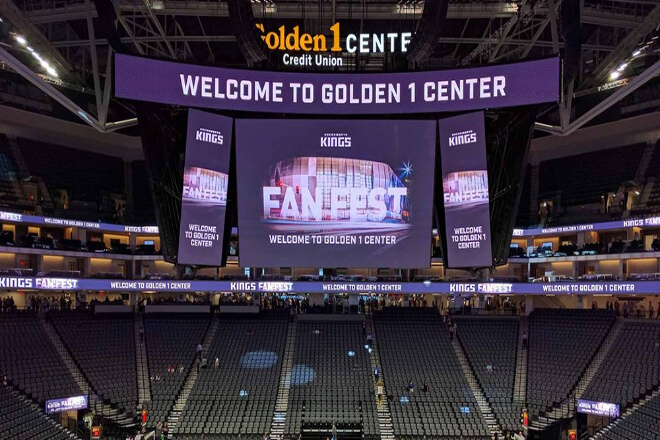
1) High Luminosité and Strong Contrast, Clear Visibility in Any Environment
In live events, the lighting environment often changes and is subject to significant interference, especially at outdoor events, which are affected by direct sunlight.
LED displays have high brightness and strong contrast, ensuring that the image remains clear and visible even in strong light, without becoming faded or distorted.
When used indoors, they can also present a layered image effect, ensuring that the audience can clearly see the screen content from different positions.
2) Flexible Size and Free Splicing, Adaptable to Various Event Venues
LED displays can be freely spliced according to event needs, whether it’s a large main background screen or auxiliary screens on either side of the organiser, allowing for flexible combinations.
Regardless of the venue size or stage structure, the display screen can quickly adjust its form, even creating curved.
Or irregularly shaped designs, making the image more consistent with the overall stage style and bringing richer visual layers to the event.
3) Clear Image and Vivid Colors, Easier to Attract Audience Attention
With continuous technological advancements, LED displays have made significant progress in clarity and color performance.
High resolution makes image details more realistic, and people, videos, and animations look more natural.
At the same time, the colors are rich, and the transitions are smooth, making the overall image more impactful and engaging, helping to quickly capture the audience’s attention and enhance the atmosphere and communication effect of the event.
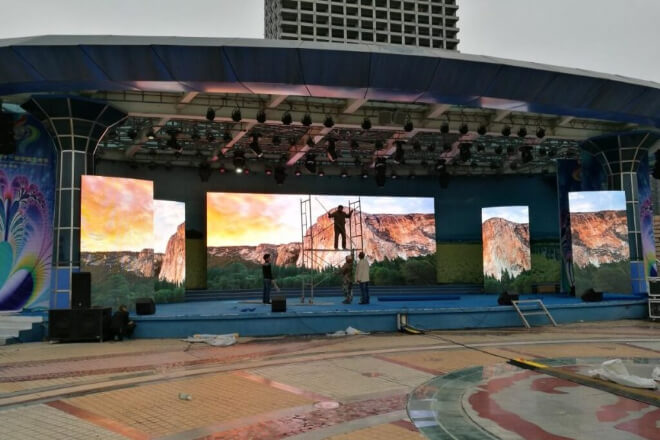
1) Real-time Interaction and Multimedia Integration
LED displays can not only play videos, animations, and live broadcasts, but also support real-time interaction with social media content, greatly enriching the forms of expression for the event.
Through QR code scanning, touch operation, or sensor technology, the audience can directly participate in interactions, achieving instant feedback and content sharing.
This multimedia integration and interactive experience not only enhances the fun of the event but also makes it more lively and attractive.
2) Strong Environmental Adaptability
Whether it’s an indoor organiser or an outdoor plaza, LED display screens can easily handle the job.
Their high-luminosité design ensures the screen remains clearly visible even in direct sunlight, and they also feature windproof, rainproof, and dustproof characteristics, making them suitable for various complex environments.
Even in event venues with complex lighting, LED display screens maintain excellent visual effects, ensuring that viewers get a consistent viewing experience from different positions.
3) Easy Management and Content Updates
LED display screens offer very flexible content management. Multiple screens can be updated simultaneously via remote control, reducing on-site operational pressure.
Content can also be quickly switched at the event site, from brand promotion and event information to interactive content, all presented in a timely manner.
This convenient management method not only improves work efficiency but also ensures the diversity and timeliness of event content.

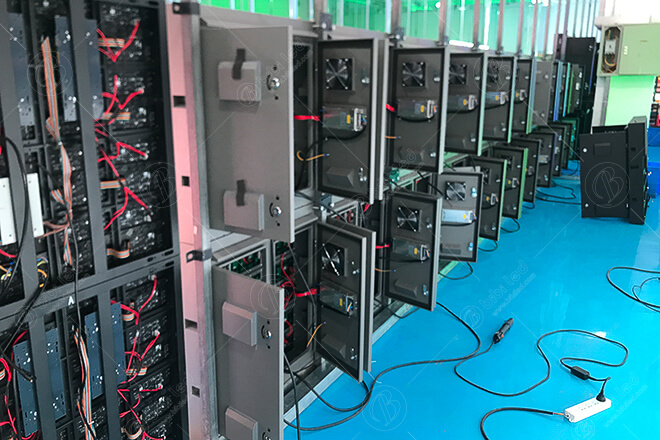
Les méthodes de maintenance des écrans LED extérieurs sont divisées en maintenance par accès avant et maintenance arrière, principalement utilisées pour la réparation et la maintenance après-vente des écrans LED.
D'une manière générale, le prix des produits d'entretien arrière est relativement bas et l'efficacité de l'inspection et de l'entretien est élevée. Cependant, si l'endroit où vous installez est rare et que le terrain est cher, la maintenance par accès frontal peut vous aider à économiser de l'espace et à réduire le coût de l'espace foncier.
Alors, comment déterminer quelle méthode de maintenance convient à votre écran d’affichage LED ?
Entretien arrière-arrière de grands écrans pour bâtiments extérieurs, écrans installés en toiture, piliers autonomes, etc.
Maintenance par accès frontal : un écran peu encombrant et de petite surface est nécessaire.
(Si tu veux savoir la différence entre la maintenance avant et la maintenance arrière de l'écran LED en détail, cliquez sur apprentissage rapide)
En plus des coûts de maintenance courants, si vous coopérez avec une entreprise fiable qui prolonge la période de garantie, les coûts de maintenance peuvent être réduits.
Est-ce d’origine locale ou importé ?
Il est évident; prix : approvisionnement local > approvisionnement importé, approvisionnement local coûte plus cher.
Cependant, il serait préférable que vous preniez une décision en fonction de votre situation réelle, par exemple :
1) Si vous ne vous souciez pas du budget et que vous appréciez davantage un service de vente rapide et local, vous pouvez acheter directement localement.
2) Si votre budget est limité ou si vous souhaitez économiser beaucoup d’argent et disposer de suffisamment de temps, vous pouvez importer auprès des fabricants d’écrans d’affichage LED.
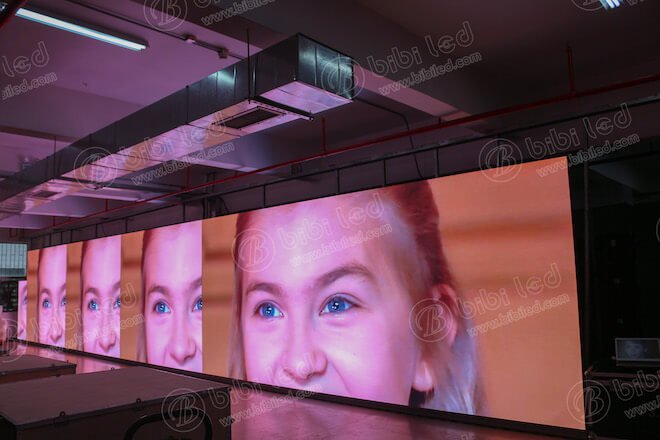
Concernant la facture d’électricité, il s’agit d’un coût accumulé sur le long terme. La facture d'électricité est fortement corrélée à la consommation électrique réelle de l'écran LED. Une faible consommation d'énergie signifie de faibles factures d'électricité. Par conséquent, lors de l’achat d’un écran LED, vous devez demander au fournisseur la consommation électrique réelle.
Comment réduire la consommation électrique de l’écran d’affichage LED extérieur ?
1) Planifiez raisonnablement votre temps
L'écran d'affichage LED n'a pas besoin d'être affiché pendant 24 heures et l'heure peut être réglée via la gestion des applications.
2) Utilisez un capteur de lumière
Une luminosité élevée signifie une consommation d’énergie élevée. L'utilisation de capteurs de lumière peut non seulement garantir que l'image n'est pas affectée par l'environnement, mais également empêcher l'écran LED de rester dans un état de consommation d'énergie élevée pendant une longue période.
3) Achetez un écran LED à économie d'énergie
Dans une perspective à long terme, les écrans LED à économie d'énergie peuvent réduire les factures d'électricité.
Les coûts de transport sont pris en compte à partir des coûts d’importation, des frais de transport et des taxes.
Les coûts et taxes d'importation doivent être pris en compte en fonction de la politique d'importation et des croyances religieuses de votre pays, et chaque pays est différent.
Concernant les frais de transport, il existe deux modes de transport : maritime et aérien. Le mode de transport spécifique à choisir dépend de vos besoins, par exemple :
1) Si vous disposez de beaucoup de marchandises et de suffisamment de temps pour importer des écrans d’affichage LED, le coût du fret maritime sera inférieur, soit environ 5 fois inférieur à celui du fret aérien. La date de livraison de Shenzhen aux États-Unis est de 25 à 30 jours ouvrables.
2) Si votre projet est plus urgent ou si les marchandises sont moins nombreuses, pensez au fret aérien, la date de livraison du fret aérien est d'environ 3 à 7 jours ouvrables.
 English
  Español
  简体中文
简体中文  Français
  日本語
日本語  한국어
한국어  العربية