
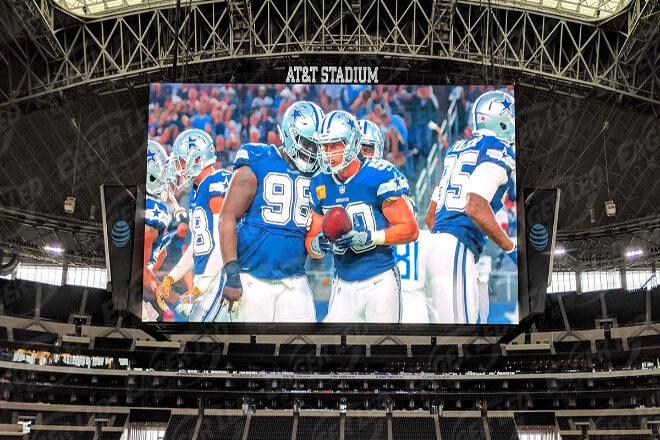
At large sporting events or activities, spectators often face strong sunlight, stadium lighting, and different angles de vision, all of which can affect the viewing experience.
LED displays effectively solve these problems. Their high brightness and high contrast ensure that the image remains clearly visible even in direct sunlight during the day or under complex lighting at night.
Every movement and every attack on the field will not be blurred by ambient light; details and nuances can be easily captured by the audience, making the viewing experience more enjoyable.
Furthermore, the ultra-large size and wide viewing angle of LED displays also make the viewing experience more balanced.
Whether you are sitting in the main stand, the side stand, or a high-angle seat in the corner, you can see a bright and complete image.
The screens can be seamlessly spliced together to form a huge display area, covering the entire spectator area.
So that viewers in every seat don’t have to worry about viewing angles and can enjoy watching the game as if they were in a prime location.
During crucial moments in a game, such as goals, finishes, or penalties, slow-motion replays are essential.
Le haut fréquence de rafraîchissement of LED displays ensures smooth images without ghosting or flickering, allowing viewers to see even fast-paced, high-action scenes clearly.
During slow-motion replays, the image is clear and realistic, allowing viewers to see every crucial movement, maximizing the tension and excitement of the live event.
Compared to traditional projectors or LCD screens, the advantages of LED displays are very intuitive.
Traditional solutions are often difficult to see in strong light, have limited viewing angles, and large screens are prone to visible seams or uneven brightness.
LED displays, on the other hand, are not only bright and clear but can also be easily spliced into ultra-large screens, adapting to various stadium environments, while being durable and reliable for continuous use.
For this reason, it is becoming an indispensable viewing tool in modern sports venues and large event sites.
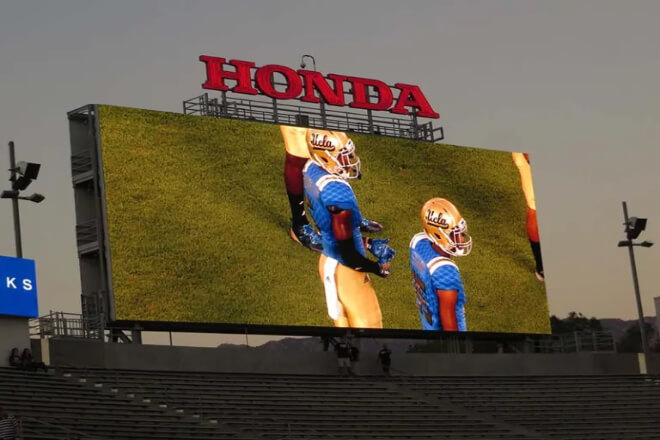
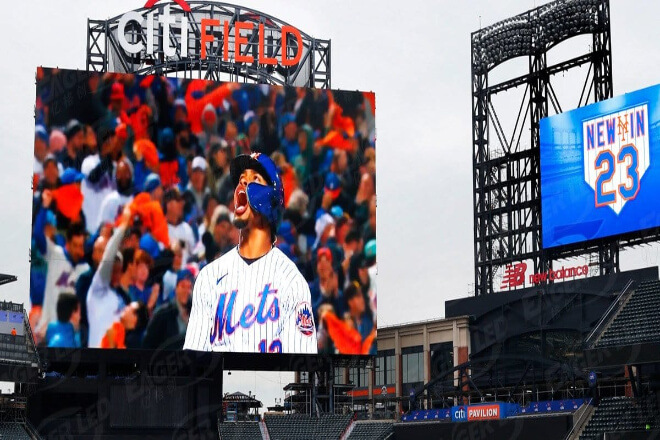
1) High-intensity, long-term operation requirements for hardware quality
LED displays in sports venues often need to operate continuously for long periods, especially when hosting consecutive matches or large events.
The screen must have high reliability and stability, capable of handling long-term high-luminosité display without overheating or screen flickering problems.
For example, in an all-day football tournament, LED screens need to operate continuously for several hours from morning to night.
If the hardware quality is insufficient, screen abnormalities or equipment failures can easily occur, affecting the audience’s experience and the smooth running of the event.
2). Adaptability to the venue environment, including vibration resistance, dustproof, and moisture-proof capabilities
Sports venues have complex environments. LED displays must not only withstand vibrations and trampling from the audience but also be dustproof and moisture-proof.
For example, in an indoor basketball arena, frequent standing and clapping by the audience during a game can cause vibrations.
If the screen lacks sufficient vibration resistance, it can easily affect splicing accuracy or display effects.
Outdoor venues require waterproof and dustproof designs to withstand wind, sand, or rain, ensuring long-term stable operation of the screen.
3) Selection of protection level for outdoor and semi-outdoor sports venues
In outdoor or semi-outdoor venues, the protection level (IP rating) is an important selection criterion.
An IP65 or higher protection level can ensure that the screen operates normally in rain, snow, and dusty environments.
For example, in an open-air football field, if the LED screen’s protection level is insufficient, a single rainstorm could cause short circuits or screen damage, directly affecting live broadcasts and the on-site viewing experience.
Therefore, the protection design needs to be reasonably selected based on the actual conditions of the venue.
4) Impact of maintenance costs and failure risks on operators
LED displays inevitably experience failures during long-term use. High maintenance costs or long repair cycles can put pressure on venue operations.
For example, in a large sports stadium, if modules or control systems need to be frequently replaced or repaired after each game, it not only increases operating costs but also may affect the smooth running of games and events.
Therefore, choosing equipment that is easy to maintain and has a low failure rate is very important for operators, as it reduces daily maintenance pressure and improves the audience’s viewing experience.
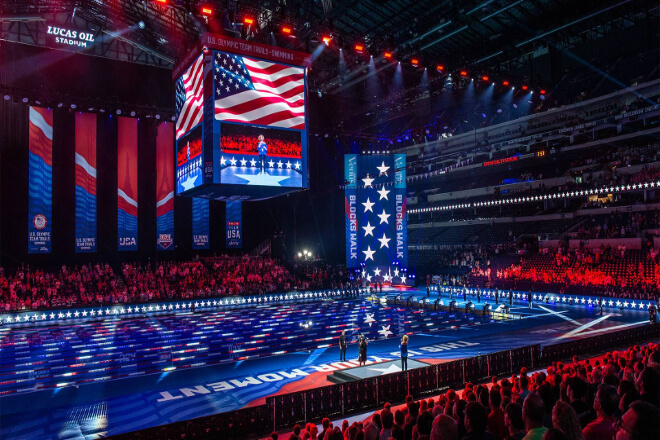
1) Enhanced advertising value and upgraded sponsorship display methods
LED displays make venue advertising more vivid and attractive.
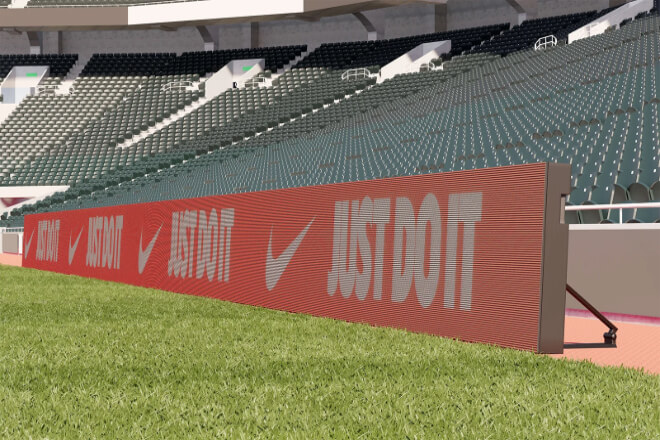
For example, in a basketball game, the LED screens on the sidelines can display real-time video advertisements, animations, or interactive content from sponsors, which is more likely to attract the audience’s attention than traditional static billboards.
This not only increases the value of advertising space but also allows sponsors to display more creative content, benefiting both parties.
2). Dynamic Content and the Premium Value of Brand Exposure
LED screens can also display highlights of matches, player interviews, or audience interaction content, naturally integrating advertising with the event.
For example, in a football stadium, when fans’ interactive photos appear on the screen along with brand promotional information, the attention to the advertisement increases significantly.
This dynamic display method is more engaging than simple static advertising and brings additional premium value to the brand.
3). Flexible Commercial Applications for Different Events and Activities
LED display screens can flexibly adjust content and partitioning according to venue activities.
For example, during the day, it can be used for basketball games, displaying live game broadcasts, and advertisements.
At night, when a concert is held, the screen can switch to the organiser background and event promotion.
This allows one screen to serve multiple activities simultaneously, maximizing the commercial value of the venue and providing more possibilities for different types of events.
4) Return on Investment Cycle: From Cost Expenditure to Long-Term Asset
Although high-quality LED displays require a significant initial investment, they are a “great helper” for long-term returns.
Venues can recoup their costs within a few years through advertising revenue, sponsorship partnerships, and multi-type event operations, and then continue to generate revenue.
In other words, LED screens not only enhance the viewing experience but are also a long-term asset that truly helps venues make money.

1) Core Technical Parameters such as Résolution, Luminosité, et Fréquence de rafraîchissement
The image performance of LED display screens directly affects the viewing experience, so resolution, brightness, and refresh rate are the most critical technical indicators.
For example, in an indoor basketball arena, if the resolution is not high enough, the players’ movements and score data may not be clear when viewed from a close distance; if the brightness is insufficient, the image may appear dim in daylight or strong light.
If the refresh rate is too low, ghosting or flickering will occur, significantly reducing the slow-motion replay experience.
Therefore, when selecting, appropriate parameters should be chosen based on the venue type and audience viewing distance.
2) Supplier Project Experience and After-Sales Service Capabilities
High-quality LED screens are not only important in terms of hardware, but the supplier’s experience and after-sales service are equally crucial.
For example, for large stadium projects, it is important that the supplier has extensive experience in similar venue projects.
Providing customized solutions and timely technical support can significantly reduce installation and commissioning risks and ensure that problems during subsequent operations are quickly resolved.
3) System Compatibility and Future Upgrade Potential
LED screens are usually not used in isolation; they need to work in conjunction with the event control system, broadcasting system, and other equipment in the venue.
Therefore, when selecting equipment, it is important to consider system compatibility and future upgrade potential.
For example, a venue might add interactive advertising or AR technology a few years later.
Choosing an expandable LED system in advance can prevent the equipment from becoming obsolete quickly and reduce the cost of secondary investment.
4) Avoiding the Common Procurement Pitfall of “Only Looking at Price.”
Many venues tend to focus only on price during procurement, neglecting performance, reliability, and service guarantees.
Low-priced products may have lower initial investment, but they are prone to malfunctions or high maintenance costs in the long run, ultimately increasing the total investment.
For example, low-cost LED screens may perform poorly in bright light environments or frequently experience flickering problems, ultimately leading to a decline in audience experience and loss of advertising revenue.
Therefore, when purchasing, it is important to consider performance, service, and long-term operating costs comprehensively, rather than simply comparing prices.
 English
  Español
  简体中文
简体中文  Français
  日本語
日本語  한국어
한국어  العربية