
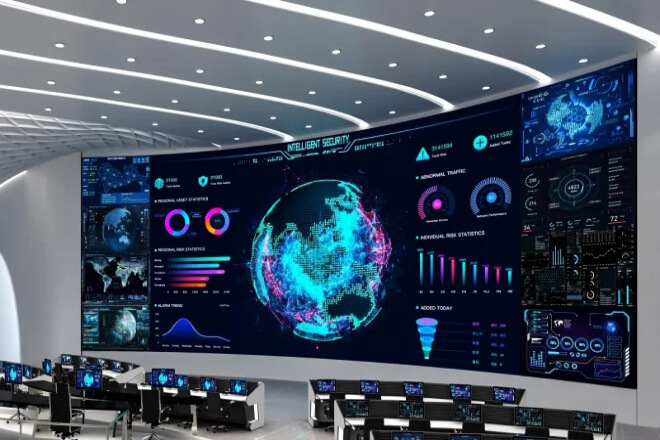
Large control rooms process massive amounts of information daily: traffic flow, equipment operating status, production data, emergency alarms, weather information…
This information comes from different departments and systems. Without unified management, data asynchrony, information delays, and even misunderstandings can easily occur.
Imagine if each department uses its own screen or its own Excel report.
To confirm data, operators might have to make phone calls and send messages simultaneously, repeatedly asking, “Is what you see the same as mine?”
This not only wastes time but can also lead to communication errors and even affect the accuracy of decision-making.
At this point, the Affichage LED acts as the “central brain” of the control room, centralizing all key information on a single platform for real-time display.
Whether it’s a comprehensive dispatch center monitoring urban traffic conditions, a corporate operations center tracking production indicators.
Or an emergency command center handling sudden events, the LED screen ensures that every staff member sees the latest and most complete data.
Each department and every operator can access information synchronously on the same screen, eliminating the awkward situation where “department A sees data a minute later than department B.”
Through this unified information display method, communication costs are significantly reduced.
Teams no longer need to frequently verify data or switch between different systems; discussions and decisions can be quickly completed on a single page.
More importantly, the LED screen provides the control room with a shared perspective: when everyone can see the same data and charts, the focus of discussions is clearer.
Task allocation is more precise, and cross-departmental collaboration becomes smoother.
For example, in a large city’s comprehensive traffic dispatch center, the LED screen simultaneously displays road condition information.
Traffic accident alerts, public transportation operation data, and construction reminders.
Dispatchers can quickly determine which road sections require traffic light adjustments, patrol vehicle deployment.
Or public travel advisories simply by standing in front of the screen, without having to visit each department individually to confirm information.
This efficient collaboration not only saves time but also significantly reduces the risk of operational errors.
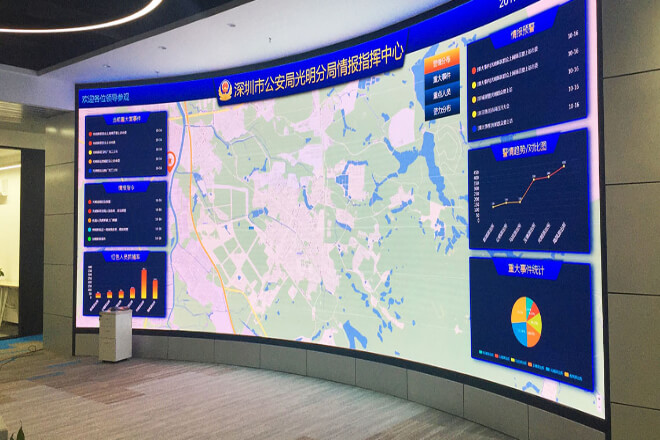
In large control rooms, team collaboration is like a multi-person “tactical exercise.”
Everyone needs to have access to a large amount of information in real time to analyze data and make decisions.
If everyone is staring at their own small computer screen, information is scattered, and communication is inconvenient.
Like everyone holding a map and staring at different corners—it’s easy to get lost or give each other the wrong directions.
The role of a large LED screen is like spreading a map across the entire room’s walls, allowing team members to discuss issues from the same “visual battlefield.”
Whether it’s a corporate operations center simultaneously viewing production line, inventory, and sales data.
Or a traffic dispatch center monitoring the city’s road network and accident situation, the large screen provides everyone with the same view, making discussions more intuitive and decisions faster.
For commanders, the large screen is more like their “command baton.”
They can mark key points, assign tasks, and even demonstrate operational procedures using touch or gestures in real time on the screen.
This method is more intuitive than traditional verbal explanations or small-screen demonstrations.
It’s like a coach demonstrating tactical maneuvers on a large screen; team members understand immediately what to do.
For example, in a large traffic control center, a large LED screen simultaneously displays road network conditions, accident alarms, and construction information.
Dispatchers mark key areas on the screen, and the entire team can see and respond immediately, without needing to double-check or stop their work to check other data.
Teamwork instantly becomes like precise gears, greatly improving efficiency.
In short, large LED screens are not just about “amplifying information,” but also a “super magnifying glass” for team collaboration.
It allows everyone to think about problems on the same screen, making communication smoother and decision-making more efficient.
Transforming the control room from a small room filled with information into a true “battleground”—professional yet with a touch of high-tech coolness.
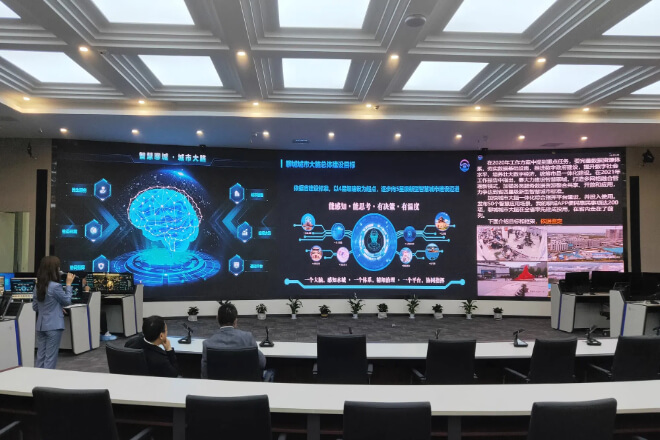
In large control rooms, operators often need to monitor data from multiple systems simultaneously: traffic conditions, surveillance cameras, production line information, alarm systems, etc.
With such diverse information sources scattered across different screens or terminals, it’s easy to become overwhelmed, and comparing data becomes as arduous as piecing together a jigsaw puzzle.
Un Ecran LED acts like a “super information jigsaw puzzle,” simultaneously displaying signals from different systems through multi-window displays.
Operators can see multiple windows on the same large screen, each showcasing data from one system.
Whether it’s real-time video monitoring, equipment status, statistical charts, or alarm information, everything is clearly presented.
This unified visualization of data from different sources makes the entire control room’s “information landscape” readily apparent.
The benefits of this integration method are significant: operators can quickly compare and analyze data from different systems, promptly identifying anomalies or potential problems.
For example, in a company’s operations center, a large screen simultaneously displays the production line’s operational status, warehouse inventory, and logistics information.
Managers can identify production bottlenecks or inventory shortages at a glance, eliminating the need to switch between multiple terminals or spend time comparing reports.
Multi-window displays not only improve information processing efficiency but also reduce the risk of misoperation.
Team members can observe, discuss, and make decisions simultaneously on the same screen, resulting in lower communication costs and smoother collaboration.
In short, LED screens transform the control room into an “information brain,” integrating all system signals and making the relationships between data as clear as a jigsaw puzzle, helping the team make quick and accurate decisions.
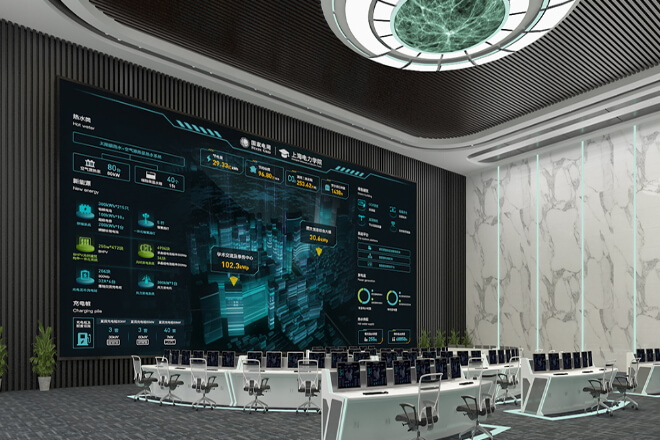
In large control rooms, operators process a large amount of charts, maps, videos, and real-time data daily.
With such a large volume of information and numerous details, insufficient screen résolution can easily lead to blurry data or misreading of key figures.
Such misreading not only wastes time but can also lead to communication errors or incorrect decisions.
High-definition LED displays are like putting “high-definition glasses” on information. It presents complex charts, maps, and videos with clarity and sharpness.
Whether it’s subtle changes in indicators, fine map annotations, or detailed content in real-time video, everything is readily apparent.
Operators don’t need to painstakingly decipher data or zoom in to quickly obtain key information and understand complex situations.
For example, in a city traffic control center, a high-definition screen can simultaneously display traffic flow, accident locations, and traffic light status for multiple roads.
Dispatchers can immediately identify which road sections are severely congested and where emergency vehicle dispatch is needed, without having to repeatedly confirm or guess data.
This not only improves the accuracy of information retrieval but also reduces errors in cross-departmental communication.
High-definition displays also make team discussions and decision-making more efficient.
When team members face the same high-resolution screen, everyone sees the same clear and consistent data, reducing misunderstandings.
In short, a high-definition Ecran LED is not just a large screen, but also an “information amplifier” in the control room, helping the team quickly grasp complex data and make accurate judgments.
In conclusion, high-definition LED displays make information easier to read and details clearer, reducing misunderstandings and communication costs.
It’s like the team in the control room is wearing “information-enhancing glasses,” allowing them to handle complex data with ease and make quick, accurate decisions.
 English
  Español
  简体中文
简体中文  Français
  日本語
日本語  한국어
한국어  العربية