
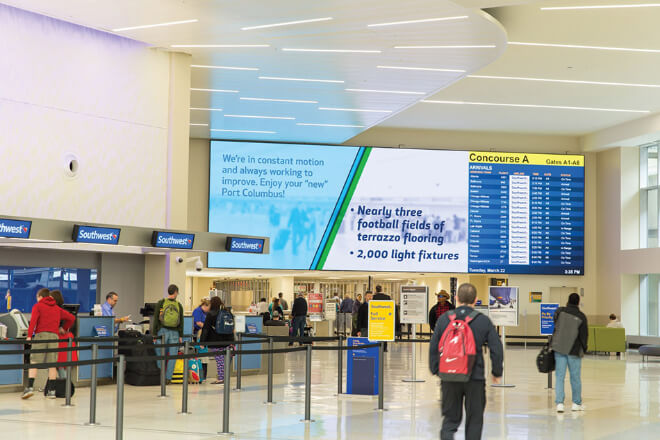
In busy places like aéroports and train stations, where people are often in a hurry, the clarity and timeliness of information directly affect passengers’ moods.
Whether flights or trains are delayed, or if there are changes to boarding gates/platforms, a lack of transparency can easily lead to anxiety or getting lost.
The biggest advantage of LED displays is real-time updates – flight delays, gate changes, boarding announcements – all information can be immediately displayed on the large screen.
Passengers don’t need to constantly check their phones or repeatedly ask staff, reducing anxiety.
In waiting areas, LED screens also serve as navigation and guidance tools. Clear arrows, directional prompts, or area indicators allow people to quickly find boarding gates, ticket gates, baggage claim areas, or restrooms.
Compared to old-fashioned static signs, this dynamic display is easier to notice and reduces instances of people getting lost or crowding in certain areas, making the entire space flow more smoothly.
More importantly, in emergencies, LED screens can immediately broadcast safety notices or evacuation instructions.
For example, in case of sudden weather changes, equipment malfunctions, or emergency evacuations, information can be quickly and uniformly updated on the screens, visible to everyone within seconds.
This is much safer than broadcasts, which can be easily disrupted by noise, or paper signs, which cannot be changed quickly enough.
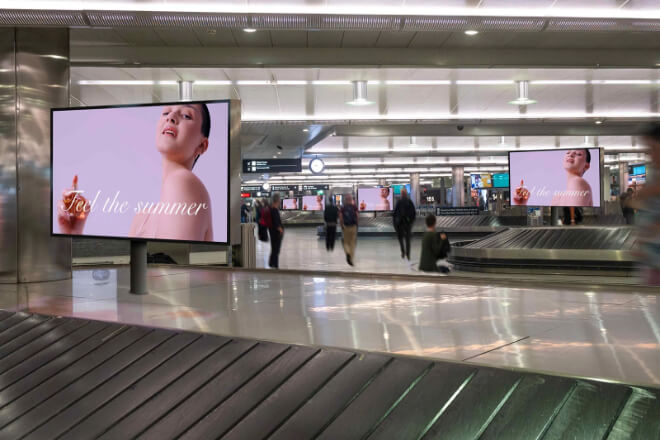
Airports and train stations have huge daily passenger traffic, making their advertising value very high.
LED displays have a distinct advantage here – they can not only display advertisements but also feature dynamic content and segmented advertising.
For example, airline brands can be promoted near boarding gates, and information about restaurants, duty-free shops, or cafes can be displayed in waiting areas.
This makes advertising more targeted and more likely to attract the target audience.
The benefits of high-luminosité screens are also straightforward: whether in bright sunlight during the day or dimly lit at night, the advertising content can be clearly displayed, ensuring no exposure opportunities are missed.
Compared to traditional posters or static signs, LED screens offer more dynamic visuals and are more likely to capture travelers’ attention.
From a return on investment perspective, LED screens not only provide information and navigation but also generate advertising revenue for the venue.
Renting out advertising space, collaborating with brands, or promoting the venue’s own services can all bring considerable profits.
The key is to plan the advertising playback strategy and screen placement effectively, so that advertising revenue not only covers hardware costs but also generates additional profits.
Simply put, these screens are not just aesthetically pleasing, but also powerful money-making tools.
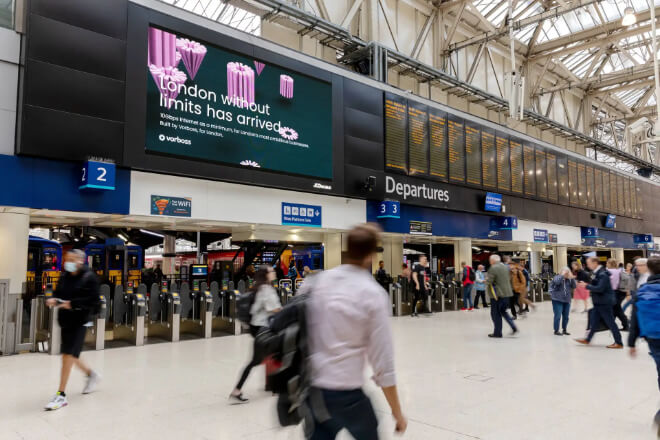
In today’s airports and train stations, simply looking at large screens is no longer enough; interactive experiences are becoming increasingly important.
LED screens can directly “interact” with passengers, for example, by setting up inquiry screens that allow people to check flight or train status, view venue maps, and get weather information at any time.
Passengers no longer need to constantly ask staff or keep refreshing their phones; information is readily available, making the travel experience smoother.
Even more interestingly, grands écrans LED can be linked with mobile devices.
For example, passengers can scan a QR code via an app or WeChat mini-program to display their seat information, travel reminders.
Or interactive content on the large screen, making the experience more personalized and engaging.
Venues can also use this method to offer customized services, such as personalized navigation, coupon pushes.
Or interactive games, allowing passengers to not only “wait” but also actively participate in venue activities while waiting for their flight or train.
In short, these interactive and smart applications transform LED screens from simply “displaying information” into travel assistants for passengers, improving convenience while also enhancing the experience and adding fun.
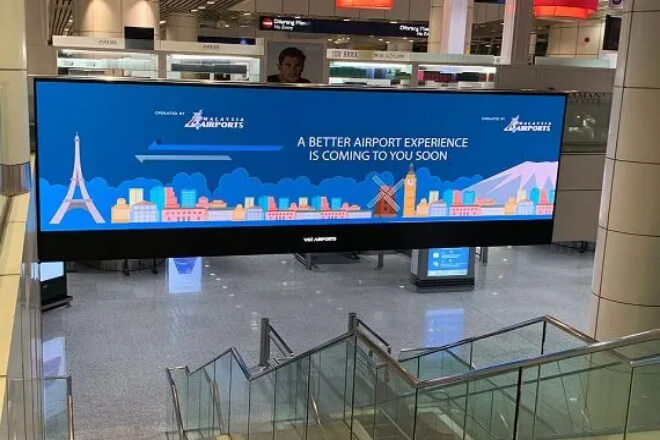
LED displays not only allow passengers to see clearly and have fun, but they are also very helpful for venue operations and management.
Through a central control system, managers can uniformly control the content of all screens, updating flight or train information in real time, reducing manual operations and the possibility of errors.
For example, if a flight is temporarily changed or the boarding gate is adjusted, management personnel only need to operate in the background, and all screens will be updated simultaneously, allowing passengers to see the latest information instantly.
Moreover, LED screens can collect a large amount of data, such as advertising playback effects, passenger location, and interaction behavior.
This data can help venues optimize advertising strategies, adjust information display methods, and even analyze passenger behavior, providing a reference for future operational decisions.
In other words, LED screens are not just for “information display,” but also a smart operational tool, making venue management more efficient and passenger experience smoother.
At airports and train stations, LED displays have become an “essential tool,” with screens in different areas serving different purposes, both convenient for passengers and creating commercial value.
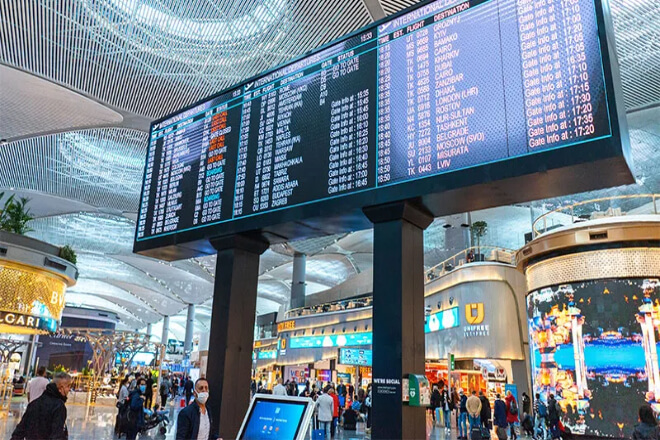
1). Main Screens and Information Screens in Waiting Halls
Waiting halls are where passengers spend the most time, so the main screens and information screens are crucial.
The main screen displays real-time flight or train status, boarding/gate information, and delay notifications, allowing everyone to see the most important updates at a glance.
Information screens provide navigation, weather, service guides, or interactive inquiries, helping passengers quickly find their destination or learn about surrounding services.
This way, people don’t have to constantly ask staff or worry about missing information.
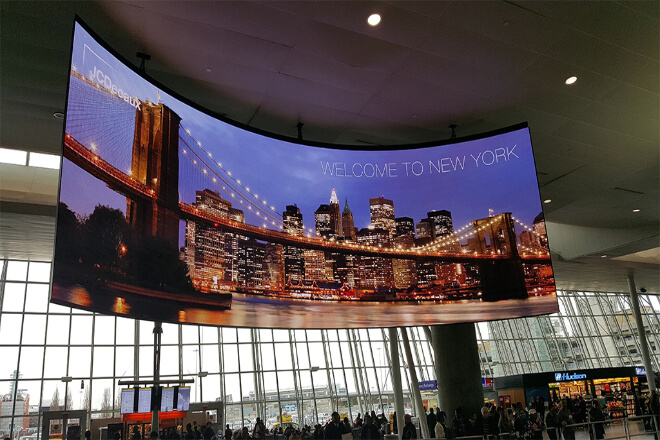
2). LED Displays at Boarding Gates/Ticket Gates
The screens at boarding gates and ticket gates are primarily designed to deliver information to passengers quickly and accurately.
Flight or train status, boarding order, and boarding reminders are displayed in a timely manner, avoiding queuing congestion or missing boarding.
The screens are clear, and the font is large, making them visible even from a distance, ensuring a smoother travel experience for passengers.
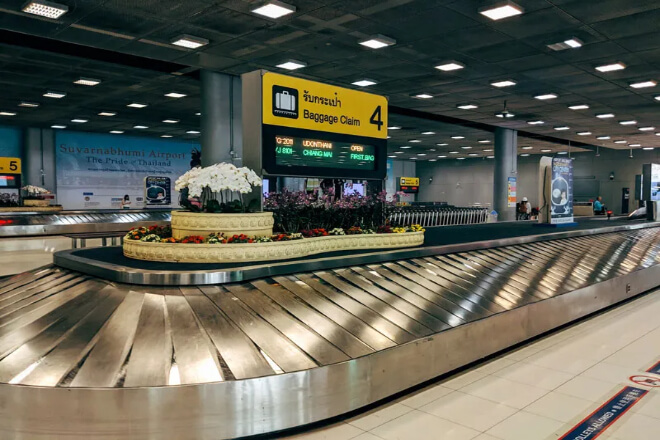
3). Advertising Screens in Baggage Claim Areas, Passages, and Commercial Areas
Baggage claim areas and passages are places where passengers wait or pass through, and LED screens can provide both information and advertising.
While waiting for their luggage, passengers can see brand advertisements, dining and shopping offers.
And the screens can also display flight or train arrival information, ensuring that they don’t miss the latest updates while retrieving their luggage.
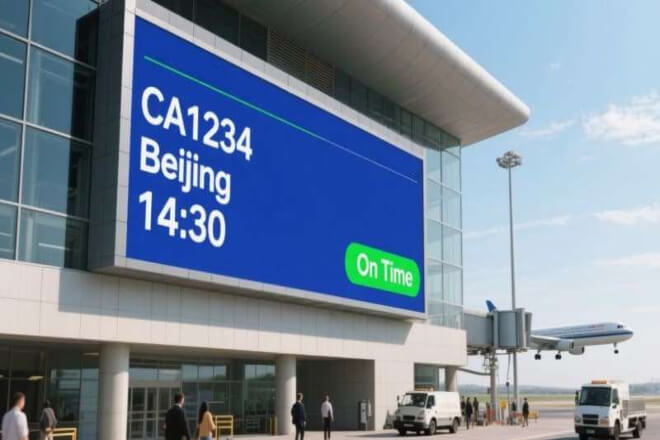
4). Extra-Large LED Displays at Outdoor Entrances/Plazas
At the entrances and plazas of airports or train stations, extra-large LED screens not only have a strong visual impact but also provide information and advertising.
Passengers entering the terminal can quickly see flight or train information and ticketing details, as well as browse advertisements or promotional materials.
In emergency situations, these screens can also display evacuation or safety information, covering the entire public area and ensuring faster and more intuitive information dissemination.
 English
  Español
  简体中文
简体中文  Français
  日本語
日本語  한국어
한국어  العربية