
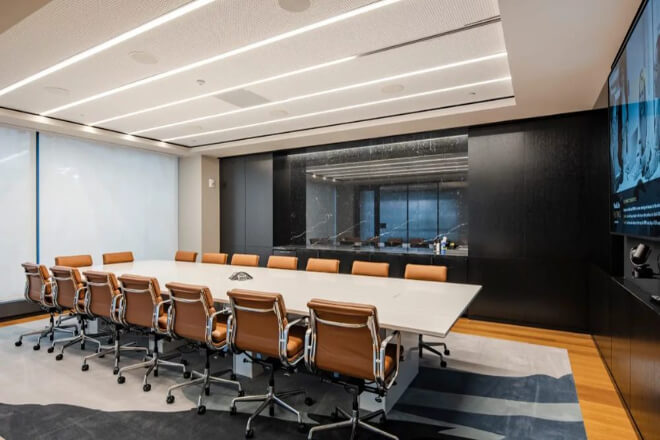
Different types of meeting rooms have vastly different usage requirements, which directly affect the size and configuration of the LED display.
Small meeting rooms, generally accommodating 5-10 people, are primarily used for quick discussions or displaying documents, spreadsheets, and PowerPoint presentations.
In these scenarios, the screen doesn’t need to be particularly large, but it must ensure that everyone can clearly see the content, prioritizing viewing distance and clarity. A screen that is too large can easily cause eye strain or make the space feel cramped.
Medium-sized meeting rooms, accommodating 10-30 people, are typically used for daily reports, training, or internal sharing.
Here, the screen needs to cover a wider ángulo de visión, ensuring that people in every corner can clearly see the content.
Brightness and clarity also need to be appropriately increased to accommodate longer distancias de visualización.
Large meeting rooms or multi-functional halls, accommodating more than 30 people, are used for large presentations, video conferences, or remote connections.
Screen size and clarity become the core considerations; it must be ensured that even those in the back can clearly see the text and images.
Simultaneously, multiple signal inputs, split-screen display, and viewing effects in high-brightness environments must be considered.
In general, the type of meeting room determines the priority of screen size: small meeting rooms prioritize practicality and clarity, medium-sized meeting rooms balance coverage and clarity.
And large meeting rooms prioritize visibility from a distance and multi-functional adaptability.
Correctly matching the screen size to the meeting room’s usage scenario will improve meeting efficiency and viewing experience.
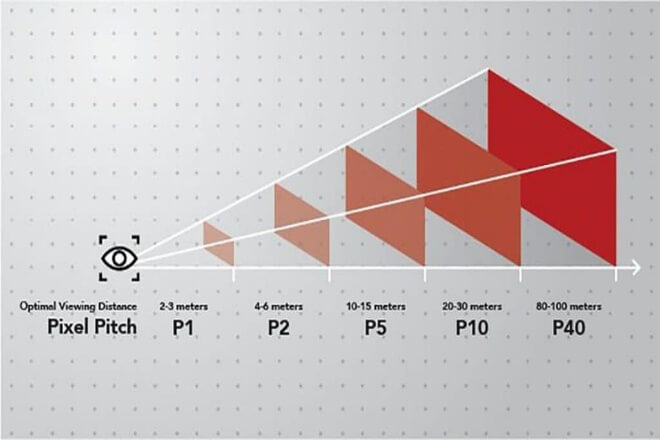
When choosing an LED screen for a meeting room, viewing distance and screen size are among the most critical factors.
Many projects, when designing their display solutions, only consider the screen’s diagonal length or price, neglecting the actual distance between the seats and the screen.
The result is that sitting too close strains the eyes, while sitting too far makes it difficult to see, significantly reducing the meeting experience and impacting efficiency.
A commonly used rule of thumb is: distancia de visualización × 1/4 to 1/3 = screen height.
For example, if the seating distance from the screen is approximately 4 meters, the screen height should ideally be between 1 and 1.3 meters.
Although simple, this formula is very practical when choosing a screen for a meeting room.
Allowing you to quickly determine a reasonable screen height range and avoid buying a screen that is too small or too large.
Besides height, the screen aspect ratio should also be considered. Widescreen and square screens significantly impact the visual experience.
Widescreen is suitable for displaying horizontal content, such as PPT presentations, videos, or multi-window split screens, providing a wider field of view and more natural information display.
Square screens are more suitable for displaying documents, spreadsheets, or vertical content.
If the screen aspect ratio is chosen incorrectly, even if the size is large enough, the image may be compressed, content may not be fully displayed, or the viewing experience may be uncomfortable.

When choosing an LED screen for a meeting room, resolution and pixel pitch are often more critical than screen size.
No matter how large the screen is, if the resolution is not high enough, text and graphics will still be blurry when viewing PPT presentations, videos, or detailed charts.
Those in the front rows will see clearly, but those in the back will not, and this is what truly affects meeting efficiency.
Generally, the smaller the tamaño de píxel, the higher the resolución.
Small to medium-sized meeting rooms commonly use pixel pitches between P1.5 and P2.5, ensuring that even those sitting in the back can clearly see text and chart content.
If the pixel pitch is too large, even with a large screen, people at a distance may not be able to see the content clearly.
This is a typical misconception of “buying a large screen but still not being able to see the text.”
Simply put, the pixel pitch multiplied by the screen height or width should cover the entire viewing distance while ensuring clear content details.
For example, in a medium-sized meeting room, if the furthest seating distance is 6 meters, choosing a P2.5 screen can generally ensure that PPT text and charts are clearly readable; choosing a P4 screen might result in blurry content for those in the back.
The key to avoiding common pitfalls is: don’t just look at screen size, and don’t simply pursue high resolution.
You should first clarify the purpose of the meeting room, seating distance, and common content types, and then select the appropriate pixel pitch and resolution.
This will not only ensure that everyone can see clearly but also avoid wasting money.
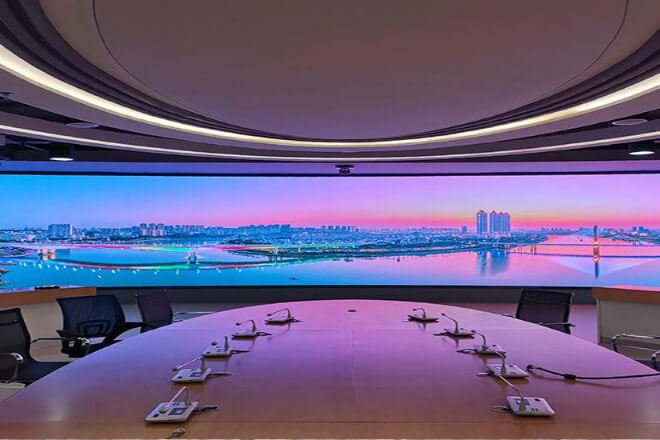
Many people, when choosing a meeting room screen, always think “bigger is better,” but they overlook the overall cost.
In fact, the cost of a large screen includes not only the price of the screen itself but also installation, wiring, debugging, and even later maintenance and power redundancy.
Especially for medium and large screens, installation is complex, and labor and maintenance costs quickly increase the total budget.
Therefore, when choosing a screen, you must consider ROI, or return on investment. Bigger is not always better.
It should match the actual function of the meeting room, allowing everyone to see the content clearly without wasting space and budget.
Small meeting rooms don’t need large screens; they only need to be clear enough to cover all participants.
For medium and large meeting rooms, the appropriate size and resolution should be selected based on seating distance and usage frequency, so that everyone can see comfortably without spending unnecessary money.
A common misconception among many decision-makers is blindly pursuing the largest size.
If the screen is too large, those sitting in the front row will be uncomfortable, and text and charts may appear stretched, leading to eye strain over time.
Moreover, the larger the screen, the higher the procurement, installation, and maintenance costs, but this does not necessarily translate into actual value.
Therefore, cost-effectiveness is key. Choosing a screen with the appropriate size and clarity that matches the actual use of the meeting room ensures that everyone can clearly see the content while controlling costs, making the investment more worthwhile, and saving time and effort.
 English
  Español
  简体中文
简体中文  Français
  日本語
日本語  한국어
한국어  العربية