
Introducción
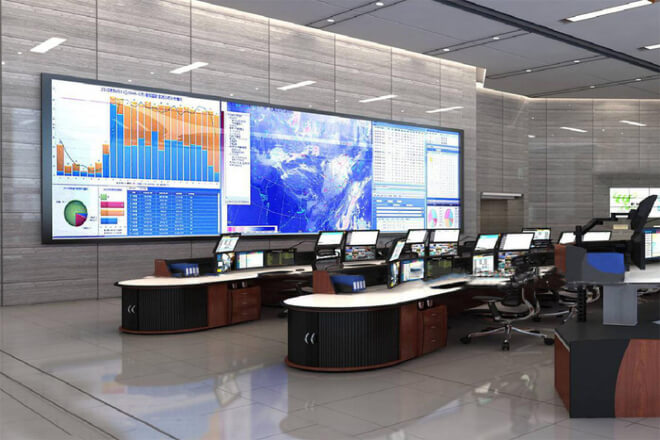
Some pantallas LED look impressive from a distance, but once you get closer, you’ll find the image isn’t sharp enough.
This is why pantallas LED de tamaño de píxel pequeño are increasingly being used in indoor settings—when the viewing distance gets closer, clarity is no longer a bonus, but a basic requirement.
The question then arises: since it’s better suited for close-up viewing, in which scenarios is it truly needed?
Tabla de contenido
Scenario 1: Conference Rooms and Command Centers
In conference rooms or command centers, viewers are usually very close to the screen.
Ordinary LED screens are prone to appearing grainy or blurry, especially when displaying text, data, or charts, where details can be lost.
This is where pantallas LED de tamaño de píxel pequeño come in—the image remains clear even at close range; every data point and every chart line is clearly visible, with every detail exposed.
Moreover, it’s ideal for extended use. Whether it’s a meeting lasting several hours or a 24/7 monitoring and dispatching scenario.
Small pixel pitch LED displays maintain stable images and uniform colors, without brightness fluctuations or eye strain, allowing staff and viewers to focus on the content for longer periods.
Imagine a command center’s large screen simultaneously displaying real-time monitoring footage, data trends, key indicators, and reports.
Every piece of information is clearly visible, allowing staff to quickly grasp the key points without having to get close to the screen, and ensuring no details are missed.
In such a high-density information display environment, the advantages of small pixel pitch LED displays are particularly evident.
They make “clear even up close and comfortable for extended viewing” a reality, making the entire meeting or command process more efficient and smoother.
Simply put, small pixel pitch LED displays transform the large screens in meeting rooms and command centers into not only information hubs.
But also comfortable and intuitive visual experience spaces, truly bringing data and reports to life.
Scenario 2: Exhibition Halls and Corporate Showrooms
En exhibición halls or corporate showrooms, screens are no longer just tools for “displaying content” but rather the “face” of the entire space.
In this case, image quality directly impacts the first impression.
The biggest advantage of small pixel pitch LED displays is their delicate image quality and high-resolution display.
Whether it’s brand promotional videos, product detail displays, or high-definition images, they can present richer layers and cleaner image effects.
Even upon close inspection, viewers won’t perceive any noticeable graininess; instead, they’ll perceive the image as “high-end.”
Simultaneously, it’s highly compatible with multimedia content. Videos, animations, and text/image content can be seamlessly switched, enriching the presentation format and moving beyond simple expression.
For example, a large screen can switch from brand stories to product introductions and interactive content, making the entire visit more rhythmic and attracting more attention.
From a spatial perspective, small-pitch LEDs integrate well into the overall design. The absence of obvious seams and a clean.
Unified image make the entire exhibition hall look more modern and technologically advanced, aligning better with the professional image the company wants to convey.
Simply put, in scenarios where “it needs to be both aesthetically pleasing and functional,” small pixel pitch LED displays not only display content but also enhance the overall quality and brand presence of the space.
Scenario 3: Shopping Malls and Retail Spaces
En Centros comerciales or retail spaces, the primary task of a screen is simple—to attract customers.
In a bustling environment, small pixel pitch LED displays act as an eye-catching element, easily standing out among numerous shops.
Compared to ordinary screens, small pixel pitch LED displays offer a more delicate and vibrant image, making them more impactful for advertising videos, product demonstrations, and event information.
Customers passing by are easily drawn to dynamic content, subconsciously slowing their pace to take a second look—those few seconds often mark the beginning of a conversion.
Simultaneously, it’s ideal for showcasing product details and brand content. For example, new product launches, promotions.
And usage scenario demonstrations can all be presented in high definition, allowing customers to understand the product more intuitively, rather than just relying on simple text descriptions.
From an overall experience perspective, small pixel pitch LED displays also enhance the visual depth of a space.
Clean, detailed images and smooth content transitions make the entire store or mall look more sophisticated and “technological,” subtly enhancing the brand image.
Simply put, in retail scenarios, small pixel pitch LED displays are not just “playing ads.”
But also attracting attention, telling product stories, and making the customer’s shopping experience more engaging and memorable.
Scenario 4: Studios and Live Streaming Environments
In studios or live streaming environments, the screen is not just for displaying content, but also a “stage partner” for the entire visual experience.
The advantages of pantallas LED de tamaño de píxel pequeño are very clear here: stable images and accurate colors.
Even when shooting at close range, there is no graininess or flickering, ensuring that every frame captured by the camera is clean and clear.
Simultaneously, it can also be used as a background screen, providing diverse visual scenarios for programs.
Whether it’s news broadcasts, variety shows, or online live events, small pixel pitch LED displays can display dynamic backgrounds, high-definition videos, interactive graphics.
And other content, enhancing the depth of the image and making the entire broadcast space more vivid and engaging.
Furthermore, small pixel pitch LED displays support smooth content switching and multimedia displays.
Allowing for adjustments to the screen content according to the program’s rhythm, making stage effects more flexible and diverse.
Compared to traditional projectors or ordinary LED screens, it not only improves the shooting effect but also makes live broadcasts and recordings more professional and visually impactful.
Simply put, in the studio and live broadcast environment, small pixel pitch LED displays are not just a screen.
But a “behind-the-scenes magician,” making every frame more outstanding, the program more vivid, and enhancing the overall visual experience.
Scenario 5: Monitoring Center and Data Display Scenarios
In monitoring centers or data display scenarios, the screen acts like the “commander’s eyes,” displaying a massive amount of information.
Small pixel pitch LED displays act like a super magnifying glass here—no matter how many images appear simultaneously, text, charts, and monitoring footage remain clearly visible.
Even the smallest data details won’t escape your eyes.
Moreover, it’s particularly suitable for long-term “duty times.” For 24/7 monitoring or data display, small pixel pitch LED displays maintain stable brightness.
And consistent color, without flickering or causing eye fatigue—even more reliable than human attention.
Even better, it makes information recognition incredibly efficient. Staff can instantly lock onto key data, quickly detect anomalies, and not miss any important changes.
Managers can also quickly grasp the overall situation and make accurate decisions.
Simply put, small pixel pitch LED displays in monitoring centers are not just large screens, but also “high-IQ assistants.”
Making information readily available, simplifying work, and making the entire workspace look more technological and sophisticated.
The value of small pixel pitch LED displays lies not in being “suitable for all scenarios,” but in being “used in the right scenarios.”
6. Conclusion
Its advantages are amplified when viewing distance, content precision, and display requirements are matched; conversely, it may appear as over-configuration.
Choosing the right scenario is more important than simply choosing the technology.
Finally, if you would like to learn more about LED displays, Por favor póngase en contacto con nosotros.
 English
  Español
  简体中文
简体中文  Français
  日本語
日本語  한국어
한국어  العربية