
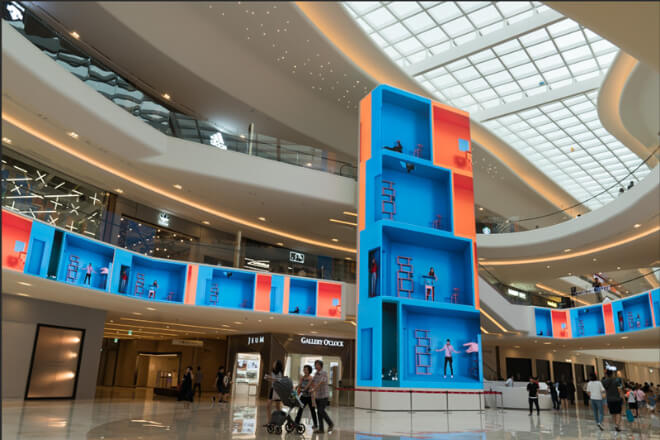
In many commercial complexes, pantallas LED are often managed independently, directly leading to inconsistent content and out-of-sync information, thus affecting the overall brand image and user experience.
The core value of unified management lies in creating a unified whole across all screens.
Centralized control ensures consistent content style and synchronized information dissemination, avoiding confusion or information discrepancies, while also enhancing the overall visual professionalism and consistency.
At the operational level, unified management enables one-click publishing and multi-screen synchronization, significantly improving efficiency and reducing repetitive operations and human error.
At the maintenance level, centralized equipment management through remote monitoring reduces labor costs and improves response speed.
Furthermore, unified management provides a foundation for data-driven operations, transforming screens from mere “display tools” into analyzable and optimizable business resources.
Simply put, unified management upgrades LED displays from “dispersed devices” to “collaborative operating systems.”
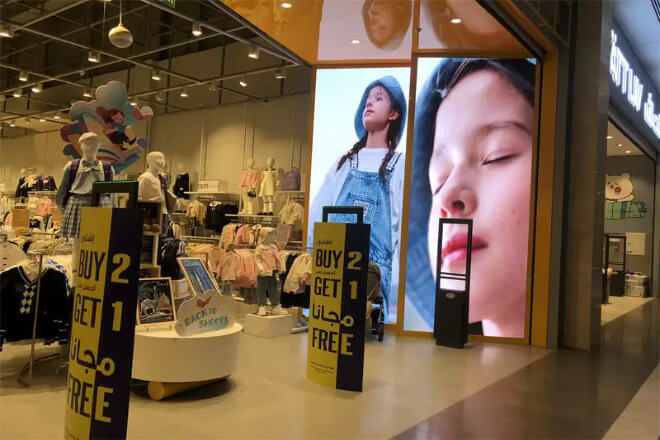
In actual operation, commercial complexes often include various types of displays such as atrium screens, corridor screens, merchant-owned screens, and outdoor advertising screens.
These different types of equipment differ in location, purpose, and technical conditions, posing numerous challenges to unified management.
First, atrium LED displays and corridor screens differ significantly in their application scenarios.
Atrium screens are typically used for brand display and event promotion, emphasizing visual impact, while corridor screens are more focused on information guidance and high-frequency exposure.
This difference in “functional positioning” makes it difficult to completely unify content arrangement and playback strategies, increasing management complexity.
Second, merchant-owned LED displays are often purchased and managed independently by each brand, resulting in inconsistent system standards and even the use of different control software or equipment protocols.
These types of screens are prone to compatibility issues when connected to a unified platform, and centralized control over content review and publishing permissions is also more difficult.
Furthermore, outdoor LED displays differ from indoor screens in their technical environments.
For example, outdoor screens require stronger waterproofing, sun protection, and brillo adaptation capabilities, while indoor screens prioritize image quality and detail.
Due to differences in usage environments and equipment standards, different control systems are typically required, increasing the complexity of unified management.
In addition, in multi-story settings, each floor may have a different number and type of LED displays, distributed widely.
This characteristic of “numerous locations and wide distribution” significantly increases the difficulty of equipment management, content scheduling, and troubleshooting.
Without a unified platform, low management efficiency and delayed responses are likely to occur.
Overall, the management challenges of LED displays in commercial complexes mainly stem from the combined effects of “different scenarios, diverse equipment.
And complex distribution,” further highlighting the importance of a unified management system.
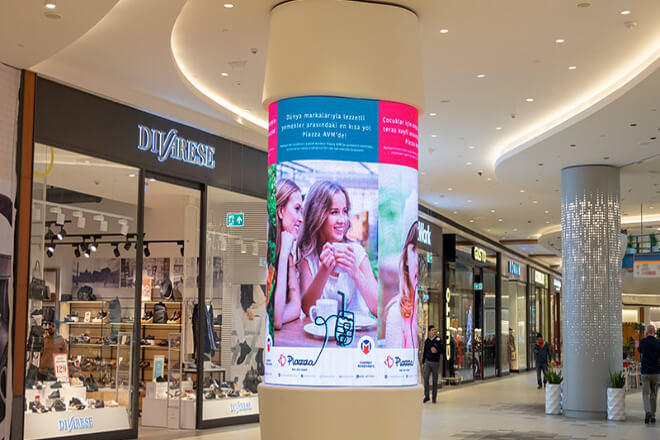
1) Unified Platform and Interface Access
In a commercial complex with numerous pantallas LED, it’s easy for them to become disparate, each using its own interface. Some screens use one system, while others use another.
To solve this problem, a centralized management platform can be built to connect all LED displays.
Then, through gateways or middleware, the “language” of different brands and types of LED displays can be standardized.
This way, regardless of where the equipment comes from, it can be managed and scheduled uniformly on a single platform.
2) Equipment Standardization and Network Unification
Once all LED displays are connected to the platform, the next step is to standardize their operation.
By using unified access standards, LED displays in different locations can connect to the system in the same way.
Then, through a unified network, LED displays distributed across different floors and areas can all be connected to the same control channel.
This way, managers no longer need to switch between systems; instead, they can clearly see the status of all LED displays on a single platform and perform unified operations.
3) Compatible Control of Multi-Brand LED Displays
In reality, most commercial projects use LED displays from different brands, making unified management more complex.
However, this problem can be solved using a “platform + gateway” approach: the platform issues unified commands, and the gateway translates these commands into a format understandable by each brand of LED display.
This way, even if the equipment has different origins, it can be uniformly controlled under the same set of rules, avoiding fragmented management.
4) Remote Management and Unified Operation of LED Displays
Once all LED displays are connected to a unified platform, many tasks can be completed “from the office.”
For example, you can monitor the real-time status of each LED display to see if it is working properly and if there are any abnormalities.
You can also remotely update content, allowing all screens to simultaneously display the latest information.
There’s no need to operate each screen individually or frequently switch between different systems; one platform can manage all LED displays, naturally improving efficiency.

1) Centralized Editing and One-Click Publishing
Imagine the workload if each Pantalla LED had to upload content individually—it would be staggering.
A more efficient approach is to use a unified content management platform to centrally edit and review all content, then publish it to all LED displays with a single click.
This not only eliminates repetitive operations but also ensures all screens are synchronized, preventing situations where one screen is still displaying outdated content.
2) Differentiated Playback in Different Areas
Unified management doesn’t mean all LED displays play the same content. By grouping screens within the system—for example, by floor, area, or scene—different areas can have their own distinct content.
The large screen in the atrium attracts attention, while the corridor screens provide information.
Each screen has its own content rhythm, maintaining flexibility while maintaining uniformity, resulting in a better overall effect.
3) Unified Scheduling Management of Advertising Content
Without a unified scheduling system, multiple LED displays can easily experience advertising content competing for the same content.
A centralized management platform allows advertising content to be pre-arranged in order and timing, enabling different ads to be played smoothly and sequentially across multiple LED displays.
The entire process resembles a meticulously curated playlist rather than fragmented manual operations, making advertising more rhythmic and controllable.
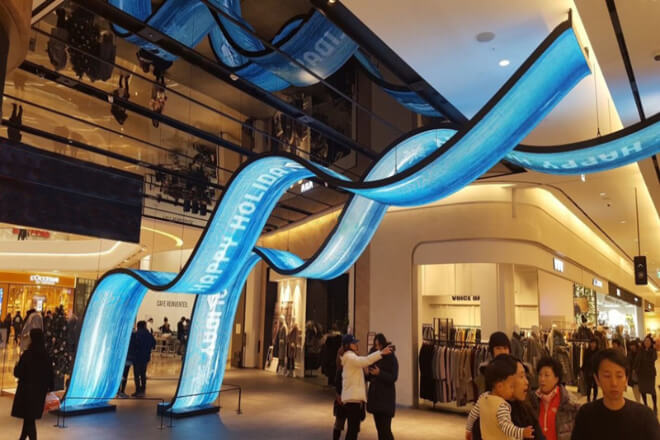
4) Unified Synchronization of Holiday Content
During holidays, LED displays often need to quickly switch atmospheres. Modifying content piecemeal is not only time-consuming but also prone to omissions.
A unified platform allows for pre-prepared holiday content, which can be synchronized to all LED displays with a single click when needed, instantly “changing the look” of the entire commercial space.
This unifies the visuals and atmosphere, making the holiday spirit more effective and impactful.
 English
  Español
  简体中文
简体中文  Français
  日本語
日本語  한국어
한국어  العربية