
介绍
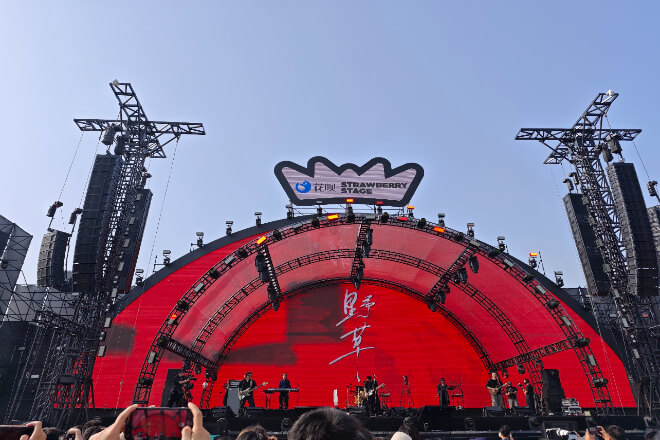
Today’s concerts feature increasingly larger 阶段 and more and more LED screens.
However, more screens don’t necessarily mean a better effect. What’s displayed on the main screen, how the side screens are positioned, and whether a floor screen should be used all depend on the venue and stage design.
Therefore, what a concert truly needs is never just a large screen, but a suitable LED显示屏 solution.
目录
Solution 1: Creating a Core Visual Centre with a Main Stage LED Screen

Now, it’s difficult to simply understand LED屏幕 as “stage backgrounds” when attending a large concert.
Often, before the singers even appear on 阶段, the massive main screen and opening visuals have already built up the audience’s emotions.
Like U2’s performance at the Sphere in Las Vegas, the giant visuals almost redefined the stage space.
At times, the audience felt like they were sitting above the city, and at other times, like they had entered a completely fictional digital world.
While this scale cannot be replicated by ordinary concerts, it at least demonstrates one thing: when LED display visuals are truly integrated into stage design, the screen itself can become part of the performance.
Taylor Swift’s The Eras Tour is also a prime example. Different musical eras correspond to different visual styles, with stage visuals changing with each song and chapter.
One moment it’s a retro colour scheme, the next it might be a more intense, dreamlike visual scene.
The stage remains the same, but the audience will clearly feel that “the story has turned a new page.”
For large stadium concerts, the main stage LED screen has another very practical function—allowing back-row audience members to clearly see the singer.
An expression, a wave, even a moment of interaction between the singer and front-row fans can be magnified by the live cameras.
Otherwise, if you pay to enter the venue and end up only staring at a “small silhouette” in the distance, the experience is diminished.
Especially when a song reaches its climax, the music, lighting, and LED display visuals advance together, instantly amplifying the visual impact.
After many concerts, these are often the images that truly dominate social media.
Therefore, the main 阶段 LED screen is no longer just for “playing videos.” It’s more like a second performer in the concert—it can’t sing, but it can deliver the emotion of a song to the entire venue.
Solution 2: Side and Extended Screens Enhance the Overall Viewing Experience

One of the most practical problems with large concerts is that there’s only one stage, but the audience can number in the tens of thousands.
While those in the front rows can clearly see the singer’s expressions, those in the higher stands or at the back of the venue may only see a “moving dot.”
Therefore, large screens on either side of the main 阶段 have become almost standard in stadium-level concerts.
For example, during Taylor Swift’s The Eras Tour, the large venue’s screen system simultaneously displayed close-ups of the singer and live footage.
Even if audience members were sitting far from the main stage, they could still see expressions, costume details, and moments of interaction with the audience.
For those in the back rows, this screen wasn’t just decoration; it genuinely “saved their view.”
Coldplay’s large-scale tours are also a typical example. The live camera constantly switched between the stage, the band members, and the audience.
When the camera suddenly panned to a section of the stands, and a large screen showed audience members singing and waving, the atmosphere in that area would often ignite instantly.
People who were originally just watching from a distance now had the opportunity to become part of the live performance.
Extended screens go a step further. They can expand to the sides or depth of the stage, extending visual content beyond the centre.
Especially in long stadiums or large outdoor venues, strategically increasing the display area can reduce the problem of awkward angles and incomplete views from some seats.
Ultimately, a concert with tens of thousands of people can’t have everyone in the front row.
But through side screens, extended screens, and real-time image switching, at least audience members in different positions can keep up with the performance.
After all, audiences buy tickets not just to “hear the singer,” but also to actually see the performance.
Solution 3: Floor LED Screens Enhance Immersive Stage Effects

If the main stage screen is responsible for “setting up the image,” then the floor LED screen’s job is to extend the visual experience from the background all the way to the singer’s feet.
The stage is no longer a black platform, but truly becomes part of the visual experience.
In some large concerts and 阶段 shows, 落地LED显示屏 have already been used to create “spatial illusions.”
For example, the screen displays flowing water, making the singer appear to be standing in the centre of a lake;
The image switches to a galaxy or clouds, and combined with the overhead lighting and the large background screen, the entire stage seems to float in the air. Even though the audience knows it’s a screen, their vision is easily drawn in.
Beyoncé’s “Renaissance World Tour” placed great emphasis on the coordination between the stage floor and the overall visual design.
The silver, futuristic visual content, along with changes in lighting and stage structure, made the floor more than just an area for the performers; it became an integral part of the overall visual design.
Another interesting feature of the floor LED screens is its ability to “move” with the performance.
As the singer walks, light diffuses beneath their feet; as the dancers move, the visuals change rhythmically.
At the climax of a song, the main screen, the floor, and the lighting switch simultaneously, instantly expanding the sense of space on stage.
For the stage design team, this also means more creative freedom. Today it could be an ocean, the next song a city street.
And the next moment a digital world—no need to actually dismantle the stage and rebuild the set; simply changing the visual content can transform the entire scene.
Therefore, the greatest value of floor LED screens isn’t simply “having a screen under your feet.”
But rather transforming the stage from a performance platform into a visual space that constantly changes with the music.
Solution 4: High-Performance LED Systems to Meet On-Site Technical Needs
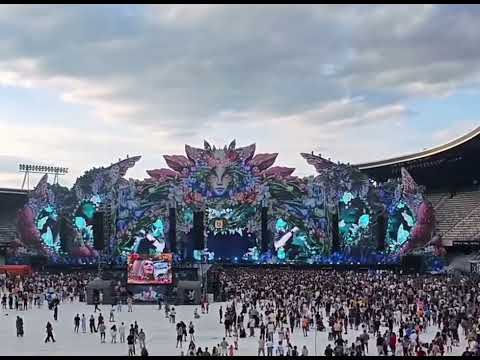
What’s the biggest fear during a concert’s climax? It might not be a singer forgetting lyrics, but rather the LED screen behind them suddenly flickering, lagging, or even going completely black.
With tens of thousands of audience members watching the 阶段, any display problem will be magnified instantly.
Therefore, the requirements for LED systems at large concerts are far more complex than simply “making the screen light up.”
At large music festivals like Tomorrowland, the visual changes on stage are extremely rapid.
Flickering lights, accelerated DJ rhythms, and fast-paced animation transitions—if the LED屏幕的 刷新率 can’t keep up, it might not be noticeable on-site.
But it will easily reveal scan lines and flickering issues when filmed with a mobile phone or professional camera.
For performances requiring live streaming or extensive social media dissemination, this obviously significantly impacts the experience.
亮度 is equally crucial. Outdoor music festivals might start in the afternoon, before sunset.
If the screen brightness is insufficient, even the most beautiful visual content can easily appear greyish.
At night, the display system needs to adjust its effects according to the environment to prevent the screen from being too bright and overshadowing the stage lighting.
Of course, the real test for an LED system is its stability. A concert can last for several hours, and a tour involves continuous transportation, installation, dismantling, and re-establishment.
Large-scale world tours like Coldplay and Ed Sheeran require complex stage systems to operate as planned at each stop, and LED displays are naturally a crucial component.
Ultimately, audiences won’t specifically discuss “what the screen’s refresh rate is.” But if the image freezes or a section of the screen goes black, everyone will notice.
That’s the value of a high-performance LED system—few people think about it when it’s running normally, but once a problem occurs, the entire venue notices.
Solution 5: Flexible Rental Options to Adapt to Tour Needs

One of the biggest challenges in 阶段 design for large concerts and tours is that each stop is different.
Today, it might be a stadium with tens of thousands of people; the next stop might be an indoor venue.
Some cities require a super-large main screen, while other venues are better suited to smaller, more refined visual layouts.
Therefore, LED display systems need to be flexible enough to keep up with changes in performance.
The advantage of 租赁LED显示屏 lies in their ability to be quickly configured for different venues.
For example, a global tour might require the same stage concept for venues of different sizes in different countries.
Staff can adjust the number, size, and combination of LED screens based on the available space, rather than redesigning the entire system for each location.
Furthermore, rental LED screens use a modular structure, making installation and disassembly more efficient.
For concerts, 阶段 setup time is often very limited; equipment might be being installed one day, and the next day the venue must accommodate tens of thousands of audience members.
Rapid deployment is crucial for ensuring a smooth performance.
Large-scale touring projects like Coldplay and Ed Sheeran adjust their stage and visual schemes according to the venue conditions in different cities.
This relies on professional display systems that can be quickly transported, set up, and adjusted.
In addition, using rental LED screens can reduce equipment stress during a tour. Instead of preparing a completely fixed display configuration for every stop.
A flexible approach based on the scale of the performance allows the stage team to focus more on visual creativity and the live experience.
Simply put: Fixed stages are more concerned with “being there all the time,” while rental LED screens are better suited for “moving with the performance.”
For constantly changing touring projects, flexibility itself is a competitive advantage.
6. 结论
At a concert, the quality of the LED screen is easily noticeable to the audience.
Whether they can see clearly from a distance, whether the visuals and music match, and the impact of the stage—all these factors are related to the LED display solution.
The screen is just equipment; the key is how to place it correctly and use it to its full potential.
Finally, if you would like to learn more about LED displays, 请与我们联系。


 English
  Español
  简体中文
简体中文  Français
  日本語
日本語  한국어
한국어  العربية