介绍

Stepping into today’s 博物馆, changes are quietly taking place.
In the past, visitors mostly stood in front of display cases to view exhibits. Now, more and more 展览 are utilizing digital technology to bring history, art, and cultural content to life.
A painting, a piece of history, an artifact—no longer confined behind glass cases- can connect with viewers through dynamic visuals and immersive scenes.
和 LED显示屏 are becoming a crucial tool in this transformation.
目录
1. How can museum exhibition halls use LED displays to make cultural content more intuitive?

Many visitors to traditional 博物馆 encounter a problem: the exhibits are precious, but the stories behind them are difficult to understand.
An artifact might be displayed, but visitors might only glance at it for a few seconds, finding it hard to truly grasp its historical background, craftsmanship, and cultural value.
The addition of LED displays opens up more possibilities for museum displays. Through dynamic visuals, video materials, and digital content, previously static exhibits can be imbued with much more background information.
For example, an LED screen next to an ancient artifact can display its historical period, usage scenario, production process, and even recreate the environment in which it existed.
Allowing visitors to not only “see the artifact” but also more easily understand the story behind it.
Some overseas museums have begun using large-scale LED显示屏 systems to create digital exhibition halls.
For instance, when displaying ancient civilizations, artworks, or historical events, the screen can play historical videos and 3D animations, allowing visitors to quickly gain an understanding of the exhibits through visual content.
Compared to traditional explanatory plaques, this method is more suitable for younger visitors and enhances the interactivity of the visit.
At the same time, LED displays can help museums overcome spatial limitations.
Many precious documents, historical images, or content that cannot be displayed permanently can be presented digitally, allowing limited exhibition space to carry more cultural information.
Of course, LED screens are not simply a replacement for traditional displays, but rather a supplement to the content of exhibits.
Truly good museum displays still require physical objects as the core, and then use digital technology to help visitors understand their value more deeply.
For modern museums, LED displays are changing not only the way they are displayed, but also helping cultural content find a more accessible way of expression for the younger generation.
Let history no longer remain merely in written descriptions, but become an experience that can be viewed, understood, and remembered.
2. How can immersive exhibitions create a "stepping into history" experience using LED displays?

In markets such as Europe, America, Japan, and South Korea, more and more museums and cultural spaces are beginning to experiment with a new way of displaying history:
Not just letting visitors “see history,” but letting them “enter history.”
Immersive exhibitions are becoming an important way to attract young visitors, and LED displays are one of the core technologies for creating this experience.
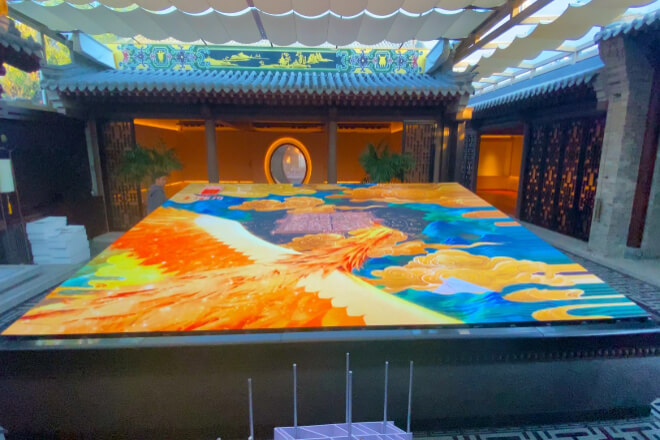
Large LED walls can quickly change the visual environment of an entire exhibition hall.
For example, in some historical exhibitions in France and the UK, digital images recreate ancient cities, natural landscapes, or important historical scenes through large-area LED screens.
Allowing visitors to feel as if they are stepping into an unfolding story from the moment they enter the exhibition hall, rather than facing a static display panel.
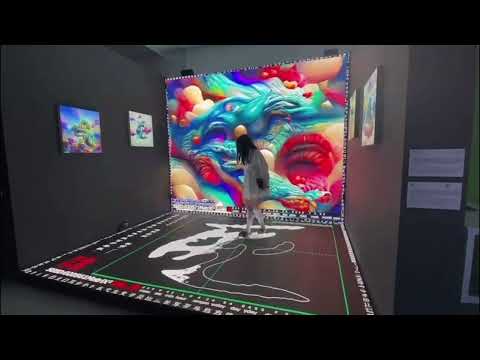
LED显示屏 are also widely used in art exhibitions. For example, some digital art galleries use high-definition LED spaces to display classic artworks.
Using dynamic light and shadow, color changes, and spatial extension to allow viewers to feel the atmosphere of the era behind the works.
Compared to traditional wall-hanging displays, this method is more likely to attract young visitors to linger and share. Multi-screen interaction further enhances the immersive experience.
In some large cultural exhibition halls, wall-mounted LED screens, floor-mounted LED screens, and interactive devices display content simultaneously.
For example, when showcasing themes such as ancient Rome and ancient Egypt, visitors can not only see reconstructed architecture but also learn about historical figures, lifestyles.
And cultural backgrounds through different screens, making the visit more like an exploration journey.
Of course, the focus of immersive 展览 is not “the more screens, the better.” Excellent digital exhibitions require LED display systems to serve storytelling, not replace the cultural content itself.
Screens are responsible for creating atmosphere and enhancing understanding, while exhibits and historical stories remain the core.
For overseas museums and cultural institutions, LED displays are helping traditional exhibitions move from “information display” to “experience design.”
When visitors no longer simply stand in front of display cases but experience history in a digital space, cultural dissemination becomes more vivid.
3. How can interactive areas in museums leverage LED displays to enhance visitor engagement?

Previously, many visitors to museums would simply “look around, read a bit, take a picture, and leave.”
Exhibits are valuable, but without interaction, many historical stories and cultural information won’t easily remain in visitors’ minds.
Now, more and more overseas 博物馆 are using LED displays to transform visitors from mere “viewers” into part of the exhibition experience.
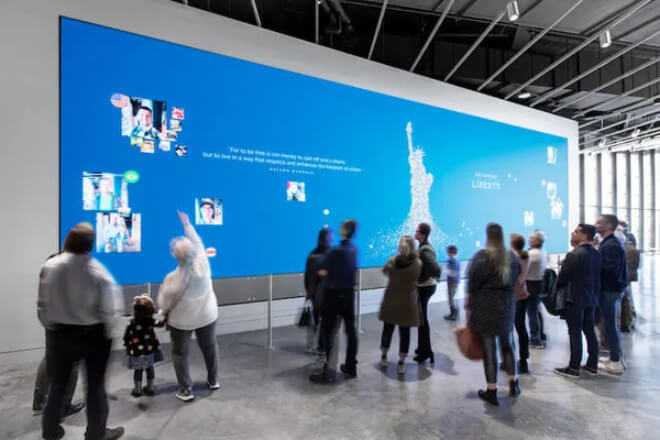
In interactive areas, LED displays make visitor participation more intuitive. For example, in art 展览, visitors can create patterns using touch devices, and their work will be displayed in real time on a large screen.
In historical exhibitions, visitors can also interactively select different storylines to explore the figures, architecture, and lifestyles of a particular period.
This kind of experience is more likely to spark interest than simply reading text descriptions.
With the development of AI technology, the interactive methods of LED displays are becoming increasingly diverse.
Some overseas museums are beginning to experiment with AI-generated content, allowing visitors to experience “creating their own exhibitions.”
For example, children can design a virtual animal through an interactive screen or participate in exploring ancient civilization scenes, learning while having fun.
This type of display is particularly suitable for children’s educational areas. For children, a dynamic and interactive LED screen is often more attractive than a static explanatory plaque.
For example, natural history museums can use interactive LED walls to simulate marine ecology, dinosaur worlds, or space exploration, allowing children to understand scientific knowledge through participation.
Besides increasing fun, interactive LED displays can also become “memorable points” in museums.
Many visitors are willing to take photos of the interactive content and share them on social media after their visit, giving the exhibition more opportunities for natural dissemination.
Of course, interactivity isn’t about having visitors constantly “play with the screen,” but rather about using technology to make cultural content easier to understand.
A good interactive area should make visitors stop because of the story and remember the place because of the experience.
For modern museums, the changes brought by LED displays are not just about adding a digital device.
But about transforming cultural display from a one-way transmission into an experience that visitors can participate in.
4. How can digital museums use LED displays to optimize information dissemination?

One of the most common problems visitors encounter when entering a large museum is:
The exhibition halls are too large, and they don’t know where to start; there are too many activities, and they don’t know when they start.
In the past, this information mainly relied on display boards, brochures, or staff introductions, but for modern museums, this approach is no longer keeping up with the pace.
The addition of LED显示屏 makes museum information dissemination more “flexible.” For example, in the entrance hall.
A large LED screen can display real-time information on the day’s open exhibitions, special events, lectures, and recommendations for popular exhibition areas.
Visitors can quickly understand “what’s worth seeing today” as soon as they enter, reducing the time spent searching for information.
In some overseas 博物馆, LED display systems have become an integral part of daily operations.
For instance, when a new art exhibition opens, the entrance screen can play an advance preview;
When hosting children’s educational activities, it can display activity times and participation methods;
And in case of last-minute adjustments, content can be quickly updated without the need to reproduce large amounts of materials.
Beyond disseminating information, LED screens can also help visitors plan their visits more easily.
For large venues like history museums and natural history museums, digital guide screens can display maps, route directions.
And the locations of key exhibits, eliminating the need for visitors to search with paper maps.
More importantly, LED displays make museum information presentation more dynamic.
Staff can adjust content according to different time periods, such as highlighting family activities in the morning and promoting special exhibitions in the afternoon, maximizing the dissemination value of limited display space.
Of course, digitalization does not mean turning museums into “electronic billboards.”
Truly good LED applications subtly integrate technology into the experience, making information easier for visitors to find and encouraging them to stop and learn more.
For today’s museums, LED displays are more than just adding a screen to a wall; they help cultural spaces tell stories in a way that resonates with modern visitors.
5. How to Choose the Right LED Display Solution for Museum Upgrade Projects?

Installing LED displays in a museum isn’t necessarily about having the biggest screen or the highest specifications.
The truly suitable solution needs to consider how visitors will view the content, how it will be displayed, and how it will be used over the next few years.
After all, museums aren’t temporary event venues; a display system typically needs to serve exhibitions and operations long-term.
First, consider the intended use of the space. For example, an LED screen in the entrance hall primarily serves for information dissemination and event promotion.
While an immersive 展览 hall might require a large LED wall to create historical scenes and spatial atmosphere through visuals.
In interactive areas, the screen needs to accommodate touch controls, detailed displays, and visitor participation.
Different areas have different needs, so the chosen display solution will naturally differ.
Viewing distance is also a crucial factor. Art exhibitions and digital exhibitions, viewed up close by visitors, demand higher image detail, and small-pitch LEDs can display more nuances.
However, areas viewed from a distance, such as lobbies and corridors, don’t necessarily require the highest-specification products.
Appropriately matching pixel pitch not only ensures quality but also avoids wasted budget.
Long-term stable operation is equally important. Museums face large numbers of visitors daily; frequent screen malfunctions, uneven brightness.
Or display abnormalities not only impact the visitor experience but also increase maintenance burdens.
Therefore, product reliability, heat dissipation design, and after-sales support must be considered in advance when selecting LED solutions.
Some overseas museums, during their digital upgrades, do not use the same type of LED screen across all areas but rather combine them according to function.
For example, high-definition 小间距LED显示屏 are used to create a superior visual experience in key exhibition areas.
While products prioritizing stability and information display efficiency are used in public areas. This highlights key areas while controlling overall investment.
Therefore, when choosing LED display solutions, museums should not focus on the “largest screen” or the “highest parameters,” but rather on ensuring that the technology truly serves the exhibition content.
A suitable LED screen should help visitors better understand the story and help museums better convey cultural values.
6. 结论
The value of a museum lies not only in preserving the past, but also in enabling more people to understand it.
The change brought about by LED displays is not simply adding a screen, but rather giving cultural content more ways to be expressed.
When technology and culture combine, museums are no longer just “places to watch,” but can also become spaces for participation, exploration, and creating memories.
Finally, if you would like to learn more about LED displays, 请与我们联系。